
In consideration of Women’s History Month, I am reflecting on Rachel Carson and her message of precaution in protecting the living earth.
Rachel Carson’s challenge. Rachel Carson lived and wrote in a time before pollution was regulated at the federal level. Her work at the Bureau of Fisheries and in the Fish and Wildlife service documented the value of preserving natural places, enshrined in the National Wildlife Refuges and in the Endangered Species Act. Rachel Carson advocated for preserving all the parts of natural ecosystems and using the tools of natural systems for pest control and resource management. She wrote often of the need to take precaution in the broadscale dispersion of man-made chemicals. She wrote, in the formal language of the 1950s, of the trend of our society towards destruction:
Mankind has gone very far into an artificial world of his own creation. He has sought to insulate himself, in his cities of steel and concrete, from the realities of earth and water and the growing seed. Intoxicated with his own power, he seems to be going farther and farther into more experiments for the destruction of himself and his world. Rachel Carson. Speech on receiving the John Burrows Medal. April 1952.[i]
This describes the condition we face today. We see all around us the cumulative effects of pollution from burning fossil fuels to plastic waste, and forever chemicals created to control pests or for enhancements like “no-stick” pans. Rachel Carson raised concerns about the chemical stew resulting from the accumulation of materials from multiple sources and through concentration up the food chain. She documented how materials introduced into the environment migrate to unintended locations through the action of wind and water. Silent Springwas all about taking caution.[ii]
But we have not taken caution. We have conducted a massive experiment upon ourselves and our children with no controls, and no anticipation of how to redress the harm. Rachel Carson perceived this potential for harm long before the voluminous scientific documentation of health harms of pollution mounted in evidence.[iii] She wrote from a deep knowledge of the delicate intricacies of the interconnected web of life. She knew in her bones of the absolute dependence of humankind upon the smooth functioning of the ecosystems that provide fresh water, oxygen-rich air and fertile ground. Our life support system depends on these natural systems, evolved over millennia, and stable for thousands of years. But that stability also depends on respecting the laws of nature and preserving the living systems that sustain us.[iv]
The regulatory approach to controlling pollution has rested on the concept of mitigating risk to
the public and protecting the quality of air water and land from contamination. The level of total
risk is defined as the combination of inherent hazard, or how toxic a substance is to living plants,
animals and humans, and the amount of exposure.
RISK = {HAZARD X EXPOSURE}
Consequences: total toxic emissions and health harms. In spite of the voluminous regulations, pollution is increasing not only in the US but globally. Because dispersion by wind and water makes it impossible to isolate contaminants to a specific location, contamination crosses all political boundaries. Even as Rachel Carson pointed out so many years ago, we now see contamination worldwide. The public health implications of this proliferation of toxic contaminants are impossible to escape. (See full article for details.)
Although environmental regulation has improved the quality of air and water overall since before enacting the regulations under the EPA, the results have not kept up with the challenges of modern industrial chemical contamination, nor have they prevented the effects of accumulation of man-made chemicals in the environment. The expectation and complaints from industry that environmental regulation hurts the economy has not been documented. In fact, economic growth has continued even as environmental controls have been enacted and enforced.
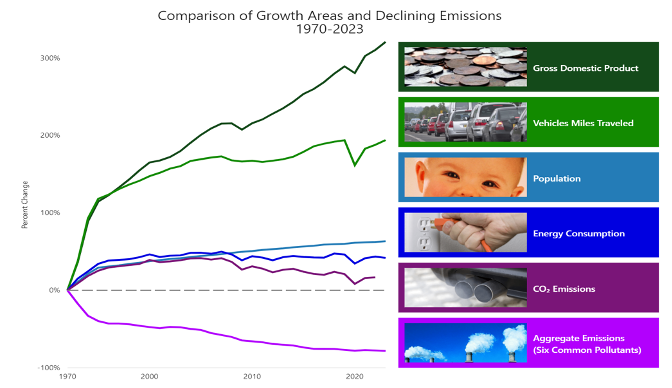
De-construction of environmental protections. Today we see the unravelling of the complex tapestry of regulatory controls on pollution, from Executive Orders granting absolution to 41 industries from emission constraints to laws rescinding critical portions of the Clean Air Act.[ii] The EPA under the Trump Administration has rescinded 31 regulations that protect water, air and land from industrial pollution and chemical contamination, challenging Safe Drinking Water and Clean Water Act requirements, and curtailing enforcement actions. Rulemaking to control forever chemicals (PFAS) has been delayed or abandoned. The Supreme Court has removed the science-based expert authority of regulatory agencies requiring a strict and narrow interpretation of authorizations stated in the enabling legislation. The EPA revoked the Endangerment Finding of 2009 which put greenhouse gas emissions control under the Clean Air Act, effectively eliminating climate action controls. The EPA has also declared that costs of health harms and deaths from pollution will no longer be calculated in the analysis of regulatory action on air emissions. Challenges to these actions have had some success in federal courts, including the declaration that rescinding congressionally approved grants for renewable energy are illegal.
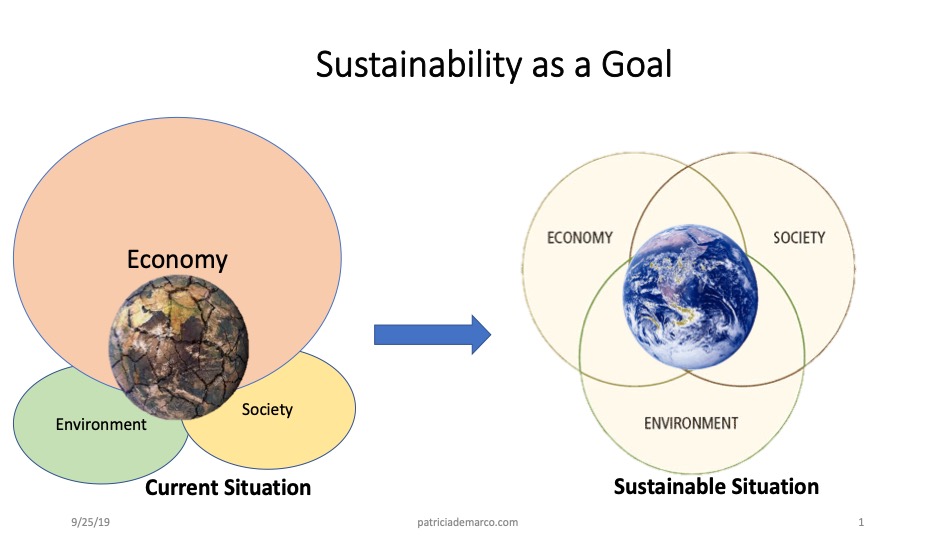
Rebuild Environmental Protection with Regenerative Thinking. The long-term implications of these policy changes alarm environmental organizations and people concerned with the health of communities who are looking toward a change of administration to correct the harms. But, at this point, simply reversing the actions taken so far will not address the underlying issues. Of all the environmental regulations adopted to date, only the Pollution Prevention Act of 1990 addresses the concept of designing to prevent pollution and encouraging recycling. We can take lessons from the regulatory approach of the last 56 years and improve the outcome going forward. This is the opportunity to move our system of laws and regulations through a transformation from an extractive fossil-based economy to a regenerative renewable resourced economy. There are at least five elements to this process.
1. REACH: The first lesson would be to adopt the precautionary principle as the basis for evaluating the introduction of new man-made materials into large scale production.
2. Green Chemistry: Second, adopt a regulatory framework that emphasizes reduction or elimination of the inherent hazard, rather than computing the “safe” amount of toxicity for individual contaminants.
3. Empower Renewable Resources. Third, adopt the regulatory infrastructure to empower distributed renewable energy systems.
4. Heal damaged lands. Beyond preventing future pollution and damage, lies the responsibility to repair the scars and harms of legacy industries.
5. Remove fossil industry subsidies. The federal subsidies currently lavished on the fossil extractive industries can be shifted directly to fund the sustainable energy system.
A shared prosperity. It is time for bold action. It is time to recognize that the laws of nature are not negotiable, nor can they be rescinded by executive order or wishful thinking. The condition of our life support system requires both reduction in the levels and types of pollution as well as strong support for the known and available technical solutions. Burning fossil resources as the base for the economy drives the global warming that will make the planet uninhabitable to life as we know it.[i] By creating a new regulatory framework based on regenerative thinking and protection for our life support system, we can establish the conditions for a shared prosperity and sustainable growth within the constraints of our living earth.Those who contemplate the beauty of the earth shall find reserves of strength that will endure as long as life lasts. Rachel Carson.
See the full analysis, with citations, of our way forward here: Rebuilding Environmental Protection PDF

 Patricia DeMarco Ph.D.