the book ReImagine Appalachia: Healing the Land and Empowering the people is now available in paperback and as an electronic edition from Springer Nature at a much reduced price from the originally published hardcover. You can order it here. https://link.springer.com/book/10.1007/978-3-031-61921-2
The concluding chapter is important today as we look toward the Midterm elections. Policy re-adjustments to enhance and grow the middle class upwards have worked. Policies proposed from the ReImagine Appalachia Blueprint and adopted into the Inflation Reduction Act, the Infrastructure and Jobs Act and the CHIPS Act began to turn the curve towards investing in communities and working people, as opposed to further enrichment of the top 1% of the wealthy, as is happening now.
This reflection from Rachel Carson seems amazingly relevant for today’s situation:
Mankind has gone very far into an artificial world of his own creation. He has sought to insulate himself, with steel and concrete, from the realities of earth and water. Perhaps he is intoxicated with his own power, as he goes farther and farther into experiments for the destruction of himself and his world. For this unhappy trend there is no single remedy—no panacea. But I believe that the more clearly we can focus our attention on the wonders and realities of the universe about us, the less taste we shall have for destruction. (Carson RL (1998) The real world around us. In: Lear LJ (ed) Lost woods—the discovered writing of Rachel Carson. Beacon Press, Boston, p 163)
By Patricia M. DeMarco, Mayor of the Borough of Forest Hills, PA
As extreme weather fluctuations and higher heat bring health concerns to the headlines, cities look for ways to adapt for a more resilient approach. Once defined only by skyscrapers and concrete canyons, many modern cities seek to bring nature into the cityscape to improve the health and quality of life of the people who live, work and play in urban environments. Natural landscapes bring many benefits to urban living, including health benefits, economic value of property, and cultural distinction.
Ecosystem services support all life on earth.[1] As people have settled into larger urban environments, we have become more removed from the essential services of the living earth that comprise our life support system. Fresh water, oxygen-rich air, fertile ground and the millions of species that make up the interconnected web of life come from the ecosystem services of the earth. Evolved over millions of years, the four categories of ecosystem services support life on earth as we know it.
These gifts of the living earth operate automatically. The supporting services include nutrient cycling for carbon, nitrogen, water, oxygen and phosphorous; soil formation from the action of millions of micro-organisms breaking down detritus; primary production includes energy conversion by photosynthesis to create biomass and release oxygen; and habitat provision which establishes living conditions specific to various regions of the planet. These services feed into all the other ecosystem services. The provisioning services generate primary food production, fresh water, wood and fiber and biomass- based fuels. The regulating services are the control systems of the earth that shape climate by storing carbon and the temperature through the thermohaline circulation of the oceans; flood and erosion control through wetlands and tree roots; water purification through wetlands; and disease control through predator/prey relationships in natural ecosystems. Finally, the cultural services provide spiritual and aesthetic values to human experience, often called biophilia- the natural feelings of being connected to nature that makes people want to be in the “outdoors” for vacations at the beach or in parks.
These services do not usually “count” in computations of the Gross Domestic Product or the economic valuation of transactions. However, they are priceless contributors to many aspects of daily life that people take for granted, such as having fresh water or pollination for agricultural products, or natural fibers like cotton, linen, bamboo and hemp. Note that all of these ecosystem services are circular in regenerating and replenishing the elements of each system, all driven primarily from the sun as the primary source of energy, temperature gradients and seasonal cycles.
Our Life Support System is Under Stress. Human activities, especially since the Industrial Revolution, have brought stress to the balanced ecosystems that have sustained life as we know it.Resource extractionfrom miningfor fuels and minerals, industrial scale farming, and land use for highways, buildings and parking lots has stressed the environment. Also, the rapid acceleration of burning fossil resources for fuel is reversing in decades the millions of years of biological process that increased the amount of oxygen in the atmosphere and sequestered carbon in coal, petroleum, and natural gas. The modern surge in use of synthetic materials, especially plastics which are derived from petrochemicals, has also stressed the natural ecosystems in many ways, especially as the population of the earth has continued to grow, and more countries adopt a heavy consumer-oriented economy. Hyper-consumption spreading worldwide adds to the stress on our natural life support system.
Pennsylvania’s Constitution Article 2 Section 27 states: “The people have a right to clean air, pure water, and to the preservation of the natural, scenic, historic and esthetic values of the environment. Pennsylvania’s public natural resources are the common property of all the people, including generations yet to come. As trustee of these resources, the Commonwealth shall conserve and maintain them for the benefit of all the people.”
However, Pennsylvania bears the scars of hundreds of years of reliance on extractive industries.
Abandoned mined lands estimated at 288,000 acres[2]
It is our ethical and moral obligation to preserve and restore the ecosystems of the living Earth for now and for the future. It is our duty to preserve the right for life to exist for the people we serve in our communities, and for future generations whole lives will be shaped by the decisions we make today. We cannot legislate the laws of chemistry and physics nor the biologic system responses to changes in the environment. But we can adjust our laws, and our way of life, to be more in harmony with the natural systems we depend on. The time for wanton exploitation of the natural world is over!
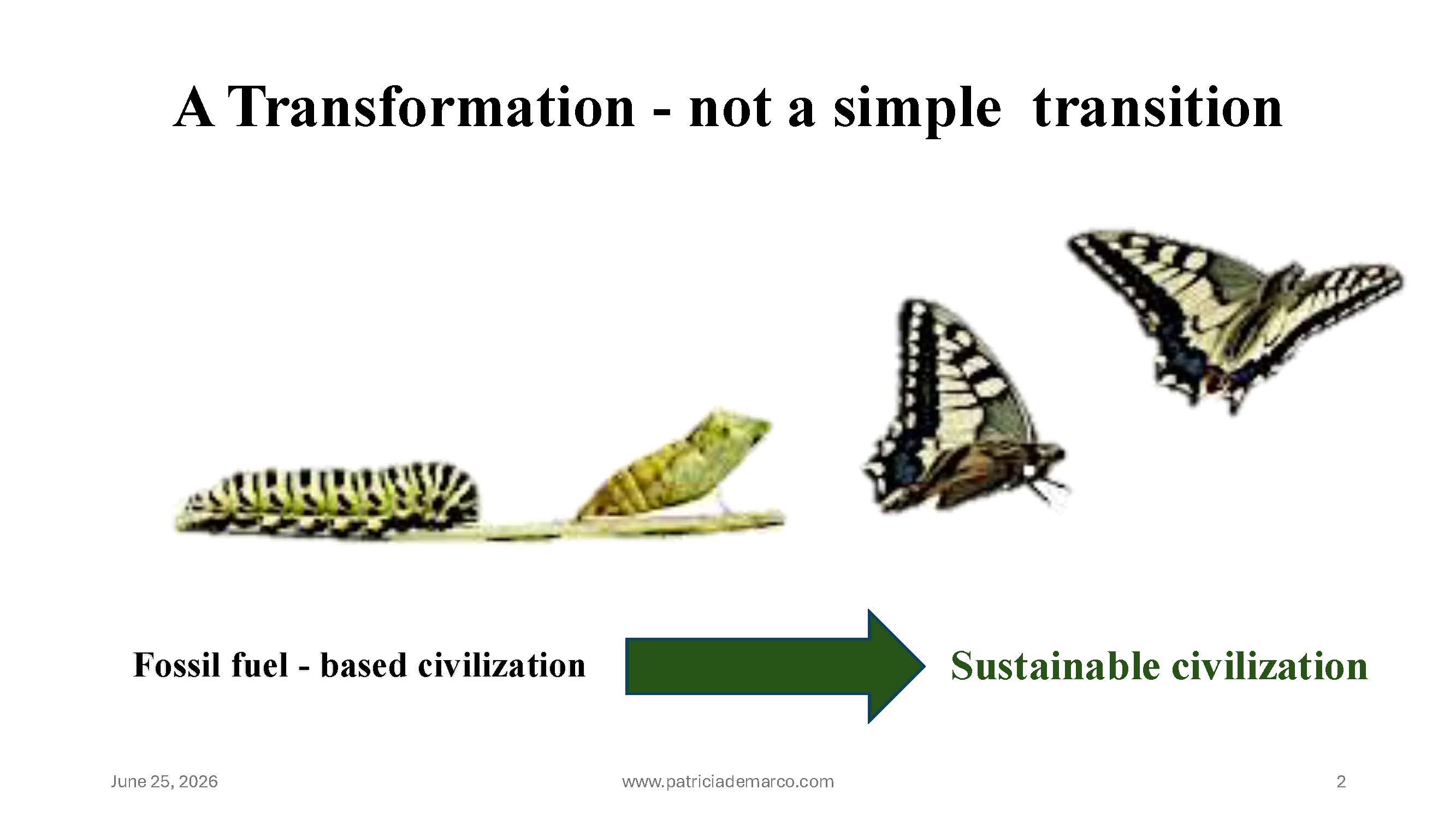
Pathways Forward We who govern at the local level are in a good position to shape a pathway to a better future. We are no longer facing a gradual transition but rather a transformation in our relationship to the natural world that supports us.
This transformation from an extractive civilization based on fossil-fuels to a regenerative civilization based on renewable resources is not a technical problem but rather a moral and ethical problem. Do we have the courage to shift the base of our economy to systems that can be sustained for the next generations, or will we persist in the destruction of our life support system for now, and for generations to come?
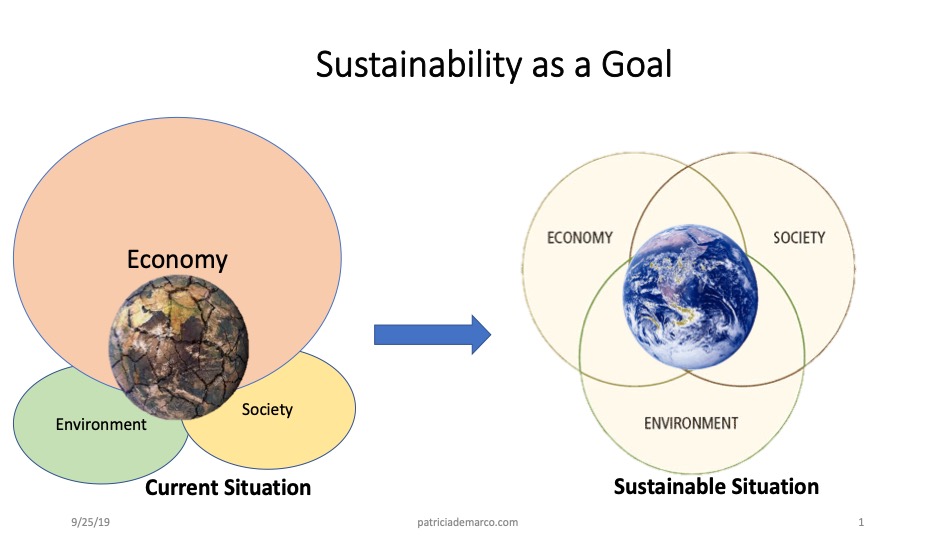
Our current situation has been built on a primary premise of economic drivers as the principal, sometimes the exclusive, basis for policy decisions. As a result, cultural values such as history, social services, public education, public health, public amenities such as parks and nature preserves as well as environmental values such as clean air, fresh water, fertile ground and preserving the biodiversity of species have diminished consideration in public policy decisions. This situation cannot be sustained for decades into the future without seriously compromising the quality of life for everyone on earth. The biggest shift from an extractive to a sustainable system involves a change in priorities to re-balance, economic, environmental and cultural values to be more equal in weight for decision making on policy.
Regenerative thinking provides a framework to support this adjustment. Regenerative thinking looks beyond the instant gratification of the next quarterly report, but rather considers the life cycle implications, and the associated impact on environmental and cultural values over time. [5] This is especially relevant in local government decisions, for example when determining what kind of a public building to invest taxpayer dollars in, or what land use decisions to make for preservation vs development. Fortunately, regenerative solutions are available, proven and cost-effective.Cities can be catalysts for living in harmony with Nature. The inherent human affinity for nature is called “Biophilia” and has been recognized as a movement throughout the world as a way to improve the quality of life for urban areas.[6][7] Incorporating nature into urban environments brings many benefits.
Renewable Energy Systems conserve and restore resources. Technology costs in renewable energy systems are dropping sharply.[8] Demand is increasing for efficiency and clean energy solutions. More supportive national policies (Inflation Reduction Act & Infrastructure Investment and Jobs Act) showed the potential for effective adoption of renewable energy resources at scale.[9] Investment in renewable infrastructure is increasing in states, public institutions, and in private investments, in spite of federal policy changes. The Borough of Forest Hills designed and built a net-zero energy borough building, and now also has solar on five additional buildings to save energy costs and have more efficient operations. The capital costs the solar were administered through a Guaranteed Energy Savings Program of the PA Department of Conservation and natural Resources.
Prevent Pollution by designing materials through Green Chemistry principles that are benign by design.[10] This process reduces the inherent hazard from things like plastics and forever chemicals rather than limiting our exposure to toxic substances through regulation. Substituting biological materials like hemp, bamboo, algae and fungi for petrochemicals can shift the production to less environmentally and health damaging materials.
Circular Materials Management shifts our economy away from using raw materials to make products designed to be replaced rapidly.[11] Instead, materials and products can be designed to be made in America and made to last as durable goods. Also design features can include reclaiming raw material for re-use or repurposing, rather than to become trash. Ideally, circular materials management using renewable resources as feedstocks can create an economy of higher value with much less waste.
Reduce urban stress. Urban living often brings social stress, a sense of physical threats from crime, traffic safety and adverse environmental exposures associated especially with noise and air pollution, and heat island stress. Adding urban tree cover contributes to more vigorous physical activity among adults aged 18 to 24 as well as reduced obesity, better general health, less asthma and better social cohesion in communities.[12] Forest Hills has been a USA Tree City since 1975. Our 2,800 urban Trees contribute an estimated $19.7 Million in cumulative asset value.[13]
Calm traffic. Using natural landscapes and plantings as part of a Complete Streets policy helps to calm urban traffic and improve the quality of experience for pedestrians. This was especially effective when native plants and shrubs were used as well as incorporating water features such as fountains and ponds as part of bioswales for stormwater management.[14]
Provide economic value. Studies completed by the US Department of Agriculture show that urban tree canopies deliver over $18.3 billion in annual environmental and economic value.[15] This value is derived from shade that reduces cooling demand, health improvements from absorbing pollutants in the air, and sequestering carbon in trees.
Mature trees act as critical infrastructure thatboost property values, mitigate the urban heat island effect, and improve public health.[16]
Green Infrastructure can contribute to stormwater management by diverting storm surges into bioswales and rain gardens. Especially if these are planted with native species, they can also support birds and pollinators within the urban environment. The Forest Hills Borough Building has bioswales that capture all stormwater from the property.
Zoning and policy support canencourage land uses that include landscaping with native species, wilding lawns, encouraging urban agriculture for local food production and to connect people to nature, and using neighborhood park and open spaces as part of blight remediation.
Biophilic Design in Public Buildings and Urban Spaces incorporates natural elements like greenery, water, and natural light, enhancing both the physical and mental well-being of the people who occupy these spaces. Sustainable energy features and natural landscaping are especially easy to incorporate into the design of new buildings or major renovations of public buildings or public spaces. In Forest Hills Borough, the Late Bloomers Garden Club and the Forest Hills Garden Club plant and maintain native plantings and pollinator gardens in the Ardmore Boulevard and in Forest Hills Park. Borough plantings include native species and integrated pest management practices to protect pollinators and wildlife.
We are part of the interconnected web of Life. Every opportunity we can take as local leaders to make our communities more resilient, more beautiful with living landscapes more supportive to wildlife, birds and pollinators, the more our communities will support living in harmony with nature. When we preserve the living earth, we preserve and strengthen our own life support system.
(This article will appear in the August issue of “The Municipal Reporter” published by the PA Municipal League.)
[9] Environmental and Energy Study Institute. “Implementing the Inflation Reduction Act and the Infrastructure Investment and Jobs Act- A Progress Report.” March 9, 2023. https://www.eesi.org/irabriefings Accessed July 22, 2026.
[12] Jared Ulmer, Kathleen Wolf, Desiree Backman, Raymond Truthway, Cynthia Blain, Jarlath O’Neil-Dunne, Lawrence Frank. Multiple health benefits f urban tree canopy: The Mounting Evidence for a green prescription. Health and Place. Vol 42. (2016) Pages 54-62. https://research.fs.usda.gov/download/treesearch/54105.pdf Accessed July 29, 2026.
[13]Jason Rihn, Nicholas Burnett. Forest Hills Tree Inventory and Management Plan. Bartlett Tree Experts. June. 2026.
[15] Heather Sander, Stephen Polasky and Robert Haight. “The value of urban tree cover: A hedonic property price model in Ramsey and Dakota Counties, Minnesota, USA.” Ecological Economics. Vol 69 (2010) Pages 1646-1656. https://research.fs.usda.gov/download/treesearch/36073.pdfAccessed July 29, 2026.
July 4, 2026 marks the 250th anniversary of the Declaration of Independence of the American colonies from the government of England. People across the country gather in their small towns and big cities to celebrate the government of the people, by the people and for the people established in defiance of the monarchies of Europe. America presented the audacious proposition of liberty and justice for all, and that the people consent to be governed by the rule of law applied equally. Lofty goals retained as an ideal, through wars and through economic, political, and cultural challenges. The vision of America as the land of the free and home of the brave shimmers as a mirage, sometimes clear, sometimes dimmed to abstraction. Under all the rhetoric lies the land itself whose resources and geography have protected and provided for human civilization for thousands of years before the first explorers ever set foot on this continent.
Today we mark a quarter of a millennium, a blink in the arc of time. It is a good time to recognize the fragility of this enterprise in democracy. Recognize that we depend on the land itself for our sustenance, our wealth and for our future survival. From colonial times forward, American enterprise has built on extracting the wealth of resources from the land, with little consideration for renewing or sustaining those resources over time. Vast forests of the east coast were felled as ship masts for the British Navy. What the colonists saw as untouched land as far as the eye could see and beyond was in fact a carefully curated landscape of permaculture stewarded by Indigenous Peoples who had thrived in populations of millions for thousands of years before. For example, the symbiosis of chestnut trees and passenger pigeons that sustained both the landscape and communities for hundreds of years was rendered extinct in a decade as settlers cast nets over the trees full of nesting birds, and harvested them by the thousands, leaving too few to survive future breeding cycles.
We look back to the industrialization of this country driven by the abundance of land, then coal, oil and natural gas to become a power house among nations. Steel, petrochemicals; technology for tall buildings, communication and transportation; vast agricultural expanses that feed the world, advances in medicine and science supported by public education and government investment in research and innovation. America became a beacon for the world.
Yet, we almost all came here as immigrants, whether in colonial times or in the various waves of people who fled strife and distress from other countries. The workers met in the mills and fields, factories and market places to pursue the great American Dream of a better life for their children. This vision of working hard, often with great sacrifice, to make a better way for the next generation is as truly part of what makes America as any amount of patriotic music and polemic. That ideal that anyone can come to this land of opportunity and make a good life for our children drives people to come here even in modern times.
This constant infusion of cultures, languages, foods and customs helped to shape the America where innovation thrives, and dreams come true. Often called a “Melting Pot” the immigrants, embraced the values of shared allegiance to the ideals of freedom- liberty and justice for all. But under the gloss of the ideal simmer the divisions that rose up, often with violence as in the Civil War, and in the charade of freedom for those enslaved and eventually liberated with great struggle. Under the scrim of a just and equitable society the latent racism lurks, empowered now more visibly by the rhetoric emanating from the 2026 White House. This is the caution we must face as we look ahead to the next phase of our America. Freedom is not free, and democracy has no guarantee. It depends on vigilance and engagement. Citizens must stand up to the rhetoric and actions of hate and suppression as they creep relentlessly into the trappings of government. Freedoms hard won are swept away with a casual order, upheld by a hand-picked court. We who see the promise and wonder of America as an ideal for liberty and justice for ALL must call the government to account. We must uphold the values of the inherent dignity of every person. We must stand for the role of government in providing for the health and well-being of all citizens. Laws that enrich the few at the expense of the many suppress the very heart of what makes America.
It is not OK in America for children to go hungry. It is not OK in America for people to go bankrupt over health care costs, or to suffer for unavailable services. It is not OK in America for people to find housing and basic necessities beyond reach on a minimum wage. Sacrifice zones are not OK. Allowing public land to be squandered for private profit is a betrayal of our birthright. Undermining science and limiting education guarantees a poorer and more deprived future. Enriching and protecting the few wealthiest individuals and corporations at the expense of the many is not OK in America. It is time for a reckoning and a reset.
Under all is the land. Land that bears the scars of our extractive industrial period. As we look toward a future that can be sustained for another 100 years, even to think of another 1,000 years, we would be wise to look at the ways of the Indigenous Peoples whose concepts of living in harmony with nature stand as a model for surviving and thriving in this place. As Thomas Jefferson took the concept of a government of individual states under a unified governance as a model of our Constitution, we can look to the nurture of the land as a way forward. Plan for seven generations forward considering the needs of those yet unborn whose fate we determine by the decisions we make today.
Healing the land and empowering the people will rebuild a community resilient in diversity, strong in character and enlightened in understanding our place in the world. Governing toward a shared prosperity that builds the resilience and abundance of the natural world is part of our American Dream. Shift from the extractive and unsustainable patterns of the last 100 years and embrace the commitment to regenerative practices that build a shared prosperity. Reinvesting in communities depleted by the extractive industries of the Industrial Revolution can reclaim the wealth of the land, re-employ the skilled workers and restore the shared prosperity of a region rich in culture and pride.
No technological breakthroughs are necessary for this new economy to operate building a prosperity that can last without the boom/bust cycles of depleting extractive industries. We can muster the political will to make the necessary changes in policy and practice to support a new economy for the 21st century. The true wealth of America lies in the land that supports us. Not the fossil resources buried deep within the crust of the Earth, but the living earth, the fertile ground that gives life to our planet through binding essential elements to create food, fiber, fuel, and oxygen. When we restore the land and empower the people, we set the foundation for a long-lasting prosperity for all of our citizens.
Fly the American flag for Fourth of July. Remember that freedom is not free, but earned through the sacrifice of many people over the years. The right to freedom also holds responsibility to be an engaged citizen. Follow the actions of those who represent you at the federal, state and local levels of government. Know where your representatives stand on issues you care about, and hold them accountable for their actions in office. Exercise your right and obligation to vote in every election. Your vote is your voice. The ideal of America stands before us as a goal. It is up to all of us to reach it in practice.
We commemorate Memorial Day on the last Monday in May, honoring all of those fallen in wars from the Civil War until now. It is a solemn occasion to mark the service of those who have given their lives in the name of our country. The causes and outcomes have varied over the years, with some more strikingly clear than others. But as a constant lies the dedication and support of the families of soldiers; the solidarity of those who share the experience of combat in arms; and the grief of loved ones for the loss of youth and promise.
The “war of choice” in Iran engaging us now has disrupted commerce and challenged the concept of trust in our leaders to weigh the value of lives carefully.[i] We mere citizens have little influence over the powers that wage wars, but we do experience the personal losses of family and friends; and communities see the impact as resources shift from domestic to military support. As military disruptions affect the international flow of petrochemicals, we see clearly how dependent we have become on this resource in all aspects of our lives. Especially in the food system.
The Straits of Hormuz closing has restricted movement for critical materials disrupting the flow of about 20% of global oil supply.[ii] Fertilizers, pesticides, herbicides and packaging in the food industry all come from petrochemical industry. So does the fuel that runs the machinery and processing equipment for cultivating and harvesting, and fuel for transporting food from the growing areas to stores and homes. As with many other systems, the use of petrochemicals (oil and natural gas) has been a driver in their growth and development to major international industries.[iii]Now the war in Iran has put a spotlight on what it means to move away from the fossil fuel base for our basic needs for energy, food and transportation. This wartime experience has sharpened the points of need for alternatives based on non-fossil fueled, sustainable systems. It took decades for the industrial revolution to create the conditions of dependence on extractive resources we experience today, but it need not take decades to shift to a more sustainable system. The building blocks are in place already.
The Victory Garden and Domestic food initiatives of the WWII era have many parallels with the sustainable food initiatives of today.[iv] Even though the motivation for the gardens differs somewhat, using local foods, and how we prepare and acquire food for economy, health and public purpose have strong parallels. Rachel Carson compiled recipes for using domestic fishes in all regions of the United States as part of this effort.[v] Efforts to compensate for such things as sugar and butter rationing suggest approaches that can help with healthier eating habits today. Likewise, processes for preserving food for Winter have seen major advances in technology, with dehydration for example.[vi] But the concept of putting food by for year – round use stands as a long tradition to the oldest recorded history of human civilization.
This year, we face food supply constraints not only from war blockades of supply chains but also from the side effects of climate events. In Georgia wildfires have delayed planting times.[vii] In the Midwest, drought lingers, and in the agricultural areas served by the Colorado River, water restrictions loom.[viii][ix] Conflicting demands between industrial uses and domestic and agricultural needs are growing. The erratic swings in climate conditions makes reliable agricultural production even more of a challenge than it has been traditionally.
Acquiring local foods, preserving seasonal foods and practicing economy and health in what we eat are standards of food culture available to everyone. The women of WWII tended Victory Gardens as part of a war effort, displacing commercial food so production could feed the Armed Forces and Allies. An estimated 8 to 10 billion pounds of food were grown in victory gardens and from other domestic food sources, releasing commercial production for military use.[x]
Modern Home -Grown initiatives look toward reducing the carbon footprint of the food chain by using locally sourced food and using regenerative agriculture practices for healthier eating.[xi] The Rodale Institute has documented that global adoption of regenerative practices across both grasslands and arable acreage could sequester more than 100% of current anthropogenic emissions of CO2 and that stable soil carbon can be built quickly enough to result in a rapid drawdown of atmospheric carbon dioxide.[xii] Restoring fertile ground through regenerative agriculture is an effective tool for capturing carbon dioxide from the air and binding it in soils. That means growing food with natural fertilizers like compost that stores carbon and increases soil fertility. It means having food produced without pesticides and herbicides that can leave residues in food. It means less petrochemicals used for transportation fuel, packaging, and refrigeration. Even displacing a little food purchased can save much in energy use and food waste.
The Climate Victory Garden is a new initiative that contributes to the resilience and sustainability of our food supplies in uncertain times. You can see all the Climate Victory Gardens and register yours here https://greenamerica.org/climate-victory-gardens
You can also support your community farmers by buying fresh produce at local Farmers Markets or participating in Community Supported Agriculture in your area. Summertime is planting time. Harvesting foods as they are ready and appreciating seasonal fruits and vegetables fresh from local gardens and farms is a pleasure forgotten in the inundation of year-round hybrid strawberries, raspberries and apples. Gone are the regional specialties anticipated for a year and enjoyed as a rare delight- like fresh-picked peaches in August. Discover the joy of growing some of your own food and herbs. Share the experience with your children. Live closer to the force of Nature that supports our life on Earth.
[v] Rachel Carson. Food From the Sea: Fish and Shellfish of New England. Conservation Bulletin 33. United States Department of Interior, Fish and Wildlife Service. Washington DC. 1943. National Archive accessed in person May 12, 2025.
by Patricia M. DeMarco, Ph.D. Mayor, Borough of Forest Hills, PA
Black plastic is commonly used in kitchen utensils, takeout containers, food trays, and children’s toys. But they hide a dark secret- most are made from material recovered from electronic waste plastic. Many of these products are made from recycled electronic waste, which can contain harmful chemicals like brominated flame retardants and heavy metals.[i] Flame retardants (often called “Forever Chemicals”) are found in 85% of black plastic consumer products.[ii] Why is this a problem? Electronic products uniquely contain potential fire ignition sources within the components – circuit boards, batteries, transformers, connectors and other essential parts. To prevent and control the severity of fires, manufacturers coat electronics like computers, smart phones, televisions, gaming systems and tablets with a variety of flame-retardant compounds.[iii] According to the Green Sciences Institute, flammability standards for electronics were developed in the 1970s in an attempt to limit the risk of a small open flame igniting plastic materials. High levels of flame-retardant chemicals–as much as 25% of the weight of the plastic–are used to meet these standards.[iv] When these products are recycled to recover the plastic, contaminants can transfer to food through consumer products.[v]
However, the chemicals so widely used to prevent the small fire risk are well-documented and potent endocrine disruptors. As a class of chemicals, organohalogens are highly persistent, bioaccumulative, and cause health harms, especially endocrine disruption, in wildlife and humans.[vi] These compounds can migrate from the plastic cases into dust particles which can be inhaled or ingested. And, when recycled into materials in contact with food, especially hot items, they can be absorbed into the food itself.[vii] Repeated petitions to the Consumer Products Safety Commission resulted in a Guidance Notice in 2017 to be in place pending the development of final regulations: “Commission recommends that manufacturers of children’s products, upholstered furniture sold for use in residences, mattresses (and mattress pads), and plastic casings surrounding electronics refrain from intentionally adding non-polymeric, organohalogen flame retardants (‘‘OFRs’’) to their products. Further, theCommission recommends that, before purchasing such products for resale, importers, distributors, and retailers obtain assurances from manufacturers that such products do not contain OFRs. Finally, the Commission recommends that consumers, especially those who are pregnant or with young children, inquire and obtain assurances from retailers that such products do not contain OFRs.”[viii]
The Consumer Products Safety Commission has ceased rulemaking to implement this guidance, and has declared that the Commission does not have any rule prohibiting the use of flame retardants in children’s products, upholstered furniture, mattresses and mattress pads, and in plastic casings surrounding electronics.[ix]
Consumers are now without the protection of a regulatory limitation on products readily available and in common use. Why should we be concerned?
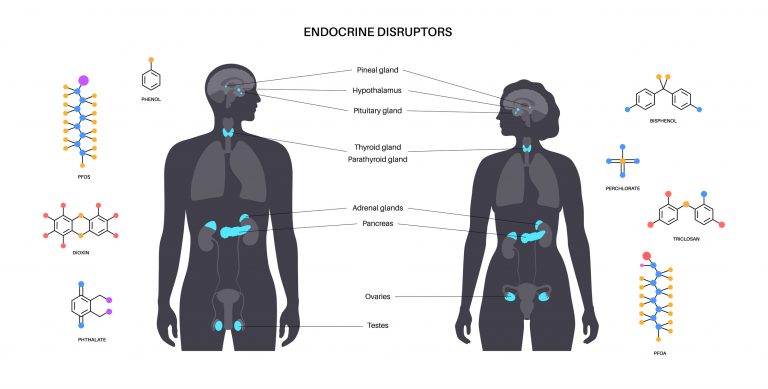
Human hormones produced by the endocrine system control essential functions. Hormone Disrupting Compounds act at very low doses of exposure. Endocrine glands and the hormones they produce enable the body to adapt to environmental change; they allow metabolic adjustments to occur in response to different nutritional demands (e.g. hunger, starvation, obesity, etc.); they are critical to reproductive function; and they are essential to normal development of the body and brain through their effects on growth and maturation of organs.[x]
EDCs disrupt normal hormone functions. EDCs can block normal hormones by binding to specific receptors.[xi] They can mimic normal hormones, like estrogen, for example, interfering with normal hormone functions. Some can cause stimulation of a normal hormone function resulting in an unintended response. Because normal hormones are receptor-specific and act at very low concentrations in the body, small amounts of EDCs can have a larger unintended effect.[xii]
Chronic exposure has been shown to cause diseases. EDCs in plastics include: bisphenols, phthalates, alkylphenol ethoxylates, nonylphenols, brominated flame retardants, perfluorinated substances, benzotriazole UV stabilizers, and toxic metals. Infertility, reduced sperm count, pregnancy loss, and low birth weight of infants have been caused by EDCs. Some EDCs have been shown to cause cancers or chronic illnesses like diabetes and obesity. Some of these EDCs are persistent and bioaccumulative (i.e., build up over time in body tissues). When humans are tested for the presence of EDCs in their blood, fat, urine, and other tissues, the results consistently demonstrate a variety of EDCs in all individuals worldwide.[xiii]
In conclusion: Please examine your daily exposure to plastics. They can enter the body from absorption to food from plastic packaging or wraps, from ingestion of small particles from coated cooking pans or plastic cutting boards, or from using personal care or cleaning products. The Environmental Working Group provides a good source for guidance and brand based lists of exposure as well as Safe Products and sources.[xiv]
Choose durable materials for food preparation, serving and storage. Many things like spatulas and cooking goods made from aluminum, stainless steel, and wood are inexpensive and readily available. Secondhand goods stores are often a very inexpensive source for amazing products from the days of handmade homemade foods and materials. Cast iron pans well-seasoned from regular use last for generations.
P. DeMarco photo
While recycling is an essential feature for a circular materials economy, it is more important than ever to design products to ensure that toxic substances do not proliferate through the process. Recycling, without the necessary transparency and restrictions to ensure safety, is resulting in unexpected exposure to toxic flame retardants in household items.[xv] The chemical industry persistently repels attempts to regulate these and other forever chemicals, and has successfully prevented requirements to produce products that are non-toxic by design.[xvi]
We are inundated with a stew of synthetic chemicals. Our bodies do not experience one chemical at a time but rather a complex mixture of contaminants now spread worldwide through air and water and soil, even to uninhabited areas like Antarctica. The effects of this complex mixture have never been studied systematically. However, the epidemiology evidence documents the fact that we have been conducting an uncontrolled experiment upon ourselves and all other living things on Earth. Rachel Carson’s early urging of precaution in the proliferation of synthetic materials into the biosphere was ignored, even despised and disparaged by the chemical industry and especially the petrochemical industry. We learn to our sorrow that she was right to urge precaution. Once released, this proliferation of “Forever Chemicals” cannot be retrieved. We have poisoned our world forever.
[ii] Liu M, Brandsma SH, Schreder E. From e-waste to living space: Flame retardants contaminating household items add to concern about plastic recycling. Chemosphere. 2024 Oct;365:143319. doi: 10.1016/j.chemosphere.2024.143319. https://pubmed.ncbi.nlm.nih.gov/39271080/
[iv] Hall, J.R. Fires Involving Appliance Housings— Is There a Clear and Present Danger?. Fire Technology38, 179–198 (2002). https://doi.org/10.1023/A:1014463317848 Accessed May 29, 2026.
[v] Liu M, Brandsma SH, Schreder E. From e-waste to living space: Flame retardants contaminating household items add to concern about plastic recycling. Chemosphere. 2024 Oct;365:143319. doi: 10.1016/j.chemosphere.2024.143319. https://pubmed.ncbi.nlm.nih.gov/39271080/
[xv] Liu M, Brandsma SH, Schreder E. From e-waste to living space: Flame retardants contaminating household items add to concern about plastic recycling. Chemosphere. 2024 Oct;365:143319. doi: 10.1016/j.chemosphere.2024.143319. https://pubmed.ncbi.nlm.nih.gov/39271080/ Accessed May 28, 2026.
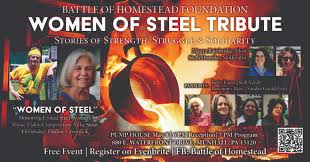
This Mother’s Day holds deep memories, and current powerful examples of the force of women on our society. I had the pleasure to attend the Battle of Homestead Foundation tribute to the Women of Steel celebrated in music, film and remembrance at the historic Pump House, the last original structure remaining from the Homestead Steel Works. Steffi Domike and Connie Portis organized the screening of Pauline Greenlick’s film set to Mike Stout’s song “Women of Steel.” https://www.youtube.com/watch?v=gORURSBGge4 Betty Esper’s stories from the early days of running as a messenger from one end of the 5-mile mill complex to the other shared a time when every advance was hard-won. Sandra Gould Ford’s tales of her time in the chem lab of J&L, with her photographs becoming the base for her amazing work as a photographic artist ,gave powerful evidence of survival in the face of monstrous adversity. And Rose Bezey ‘s and Kelly Vereb’s tales of hardships persisting to this day raised the value and importance of the Union in combatting injustice and discrimination. We need the power of unions again today, more than ever.
I was thinking about my Mother, Marcella DeMarco, all evening as I sat absorbing the solidarity and the power of so many strong union women, so many friends in the movement. My Mother organized teachers for better wages, promotion opportunities equivalent to men; for equal sports opportunities for girls, before Title IX, and for better classroom materials. She went on, after earning her Doctorate in Public Administration, to organize the Pittsburgh Administrators Association for the same needs – women’s rights, students’ rights and fair wages and opportunities to advance. Her passion for her students pervaded our lives. I remember carrying her emergency supply bag (lemons, smelling salts, water, blister salve and bandages etc.) as she coached the South Hills High School Drill Team for Memorial Day parade. I watched in awe as she coached the Women’s Gymnastics team, including my blue-ribbon sister Linda who defied gravity flying off the uneven parallel bars, or leaping to unimagined heights in floor exercises she performed to music she recorded on her flute. My Mother always had a passion for excellence and seeing that her students were able to pursue their highest ambitions.
So many of the Women of Steel, and the workers who made the steel industry the heart of our economy for nearly 100 years, came to Pittsburgh as immigrants fleeing strife and poverty. They infused America with passion for a better life, a hard-working ethic and a tight sense of community. These values still stand, even in communities disinvested for the last 50 years, especially among the immigrants here among us today. But how different their reception now compared to those many years ago! My parents and grandparents preserved the cultural richness from Italy, Poland and Croatia even as they settled into the culture of American life. Today we treat immigrants as “aliens” ignoring the richness added to our life experience in the diversity of foods, customs, music and joy they bring to our communities.
It is the women who preserve culture, who hold the community together when times get tough, and who stand in solidarity when the rules need to change. This strong spirit of solidarity and resilience holds even today. Rose Beazy spoke of the rising need for unions to protect workers rights for health and safety in the face of entrenched corporate greed. Our challenges increase as federal policies erode environmental protections, social services, education and health protections.
Hard-won rights for voting and fair representation loom as battles needed again. Freedom of religion, free speech and of the press erode daily through back-door executive powers backed by a corrupt Supreme Court. It is time for all of us to take the lessons of the Women of Steel. It is time to defend our Constitution:
“We the People of the United States, in Order to form a more perfect Union, establish Justice, insure domestic Tranquility, provide for the common defense, promote the general Welfare, and secure the Blessings of Liberty to ourselves and our Posterity, do ordain and establish this Constitution for the United States of America.” https://www.senate.gov/about/origins-foundations/senate-and-constitution/constitution.htm
We must organize, mobilize and protest this administration’s usurpation of our country by greed, avarice and corrupt self-dealing at the highest levels of government. We who stand in solidarity with the people who actually do the work that builds wealth need to level the profit field so the workers benefit more fairly from their labor. The functions of government must return to serving the people, not just private corporate interests, especially of multi-national corporations.
I return to the amazing words and work of Eleanore Roosevelt in her time as Chair of the Commission on Human Rights in forming the United Nations. Her words spoken in the wake of the horrors of World War II ring as a caution to us today:
“We must not be confused about what freedom is. Basic human rights are simple and easily understood: freedom of speech and a free press; freedom of religion and worship; freedom of assembly and the right of petition; the right of men to be secure in their homes and free from unreasonable search and seizure and from arbitrary arrest and punishment.We must not be deluded by the efforts of the forces of reaction to prostitute the great words of our free tradition and thereby to confuse the struggle. Democracy, freedom, human rights have come to have a definite meaning to the people of the world which we must not allow any nation to so change that they are made synonymous with suppression and dictatorship.“https://erpapers.columbian.gwu.edu/struggle-human-rights-1948
We live in perilous times, embroiled in a “war of choice” amid the deliberate destruction of many institutions of science, education, arts, and humanity. We must renew our dedication to standing up for what we value. We must hold true to the sacrifices of so many before us who fought and died for true government “…of the People, by the People and for the People.” It is time to step into our power as engaged citizens.
Mayoral ProclamationCommemorating the 56th Earth Day
Whereas April 22 has been designated as the annual celebration of the founding of the environmental movement in 1970 and is now celebrated in the United States and in 141 countries worldwide.
Global warming, global pollution of air, water, and land and global loss of biodiversity from the continued combustion of fossil fuels, the proliferation of plastics, and the advance of environmentally stressful technologies like data centers and fracking are causing disruption of traditionally stable environmental conditions.
Climate warming and pollution cause local increased number and severity of storms with flooding and power outages in both summer and winter, drought conditions, and increases in disease-vectors such as ticks, threatening the well-being and livelihoods of many people.
Pollution, environmental degradation and the climate crisis are generational justice issues that disproportionately affect young individuals and future generations, who will face difficulties accessing clean water and clean air.
The theme for Earth Day 2026 is “Our Power, Our Planet” recognizes the collective ability of individuals, communities, and organizations to drive climate action and environmental protection.
Whereas We recognize that the collective actions of many people contribute significantly to advancing environmental progress through sustained individual actions, civic engagement and grassroots organizing.
The Borough of Forest Hills values the quality of our environment by maintaining our standing as a Tree City since 1974, by participating as a Bird Town, by hosting two active garden clubs- The Forest Hills Garden Club and the Late Bloomers Garden Club.
The Borough of Forest Hills has incorporated environmental values through its Comprehensive Plan, Climate Action Plan and Active Transportation plan, with the participation of hundreds of residents, the Environmental Advisory Council, the Tree and Shrub Committee, and Members of Borough Council.
Forest Hills supports ecosystem restoration and watershed protection in Borough Parks and properties and encourages residents to plant and cultivate native flowers, shrubs and trees to support healthy ecosystems and clean water in our community.
Forest Hills supports the reduction of plastic waste by encouraging all citizens to first Refuse plastic when biodegradable alternatives are available, to Reduce the use of plastic by choosing alternative materials, to Reuse materials that can be adapted to other purposes, and to Recycle as much material as possible.
The Borough of Forest Hills continues its implementation of the Climate Action Goals to reduce dependence on fossil fuel resources by using renewable energy sources in Borough operations and to support citizens in their efforts to use renewable energy and consume energy more efficiently.
Now Therefore Be ItResolved that the Borough of Forest Hills recognizes the gifts of the living Earth that provide our life support system of renewable energy, fresh water, clean air, fertile ground and the wide array of species that constitute the web of life and shall celebrate Earth Day 2026 throughout the month of April with special events:
on Arbor Day on Friday April 24, 2026 at 10:00 am in Forest Hills Park with students from Trinity School to recognize the value mature tree canopies and native PA shrubs bring to our environment and our quality of life; and
on Saturday April 25, 2026 from 9:00 AM to noon Forest Hills will engage the residents of the community in a day of service to clean up accumulated litter and debris from the Parks and streets of the Borough of Forest Hills.
WHEREAS in 1872, the Nebraska Board of Agriculture established a special day to be set aside for the planting of trees, and
WHEREAS this holiday, called Arbor Day, was first observed with the planting of more than a million trees in Nebraska, and
WHEREAS Arbor Day is now observed throughout the nation and the world, and
WHEREAS trees can be a solution to combating climate change by reducing the erosion of our precious topsoil by wind and water, cutting heating and cooling costs, moderating the temperature, cleaning the air, producing life-giving oxygen, and providing habitat for wildlife, and
WHEREAS trees are a renewable resource giving us paper, wood for our homes, fuel for our fires, and countless other wood products, and
WHEREAS trees in our city increase property values, enhance the economic vitality of business areas, and beautify our community, and
WHEREAS trees — wherever they are planted — are a source of joy and spiritual renewal.
NOW, THEREFORE, I,Patricia M. DeMarco, Mayor of the Borough of Forest Hills, PA, do hereby proclaim April 24, 2026 as ARBOR DAY in the Borough of Forest Hills, and I urge
all citizens to celebrate Arbor Day and to support efforts to protect our trees and woodlands, and
FURTHER, I urge all citizens to plant trees to gladden the heart and promote the well-being of this and future generations.
Here in Pittsburgh in the first weeks of April, though the air is chilly now, this week follows five days of temperatures above 65 degrees. Blossoms not usually emergent until May are in full flower- violets, redbud trees, magnolia trees…and the daffodills and hyacinths have wilted from being so warm. As I had opened the windows a bit, i woke early to listen for the dawn chorus of birdsong I have always associated with the coming of Spring. There were several distinct songbirds- a few robins, a cardinal or two, a flicker, and American song sparrow, a Carolina wren. But the joyous chorus of many many birds greeting the dawn together is no more.
The harbingers of our fate call out in silences once filled with music. The unseen wonders lost. I take the occasion of this Earth Day theme “Our Power, Our Planet” to emphasize again the fact of our existence: we depend on the gifts of the living Earth. Our survival, our life support system comes from the solar power and ecosystem services of the interconnected web of life. The interactions between the living and mineral and inanimate parts of the planet shape our existence, and as humans we have developed the power to shape, re-shape and even destroy the living systems we depend on.
I reflected on our moral obligation to preserve these gifts of the living Earth for our children and those who follow.
Thanks to Jim Lenkner for the video recording and editing.
As you consider your own obligation to our living Earth and to the children among us and of the future, seek to live lightly on this earth, being judicious in how much of the world’s resources we use daily.
Uee your voice to advocate for preserving natural places and pulcic parks, refuges and oceans.
Engage in your own community to keep the green spaces, provide access to nature, and plant food and flowers instead of chemically supported lawn.
Remember to celebrate the joy of the natural world. We are more alike as human creatures than different in culture, religion, gender, or political persuasion. Find the common humanity across these barriers. Live in harmony with Nature.
In consideration of Women’s History Month, I am reflecting on Rachel Carson and her message of precaution in protecting the living earth.
Rachel Carson’s challenge. Rachel Carson lived and wrote in a time before pollution was regulated at the federal level. Her work at the Bureau of Fisheries and in the Fish and Wildlife service documented the value of preserving natural places, enshrined in the National Wildlife Refuges and in the Endangered Species Act. Rachel Carson advocated for preserving all the parts of natural ecosystems and using the tools of natural systems for pest control and resource management. She wrote often of the need to take precaution in the broadscale dispersion of man-made chemicals. She wrote, in the formal language of the 1950s, of the trend of our society towards destruction:
Mankind has gone very far into an artificial world of his own creation. He has sought to insulate himself, in his cities of steel and concrete, from the realities of earth and water and the growing seed. Intoxicated with his own power, he seems to be going farther and farther into more experiments for the destruction of himself and his world. Rachel Carson. Speech on receiving the John Burrows Medal. April 1952.[i]
This describes the condition we face today. We see all around us the cumulative effects of pollution from burning fossil fuels to plastic waste, and forever chemicals created to control pests or for enhancements like “no-stick” pans. Rachel Carson raised concerns about the chemical stew resulting from the accumulation of materials from multiple sources and through concentration up the food chain. She documented how materials introduced into the environment migrate to unintended locations through the action of wind and water. Silent Springwas all about taking caution.[ii]
But we have not taken caution. We have conducted a massive experiment upon ourselves and our children with no controls, and no anticipation of how to redress the harm. Rachel Carson perceived this potential for harm long before the voluminous scientific documentation of health harms of pollution mounted in evidence.[iii] She wrote from a deep knowledge of the delicate intricacies of the interconnected web of life. She knew in her bones of the absolute dependence of humankind upon the smooth functioning of the ecosystems that provide fresh water, oxygen-rich air and fertile ground. Our life support system depends on these natural systems, evolved over millennia, and stable for thousands of years. But that stability also depends on respecting the laws of nature and preserving the living systems that sustain us.[iv]
The regulatory approach to controlling pollution has rested on the concept of mitigating risk to the public and protecting the quality of air water and land from contamination. The level of total risk is defined as the combination of inherent hazard, or how toxic a substance is to living plants, animals and humans, and the amount of exposure.
RISK = {HAZARD X EXPOSURE}
Consequences: total toxic emissions and health harms. In spite of the voluminous regulations, pollution is increasing not only in the US but globally. Because dispersion by wind and water makes it impossible to isolate contaminants to a specific location, contamination crosses all political boundaries. Even as Rachel Carson pointed out so many years ago, we now see contamination worldwide. The public health implications of this proliferation of toxic contaminants are impossible to escape. (See full article for details.)
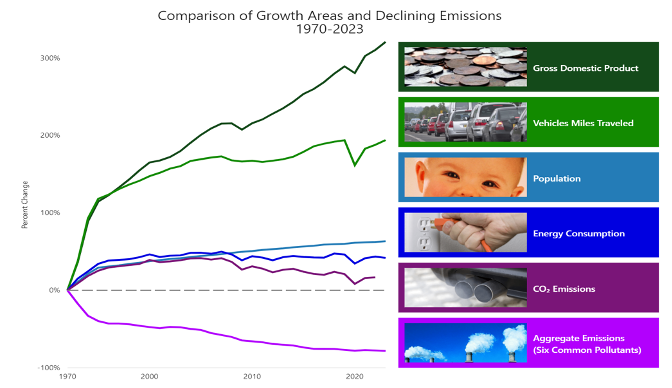
Although environmental regulation has improved the quality of air and water overall since before enacting the regulations under the EPA, the results have not kept up with the challenges of modern industrial chemical contamination, nor have they prevented the effects of accumulation of man-made chemicals in the environment. The expectation and complaints from industry that environmental regulation hurts the economy has not been documented. In fact, economic growth has continued even as environmental controls have been enacted and enforced.
De-construction of environmental protections. Today we see the unravelling of the complex tapestry of regulatory controls on pollution, from Executive Orders granting absolution to 41 industries from emission constraints to laws rescinding critical portions of the Clean Air Act.[ii] The EPA under the Trump Administration has rescinded 31 regulations that protect water, air and land from industrial pollution and chemical contamination, challenging Safe Drinking Water and Clean Water Act requirements, and curtailing enforcement actions. Rulemaking to control forever chemicals (PFAS) has been delayed or abandoned. The Supreme Court has removed the science-based expert authority of regulatory agencies requiring a strict and narrow interpretation of authorizations stated in the enabling legislation. The EPA revoked the Endangerment Finding of 2009 which put greenhouse gas emissions control under the Clean Air Act, effectively eliminating climate action controls. The EPA has also declared that costs of health harms and deaths from pollution will no longer be calculated in the analysis of regulatory action on air emissions. Challenges to these actions have had some success in federal courts, including the declaration that rescinding congressionally approved grants for renewable energy are illegal.
RebuildEnvironmental Protection with Regenerative Thinking. The long-term implications of these policy changes alarm environmental organizations and people concerned with the health of communities who are looking toward a change of administration to correct the harms. But, at this point, simply reversing the actions taken so far will not address the underlying issues. Of all the environmental regulations adopted to date, only the Pollution Prevention Act of 1990 addresses the concept of designing to prevent pollution and encouraging recycling. We can take lessons from the regulatory approach of the last 56 years and improve the outcome going forward. This is the opportunity to move our system of laws and regulations through a transformation from an extractive fossil-based economy to a regenerative renewable resourced economy. There are at least five elements to this process.
1. REACH: The first lesson would be to adopt the precautionary principle as the basis for evaluating the introduction of new man-made materials into large scale production.
2. Green Chemistry: Second, adopt a regulatory framework that emphasizes reduction or elimination of the inherent hazard, rather than computing the “safe” amount of toxicity for individual contaminants.
3. Empower Renewable Resources. Third, adopt the regulatory infrastructure to empower distributed renewable energy systems.
4. Heal damaged lands. Beyond preventing future pollution and damage, lies the responsibility to repair the scars and harms of legacy industries.
5. Remove fossil industry subsidies. The federal subsidies currently lavished on the fossil extractive industries can be shifted directly to fund the sustainable energy system.
A shared prosperity. It is time for bold action. It is time to recognize that the laws of nature are not negotiable, nor can they be rescinded by executive order or wishful thinking. The condition of our life support system requires both reduction in the levels and types of pollution as well as strong support for the known and available technical solutions. Burning fossil resources as the base for the economy drives the global warming that will make the planet uninhabitable to life as we know it.[i] By creating a new regulatory framework based on regenerative thinking and protection for our life support system, we can establish the conditions for a shared prosperity and sustainable growth within the constraints of our living earth.Those who contemplate the beauty of the earth shall find reserves of strength that will endure as long as life lasts. Rachel Carson.