Patricia DeMarco Ph.D.

"Live in harmony with nature."


From WWII Victory Gardens to Climate Victory Gardens

We commemorate Memorial Day on the last Monday in May, honoring all of those fallen in wars from the Civil War until now. It is a solemn occasion to mark the service of those who have given their lives in the name of our country. The causes and outcomes have varied over the years, with some more strikingly clear than others. But as a constant lies the dedication and support of the families of soldiers; the solidarity of those who share the experience of combat in arms; and the grief of loved ones for the loss of youth and promise.

The “war of choice” in Iran engaging us now has disrupted commerce and challenged the concept of trust in our leaders to weigh the value of lives carefully.[i] We mere citizens have little influence over the powers that wage wars, but we do experience the personal losses of family and friends; and communities see the impact as resources shift from domestic to military support. As military disruptions affect the international flow of petrochemicals, we see clearly how dependent we have become on this resource in all aspects of our lives. Especially in the food system.

The Straits of Hormuz closing has restricted movement for critical materials disrupting the flow of about 20% of global oil supply.[ii] Fertilizers, pesticides, herbicides and packaging in the food industry all come from petrochemical industry. So does the fuel that runs the machinery and processing equipment for cultivating and harvesting, and fuel for transporting food from the growing areas to stores and homes. As with many other systems, the use of petrochemicals (oil and natural gas) has been a driver in their growth and development to major international industries.[iii]Now the war in Iran has put a spotlight on what it means to move away from the fossil fuel base for our basic needs for energy, food and transportation. This wartime experience has sharpened the points of need for alternatives based on non-fossil fueled, sustainable systems. It took decades for the industrial revolution to create the conditions of dependence on extractive resources we experience today, but it need not take decades to shift to a more sustainable system. The building blocks are in place already.

The Victory Garden and Domestic food initiatives of the WWII era have many parallels with the sustainable food initiatives of today.[iv] Even though the motivation for the gardens differs somewhat, using local foods, and how we prepare and acquire food for economy, health and public purpose have strong parallels. Rachel Carson compiled recipes for using domestic fishes in all regions of the United States as part of this effort.[v] Efforts to compensate for such things as sugar and butter rationing suggest approaches that can help with healthier eating habits today. Likewise, processes for preserving food for Winter have seen major advances in technology, with dehydration for example.[vi] But the concept of putting food by for year – round use stands as a long tradition to the oldest recorded history of human civilization.

This year, we face food supply constraints not only from war blockades of supply chains but also from the side effects of climate events. In Georgia wildfires have delayed planting times.[vii] In the Midwest, drought lingers, and in the agricultural areas served by the Colorado River, water restrictions loom.[viii] [ix] Conflicting demands between industrial uses and domestic and agricultural needs are growing. The erratic swings in climate conditions makes reliable agricultural production even more of a challenge than it has been traditionally.

Acquiring local foods, preserving seasonal foods and practicing economy and health in what we eat are standards of food culture available to everyone. The women of WWII tended Victory Gardens as part of a war effort, displacing commercial food so production could feed the Armed Forces and Allies. An estimated 8 to 10 billion pounds of food were grown in victory gardens and from other domestic food sources, releasing commercial production for military use.[x]

Modern Home -Grown initiatives look toward reducing the carbon footprint of the food chain by using locally sourced food and using regenerative agriculture practices for healthier eating.[xi] The Rodale Institute has documented that global adoption of regenerative practices across both grasslands and arable acreage could sequester more than 100% of current anthropogenic emissions of CO2 and that stable soil carbon can be built quickly enough to result in a rapid drawdown of atmospheric carbon dioxide.[xii] Restoring fertile ground through regenerative agriculture is an effective tool for capturing carbon dioxide from the air and binding it in soils. That means growing food with natural fertilizers like compost that stores carbon and increases soil fertility. It means having food produced without pesticides and herbicides that can leave residues in food. It means less petrochemicals used for transportation fuel, packaging, and refrigeration. Even displacing a little food purchased can save much in energy use and food waste.

The Climate Victory Garden is a new initiative that contributes to the resilience and sustainability of our food supplies in uncertain times. You can see all the Climate Victory Gardens and register yours here https://greenamerica.org/climate-victory-gardens

You can also support your community farmers by buying fresh produce at local Farmers Markets or participating in Community Supported Agriculture in your area. Summertime is planting time. Harvesting foods as they are ready and appreciating seasonal fruits and vegetables fresh from local gardens and farms is a pleasure forgotten in the inundation of year-round hybrid strawberries, raspberries and apples. Gone are the regional specialties anticipated for a year and enjoyed as a rare delight- like fresh-picked peaches in August. Discover the joy of growing some of your own food and herbs. Share the experience with your children. Live closer to the force of Nature that supports our life on Earth.
Kitchen herb pots- P.DeMarco Spring 2026.

References and Citations:


[i]  Anton Troianovski. “Trump wants to call the shots but in Iran he keeps hitting his limits.” New York Times. June 8, 2026. https://www.nytimes.com/2026/06/08/us/politics/trump-iran-war-middle-east.html  Accessed June 9, 2026. 

[ii] Samantha Gross and Ryan Beane. “From chokepoint to crisis: The Strait of Hormuz and global oil markets.” Brookings Institute. June 8, 2026.  https://www.brookings.edu/articles/from-chokepoint-to-crisis-the-strait-of-hormuz-and-global-oil-markets/   Accessed June 9, 2026.

[iii]  American Fuel and Petrochemical Manfacturers. “From Farm to table: The Role of Petrochemicals in Agriculture.” March 15, 2016.  https://www.afpm.org/newsroom/blog/farm-table-role-petrochemicals-agriculture  Accessed June 10, 2026.

[iv] Megan Springate. Victory Gardens on the World War II Home Front. National Park Service.   https://www.nps.gov/articles/000/victory-gardens-on-the-world-war-ii-home-front.htm  Accessed June 9, 2026.

[v] Rachel Carson. Food From the Sea: Fish and Shellfish of New England. Conservation Bulletin 33. United States Department of Interior, Fish and Wildlife Service. Washington DC. 1943. National Archive accessed in person May 12, 2025.

[vi]  USDA. Complete Guide to Home Canning, 2015 Revision. National Agricultural Library Digital Exhibit.  https://www.nal.usda.gov/exhibits/ipd/canning/items/show/101   Accessed June 9, 2026.

[vii]  Southern Georgia Wildfires. Satellite Imagery. Cooperative Institute for Research in the Atmosphere. NOAA. April 18, 2026 https://satlib.cira.colostate.edu/event/southern-georgia-wildfires/  Accessed June 9, 2026.

[viii] Natalina Sents Bausch. Five Corn States Enter 2026 with Extreme or Exceptional Drought. Successful Farming. January 9, 2026. https://www.agriculture.com/5-corn-states-enter-2026-with-extreme-or-exceptional-drought-11882929  Accessed June 9, 2026.

[ix]  John Frank. Colorado River ranked as “most endangered” in the nation. Axios News. April 19, 2022. https://www.axios.com/local/denver/2022/04/19/colorado-river-ranked-most-endangered    Accessed June 9, 2026.

[x] Sundin, Sarah (2022) “Victory Gardens in World War II. Today in World War II History, August 15, 2022. https://www.sarahsundin.com/victory-gardens-in-world-war-ii/    Accessed June 10, 2026.

[xi]  Hilary McClafferty. Benefits of Eating Locally Sourced Foods. American Board of Physician Specialties. https://www.abpsus.org/eating-local-foods/  Accessed June 10, 2026.

[xii]  Jeff Moyer, Andrew Smith, Yichao Rui,and Jennifer Hayden.  Regenerative Agriculture and the Soil Carbon Solution. Rodale Institute. September 2020.   https://rodaleinstitute.org/wp-content/uploads/Rodale-Soil-Carbon-White-Paper_v11-compressed.pdf


Our Moral Obligation to Preserve the Living Earth

Here in Pittsburgh in the first weeks of April, though the air is chilly now, this week follows five days of temperatures above 65 degrees. Blossoms not usually emergent until May are in full flower- violets, redbud trees, magnolia trees…and the daffodills and hyacinths have wilted from being so warm. As I had opened the windows a bit, i woke early to listen for the dawn chorus of birdsong I have always associated with the coming of Spring. There were several distinct songbirds- a few robins, a cardinal or two, a flicker, and American song sparrow, a Carolina wren. But the joyous chorus of many many birds greeting the dawn together is no more.

The harbingers of our fate call out in silences once filled with music. The unseen wonders lost. I take the occasion of this Earth Day theme “Our Power, Our Planet” to emphasize again the fact of our existence: we depend on the gifts of the living Earth. Our survival, our life support system comes from the solar power and ecosystem services of the interconnected web of life. The interactions between the living and mineral and inanimate parts of the planet shape our existence, and as humans we have developed the power to shape, re-shape and even destroy the living systems we depend on.

I reflected on our moral obligation to preserve these gifts of the living Earth for our children and those who follow.

Thanks to Jim Lenkner for the video recording and editing.

As you consider your own obligation to our living Earth and to the children among us and of the future, seek to live lightly on this earth, being judicious in how much of the world’s resources we use daily.

Uee your voice to advocate for preserving natural places and pulcic parks, refuges and oceans.

Engage in your own community to keep the green spaces, provide access to nature, and plant food and flowers instead of chemically supported lawn.

Remember to celebrate the joy of the natural world. We are more alike as human creatures than different in culture, religion, gender, or political persuasion. Find the common humanity across these barriers. Live in harmony with Nature.

Happy Earth Day!

Patricia DeMarco

8 April 2026


55th Celebration of Earth Day

My Dear Colleagues and Friends.
The passion for preserving our life support system – the living earth – runs as an elixir of inspiration through our work as teachers, guides and models of living in harmony with Nature. Regardless of any pronouncements or Executive Orders, the laws of Nature are not negotiable.

Earth Day has marked annual community clean-up days, opening farmer’s markets, flower displays and recycling events. But really in this year where the EPA Administrator gleefully proposed rolling back 31 environmental protection regulations that were intended to curtail toxic air emissions like mercury and proliferation of forever chemical materials like PFOS, we need more than one-time reminders and displays. We need to take the issue of actively protecting our life support system seriously. That means addressing climate change with leadership and courage. That means curtailing pollution from man-made materials, especially plastics. And that means looking at our own lifestyle for ways to live with less burden on the earth.

On this Earth Day I share with you Rachel Carson’s words:
“…man, far from being the overlord of all creation, is himself part of nature, subject to the same cosmic forces that control all other life. Man’s future welfare and probably even his survival depend upon his learning to live in harmony, rather than in combat, with these forces.” {From Rachel Carson’s essay on Biological Sciences for the National Council of Teachers. In Lost Woods- the Discovered Writing of Rachel Carson. Linda J. Lear (Ed.)Beacon Press. Boston. 1998.Page 165.}


As we celebrate this 55th Earth Day, may we remember that the greatness of a nation is not determined by the number and fame of its billionaires but by the well-being and shared prosperity of its children, the elderly, the infirm and the poorest among us. We cannot have healthy people in a polluted environment. We must offer leadership and give voice to the 73% of Americans, of both parties, who want more direct action on climate change. We who know cannot remain silent in defense of the Living Earth that provides fresh water, oxygen-rich air, fertile ground and the millions of species that constitute the great web of life, of which we humans are but one part.

On this Earth Day re-dedicate yourself to stand as a strong advocate for preserving our living earth…every day! Call you Senators and Congressional Representative today and remind them that our quality of life, indeed our survival, depend on preserving and restoring a healthy environment.

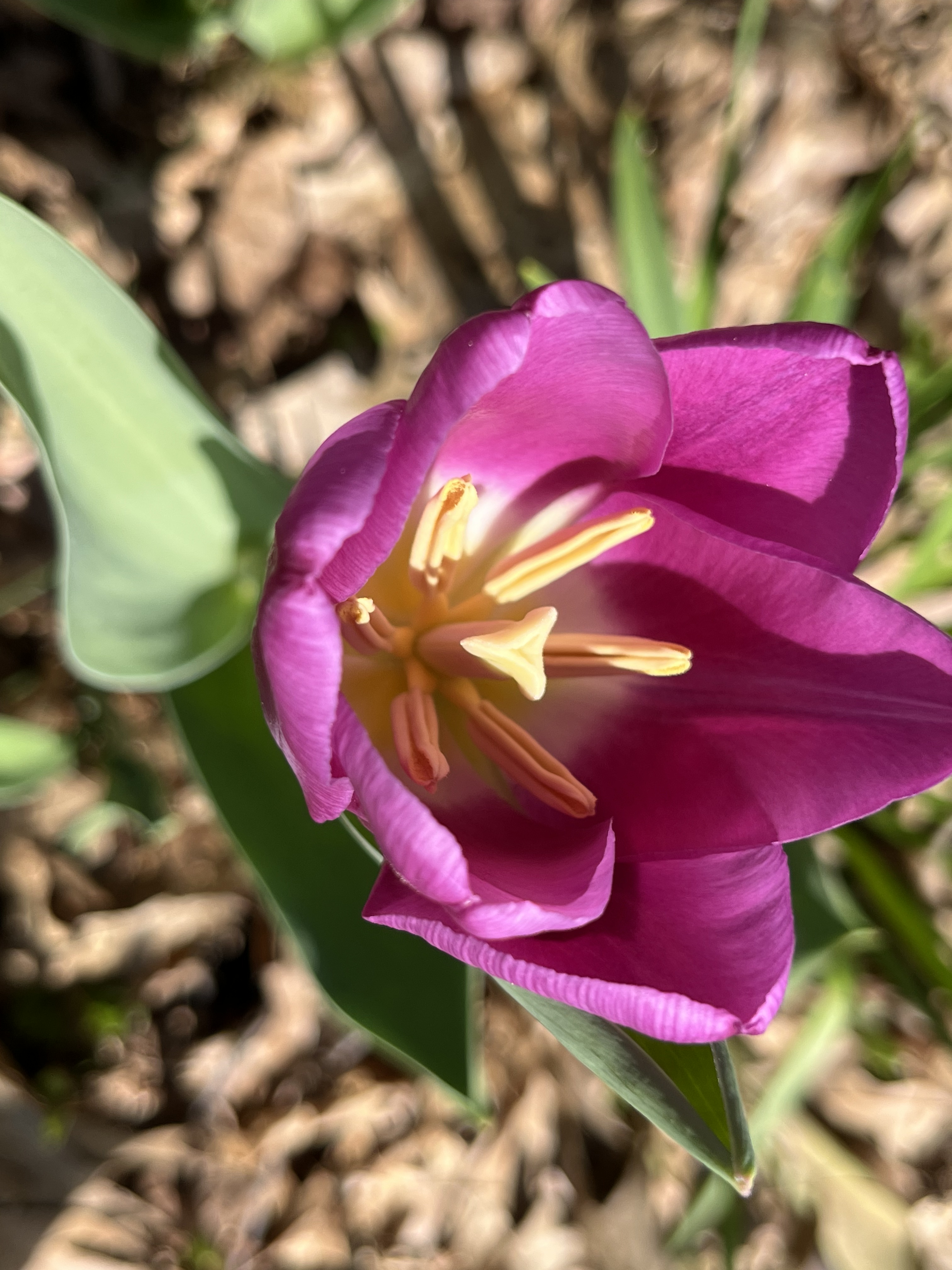
One tulip spared by the rabbits and deer!

Here is the link to my presentation for Earth Day at the Duquesne University Law School

and my interview with Dr. Dana Noescue.
4-22-2025Duquesne_Law-Earth_Day.pptx
 (11054 kB)
Healing the Land and Empowering the People: A Message for Earth Day

DKLL LEGAL TALK SERIES Patricia Demarco-Event.pdf  (255 kB)
Event Sponsored by DKLL and the 2025 Students of Climate Change Law, Research, and Writing

The interview with Dr. Dana Neascu can be found here.

https://dsc.duq.edu/law-dcli-speakers/10/


Metamorphosis- A model for our way forward

Metamorphosis

August 2019

The monarch butterfly has become an iconic emblem of the need to preserve the environment.  As insect populations decline from loss of habitat due to climate change and from broad use of pesticides and herbicides that are acutely toxic to pollinators, people have become more concerned. Pleas for help now fall on deaf ears at the EPA where industry influence has constrained controls on wide use of neonicotinoids, glyphosate, and dicamba.  Pollinator populations are crashing, with terrible consequences for food production. A world without insects would be dreary and uninhabitable as these creatures are essential parts to many food chains and essential ecosystems.

Barb Martin at the Sunny Plot

It is encouraging that individual efforts can make a significant difference in the outcome of this sad story.  In my home town of Forest Hills PA, Barbara Martin and the Late Bloomers Garden Club made a deliberate effort to increase the habitat for pollinators in the public gardens the club maintains.  Individual members also began planting specifically for pollinator-friendly gardens. Milkweed cultivation became very popular.  We all send pictures around celebrating the latest development- Monarch egg- laying, caterpillar sightings, chrysalis formation! We await the first emergence to be documented as a new generation of adult butterflies joins the hopefully growing throng. We share the small tragedies of caterpillars killed by stinkbugs or cadis fly attacks. The gardens are now scenes of high drama, not just places of colorful attraction.

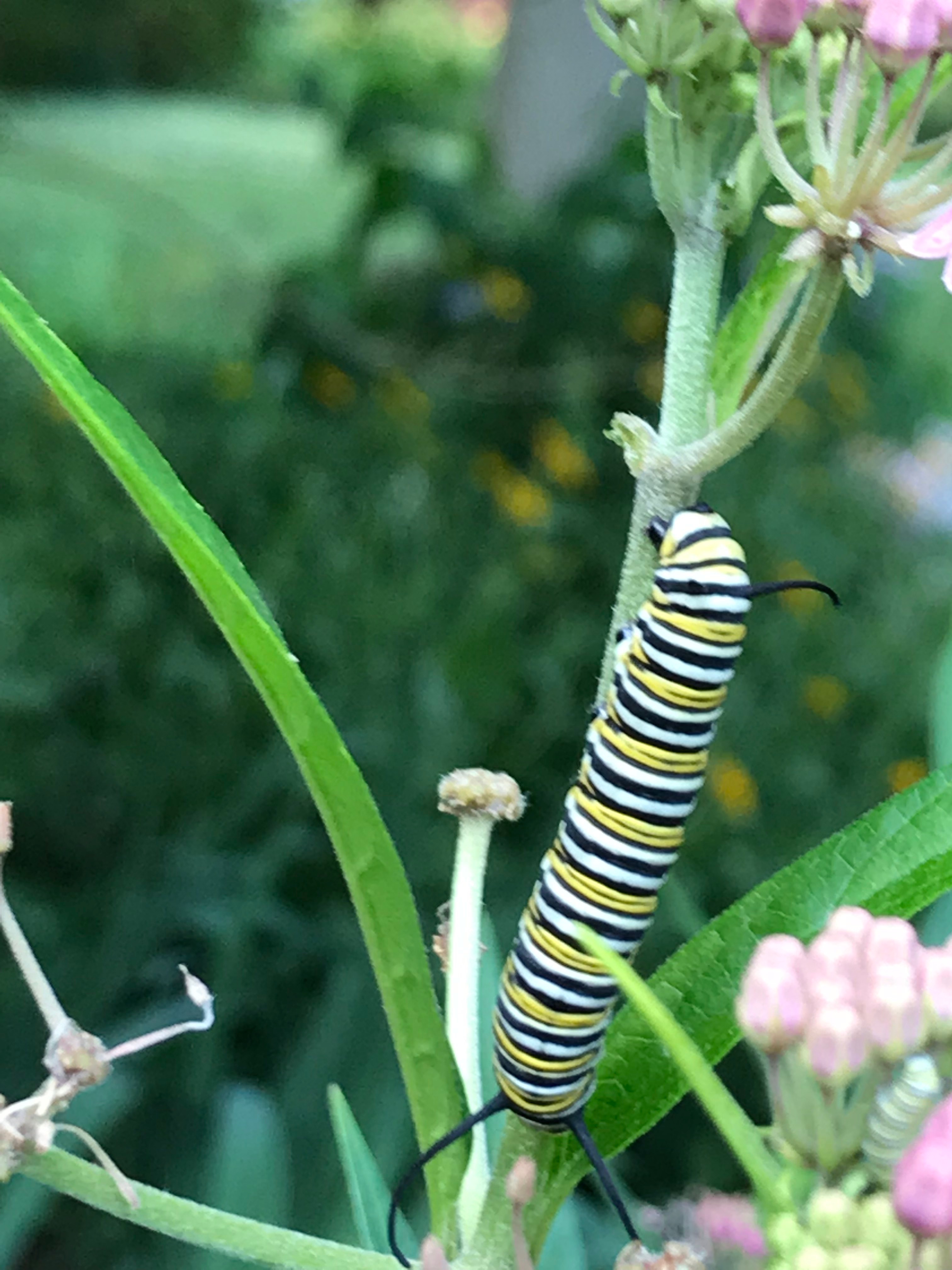
Second instar Monarch caterpillar eating milkweed in Patty DeMarco's garden
Third instar Monarch caterpillar on milkweed in Linda Hyde’s garden
Monarch chrysalis photographed by Barb Martin in her garden
Monarch adult emergent in Barbara Martin’s garden

Metamorphosis thus tracked and observed is revealed as one of the wonders of nature. Metamorphosis is the process through which insects, such as butterflies, develop from the egg to caterpillars, which molt two or three times as they grow, to pupate in a chrysalis, and then emerge in a totally different form as a butterfly. All of the fuel and resources necessary for the final adult butterfly form are contained in the caterpillar.  You can think of the caterpillar as an eating machine devoted to storing fat, and a butterfly as a flying machine devoted to reproduction. The special cells that become the organs and parts of the butterfly are clustered behind the head in the caterpillar- small “imaginal discs” of specialized cells that grow slightly, but wait until the chrysalis forms to become active. During pupation, the stored resources the caterpillar made become the fuel for growth and development of the organs that will be evident in the butterfly. It is an elegant manifestation of nature!

Metamorphosis is also a good descriptor for the changes our civilization is facing with the existential challenges of climate change and global pollution. We have grown our industrial age on the resources extracted from the Earth – coal, oil, and natural gas – and consumed them with explosive effect on the capacity of the economy to support growth…at least for a while.  Now, after roughly 100 years since the beginning of the industrial revolution, we are hitting the limits of growth.  Not growth as usually defined in economic terms, but growth in terms of keeping the balance of the life forces of the Earth.  Unlike the caterpillar, human society has no signal to trigger the transformation to the next stage. We must listen to the voice of the Earth warning of the limits to growth in its current mode. The way forward cannot pursue the same path as the past.  Just as the munching caterpillar is transformed into a flying creature, we need to transform our civilization from a rapacious converter of raw material into trash into a civilization devoted to preserving and sustaining the life support system the living Earth has provided to us.

The tools and resources necessary for the transformation to a sustainable civilization are at hand. This is not a technology issue. It is an issue of values and ethics, of recognizing that we have reached, perhaps even exceeded the limits of growth in this mode.  I share here the wisdom of Donella Meadows, one of the authors of The Limits to Growth.

People don’t need enormous cars; they need respect. They don’t need a closetful of clothes; they need to feel attractive and they need excitement, variety and beauty. People need identity, community, challenge, acknowledgment, love, joy. To try to fulfill these needs with material things is to set up an unquenchable appetite for false solutions to real and never-satisfied problems.[1]

If we really look at the way nature manages healthy systems, we see the balances among growth and decomposition and reconstitution.  In the great cycles of life, nothing is wasted and every part is interconnected with other parts to make a complex system that changes and evolves in succession. Human civilizations in past times have sustained a harmonious existence in nature for thousands of years, as the indigenous populations in many diverse parts of the world have illustrated. Modernizing such cultures has rarely achieved a similar balance.

The elegance of natural systems and the absolute economy of resource cycles in nature can inspire our future ways. As the monarch flutters through the milkweed in the garden, I am thankful for the efforts of my friends and of so many people from Mexico to Canada who are stepping forward to provide sanctuary for these amazing wanderers. Because their life cycle spans a continent, the healthy presence of monarch butterflies gives hope that we can restore the health of our own life support system for our children and the children yet to be born in the 21stcentury.


[1]L. Hunter Lovins et.al. A Finer Future – Creating an Economy in Service to Life. New Society Publishers. B.C. Canada. 2018. Page 27