
by Patricia M. DeMarco, Ph.D.
Mayor, Borough of Forest Hills, PA
Black plastic is commonly used in kitchen utensils, takeout containers, food trays, and children’s toys. But they hide a dark secret- most are made from material recovered from electronic waste plastic. Many of these products are made from recycled electronic waste, which can contain harmful chemicals like brominated flame retardants and heavy metals.[i] Flame retardants (often called “Forever Chemicals”) are found in 85% of black plastic consumer products.[ii]
Why is this a problem? Electronic products uniquely contain potential fire ignition sources within the components – circuit boards, batteries, transformers, connectors and other essential parts. To prevent and control the severity of fires, manufacturers coat electronics like computers, smart phones, televisions, gaming systems and tablets with a variety of flame-retardant compounds.[iii]
According to the Green Sciences Institute, flammability standards for electronics were developed in the 1970s in an attempt to limit the risk of a small open flame igniting plastic materials. High levels of flame-retardant chemicals–as much as 25% of the weight of the plastic–are used to meet these standards.[iv] When these products are recycled to recover the plastic, contaminants can transfer to food through consumer products.[v]

However, the chemicals so widely used to prevent the small fire risk are well-documented and potent endocrine disruptors. As a class of chemicals, organohalogens are highly persistent, bioaccumulative, and cause health harms, especially endocrine disruption, in wildlife and humans.[vi] These compounds can migrate from the plastic cases into dust particles which can be inhaled or ingested. And, when recycled into materials in contact with food, especially hot items, they can be absorbed into the food itself.[vii] Repeated petitions to the Consumer Products Safety Commission resulted in a Guidance Notice in 2017 to be in place pending the development of final regulations:
“Commission recommends that manufacturers of children’s products, upholstered furniture sold for use in residences, mattresses (and mattress pads), and plastic casings surrounding electronics refrain from intentionally adding non-polymeric, organohalogen flame retardants (‘‘OFRs’’) to their products. Further, theCommission recommends that, before purchasing such products for resale, importers, distributors, and retailers obtain assurances from manufacturers that such products do not contain OFRs. Finally, the Commission recommends that consumers, especially those who are pregnant or with young children, inquire and obtain assurances from retailers that such products do not contain OFRs.”[viii]
The Consumer Products Safety Commission has ceased rulemaking to implement this guidance, and has declared that the Commission does not have any rule prohibiting the use of flame retardants in children’s products, upholstered furniture, mattresses and mattress pads, and in plastic casings surrounding electronics.[ix]
Consumers are now without the protection of a regulatory limitation on products readily available and in common use. Why should we be concerned?
Human hormones produced by the endocrine system control essential functions.
Hormone Disrupting Compounds act at very low doses of exposure.
Endocrine glands and the hormones they produce enable the body to adapt to environmental change; they allow metabolic adjustments to occur in response to different nutritional demands (e.g. hunger, starvation, obesity, etc.); they are critical to reproductive function; and they are essential to normal development of the body and brain through their effects on growth and maturation of organs.[x]
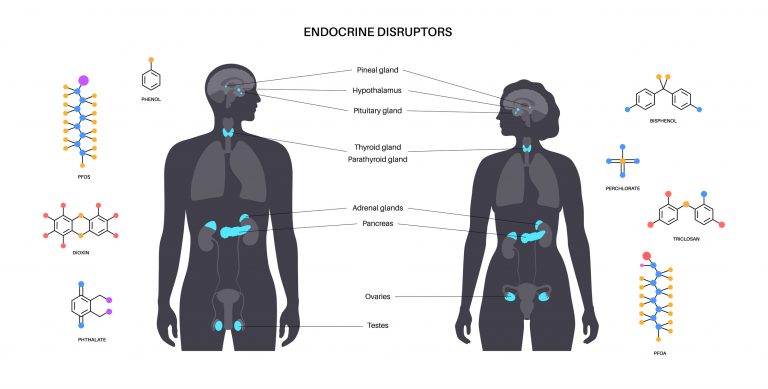
EDCs disrupt normal hormone functions.
EDCs can block normal hormones by binding to specific receptors.[xi] They can mimic normal hormones, like estrogen, for example, interfering with normal hormone functions. Some can cause stimulation of a normal hormone function resulting in an unintended response. Because normal hormones are receptor-specific and act at very low concentrations in the body, small amounts of EDCs can have a larger unintended effect.[xii]
Chronic exposure has been shown to cause diseases.
EDCs in plastics include: bisphenols, phthalates, alkylphenol ethoxylates, nonylphenols, brominated flame retardants, perfluorinated substances, benzotriazole UV stabilizers, and toxic metals. Infertility, reduced sperm count, pregnancy loss, and low birth weight of infants have been caused by EDCs. Some EDCs have been shown to cause cancers or chronic illnesses like diabetes and obesity. Some of these EDCs are persistent and bioaccumulative (i.e., build up over time in body tissues). When humans are tested for the presence of EDCs in their blood, fat, urine, and other tissues, the results consistently demonstrate a variety of EDCs in all individuals worldwide.[xiii]
In conclusion: Please examine your daily exposure to plastics. They can enter the body from absorption to food from plastic packaging or wraps, from ingestion of small particles from coated cooking pans or plastic cutting boards, or from using personal care or cleaning products. The Environmental Working Group provides a good source for guidance and brand based lists of exposure as well as Safe Products and sources.[xiv]
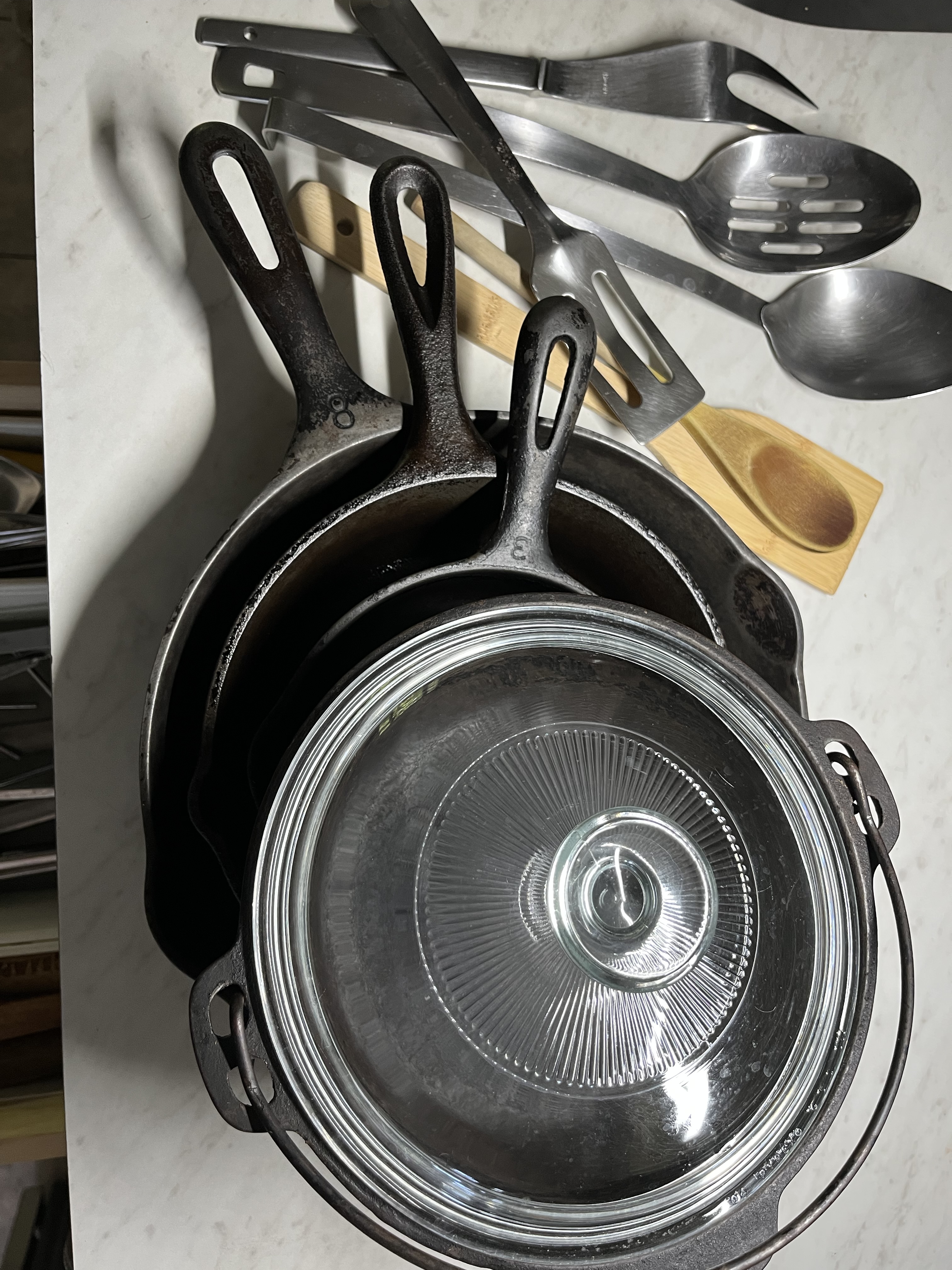
Choose durable materials for food preparation, serving and storage. Many things like spatulas and cooking goods made from aluminum, stainless steel, and wood are inexpensive and readily available. Secondhand goods stores are often a very inexpensive source for amazing products from the days of handmade homemade foods and materials. Cast iron pans well-seasoned from regular use last for generations.
P. DeMarco photo
While recycling is an essential feature for a circular materials economy, it is more important than ever to design products to ensure that toxic substances do not proliferate through the process. Recycling, without the necessary transparency and restrictions to ensure safety, is resulting in unexpected exposure to toxic flame retardants in household items.[xv] The chemical industry persistently repels attempts to regulate these and other forever chemicals, and has successfully prevented requirements to produce products that are non-toxic by design.[xvi]
We are inundated with a stew of synthetic chemicals. Our bodies do not experience one chemical at a time but rather a complex mixture of contaminants now spread worldwide through air and water and soil, even to uninhabited areas like Antarctica. The effects of this complex mixture have never been studied systematically. However, the epidemiology evidence documents the fact that we have been conducting an uncontrolled experiment upon ourselves and all other living things on Earth. Rachel Carson’s early urging of precaution in the proliferation of synthetic materials into the biosphere was ignored, even despised and disparaged by the chemical industry and especially the petrochemical industry. We learn to our sorrow that she was right to urge precaution. Once released, this proliferation of “Forever Chemicals” cannot be retrieved. We have poisoned our world forever.
Citations and Resources
[i] Katrina Korfmacher and Jane VanDis. “Is the Plastic in Your Kitchen Harmful?” Healthy Living. University of Rochester Medicine. May 30, 2025. https://www.urmc.rochester.edu/news/publications/health-matters/is-the-plastic-in-your-kitchen-harmful Accessed May 29, 2026.
[ii] Liu M, Brandsma SH, Schreder E. From e-waste to living space: Flame retardants contaminating household items add to concern about plastic recycling. Chemosphere. 2024 Oct;365:143319. doi: 10.1016/j.chemosphere.2024.143319. https://pubmed.ncbi.nlm.nih.gov/39271080/
[iii] https://www.americanchemistry.com/industry-groups/north-american-flame-retardant-alliance-nafra/electronics-and-flame-retardants Accessed May 28, 2026.
[iv] Hall, J.R. Fires Involving Appliance Housings— Is There a Clear and Present Danger?. Fire Technology 38, 179–198 (2002). https://doi.org/10.1023/A:1014463317848 Accessed May 29, 2026.
[v] Liu M, Brandsma SH, Schreder E. From e-waste to living space: Flame retardants contaminating household items add to concern about plastic recycling. Chemosphere. 2024 Oct;365:143319. doi: 10.1016/j.chemosphere.2024.143319. https://pubmed.ncbi.nlm.nih.gov/39271080/
[vi] . Prasada Rao S. Kodavanti, Margarita C. Curras-Collazo,Neuroendocrine actions of organohalogens: Thyroid hormones, arginine vasopressin, and neuroplasticity, Frontiers in Neuroendocrinology, Volume 31, Issue 4, 2010, Pages 479-496, ISSN 0091-3022, https://doi.org/10.1016/j.yfrne.2010.06.005. (https://www.sciencedirect.com/science/article/pii/S0091302210000397)
[vii] Arlene Blum et.al. Electronics. Green Science Policy Institute. https://greensciencepolicy.org/our-work/electronics/ Accessed May 29, 2026.
[viii] CONSUMER PRODUCT SAFETY COMMISSION [CPSC Docket No. CPSC–2015–0022] Guidance Document on Hazardous Additive, Non-Polymeric Organohalogen Flame Retardants in Certain Consumer Products Federal Register / Vol. 82, No. 187 / Thursday, September 28, 2017 / Notices https://www.govinfo.gov/content/pkg/FR-2017-09-28/pdf/2017-20733.pdf Accessed May 29, 2026.
[ix] United States Consumer Products Safety Commission. Flame Retardants: Frequently Asked Questions on Organohalogen Flame Retardants. https://www.cpsc.gov/Business–Manufacturing/Business-Education/Business-Guidance/flame-retardants Accessed May 29,2026.
[x] Jodi Flows, Pauline Dandimopoulou, Heather B. Potisoul, Andrew Gore, Lori Roetzman, Laura Vandenberg. Plastics, EDCs and Health: A Guide for Public Interest organizations and Policy-makers on Endocrine Disrupting Chemicals and Plastics. Endocrine Society. December 2020. https://www.endocrine.org/-/media/endocrine/files/topics/edc_guide_2020_v1_6chqennew-version.pdf
[xi] Andrea C. Gore, Michele A. LaMerrill, Heather Patisaul,and Robert M. Sargis. Endocrine Disrupting Chemicals: Threats to Human Health. Endocrine Society. February 2024. https://www.endocrine.org/-/media/endocrine/files/advocacy/edc-report2024finalcompressed.pdf and FAQ Sheet https://www.endocrine.org/-/media/endocrine/files/patient-engagement/hormones-and-series/hormones_and_edcs_what_you_need_to_know.pdf Accessed May 29, 2026.
[xii] Heather Pautisal. Patient Resource Guide: Endocrine Disrupting Chemicals. Endocrine Society. January 24, 2022. https://www.endocrine.org/patient-engagement/endocrine-library/edcs Accessed May 29, 2026.
[xiii] Jodi Flows, Pauline Dandimopoulou, Heather B. Potisoul, Andrew Gore, Lori Roetzman, Laura Vandenberg. Plastics, EDCs and Health: A Guide for Public Interest organizations and Policy-makers on Endocrine Disrupting Chemicals and Plastics. Endocrine Society. December 2020. https://www.endocrine.org/-/media/endocrine/files/topics/edc_guide_2020_v1_6chqennew-version.pdf Accessed May 29, 2026.
[xiv] Environmental Working Group. Toxic chemicals, https://www.ewg.org/areas-focus/toxic-chemicals Accessed May 29, 2026.
[xv] Liu M, Brandsma SH, Schreder E. From e-waste to living space: Flame retardants contaminating household items add to concern about plastic recycling. Chemosphere. 2024 Oct;365:143319. doi: 10.1016/j.chemosphere.2024.143319. https://pubmed.ncbi.nlm.nih.gov/39271080/ Accessed May 28, 2026.
[xvi] Tom Perkins. “US Chemical Industry Likely Spent $110m Trying to Thwart PFAS Legislation, Study Finds.” November 7, 2023. The Guardian. https://www.theguardian.com/us-news/2023/nov/07/us-chemical-industry-110-million-thwart-pfas-legislation Accessed May 29, 2026.

