Author Archives: patriciademarco
Empowering the Sustainable Energy System of the 21st Century

It is time for a new National Energy Policy to support a clean, modern energy system. The energy sector is the largest contributor to emissions of greenhouse gases that are causing climate change.[i] Consumers see rising prices for electricity and hear industry complaints about onerous regulations and government curtailment.[ii] Utility companies struggle to address reliability of service requirements and universal service standards even as data centers and AI applications add intense demands for electricity.[iii] Much of the focus on climate action involves shifting to electricity for buildings, transportation and even industry. If the country is to meet climate goals, the shift from burning coal, natural gas and petroleum for power generation must occur much more rapidly.[iv]
Transforming the nation’s energy system to one based on renewable and sustainable resources is a critical element in responding to climate change mitigation and adaptation. Unfortunately, practitioners in the renewable energy systems space currently encounter significant regulatory and institutional barriers to rapid and efficient implementation of new technologies and practices.[v] National energy policy is needed, including an update to the energy industry’s regulatory framework, to advance the modernization of our country’s electricity delivery system.
The current regulatory framework is built around centralized energy generation from utility monopolies that deliver electricity to customers residing across a wide geographical territory. Under the National Energy Act of 1992, partial deregulation of the nation’s electricity system took place, leaving a patchwork quilt of conditions in place across the country: 17 states are fully competitive with customer choice for electricity generation and gas supplies; 9 are deregulated for gas suppliers only; and 23 remain fully regulated for electricity and gas.

Data Source: US EPA https://www.epa.gov/greenpower/understanding-electricity-market-frameworks-policies
Modernizing the nation’s electrical grid system means moving away from this current model of centralized energy generation towards generating energy on site or nearer to the consumer. In this emerging, more distributed energy system, customers may also be generators of the power they consume, they may have on-site storage for all or part of their demand, and buildings can even become virtual power plants by generating excess electricity that can be shared with others in need of that energy. This empirically straightforward approach that is technically feasible, economically beneficial and widely available unfortunately faces enormous difficulties when put into practice. For example, in a Pittsburgh community three municipal buildings adjacent to each other – the volunteer fire department, public works garage and storage shed and emergency management service – cannot share a common battery storage installation or share the solar photovoltaic electricity generated on three of the four roofs because a “public way” divides the space, and the buildings are wired to three different distribution grids, but not to each other. The cost to re-wire was more than the cost of installing all of the solar arrays! There is no standard interconnection protocol, and no tariff that fairly allocates costs and benefits. Grid-interactive Efficient Buildings are technically feasible.[i],[ii] We need to clear the regulatory hurdles to expand deployment to make buildings perform as virtual power plants.
Manufacturers and large-scale energy users explore the increasing benefits of co-generation, combined heat and power operations, and on-site storage. New high energy intensity operations like data centers and AI operations could benefit from co-locating efficient power generation on site and piping excess heat to neighboring facilities in need of that heat.[iii] A new regulatory system that accommodates customer generation can accelerate the necessary large- scale advance of renewable energy systems. However, there are few models for regulatory interface among producers and users of steam plus electricity, or waste heat and power. Such arrangements usually involve complicated business negotiations and are unique to each project. If distributed energy systems are to become mainstream and accessible to a multitude of energy system configurations, a regulatory system that defines the relationships and possibly new utility services and functions can expedite and streamline such transactions.
Major existing regulatory and institutional barriers
The regulatory system has accumulated policies and practices over decades, proving resistant to change even as technology advances have accelerated.[iv] The most significant regulatory and institutional barriers to modernization include:
- Policy fragmentation across jurisdictions. Federal, state, and local jurisdictions have differing and sometimes conflicting requirements making national markets difficult to pursue. To correct policy fragmentation, we need more standardization of methods and processes in a systems-oriented approach to regulatory infrastructure modernization.
- Permitting complexity. Multiple agencies require differing and overlapping permit requirements, poorly sequenced with no clear path among multiple authorities. Grid integration challenges face transmission and distribution capacity constraints, as well as interconnection and Regional Transmission Organization [AW1] market rules, that pose barriers to renewable energy implementation, in modern utility operations, and impede net-zero greenhouse gas emissions outcomes.
- Grid integration challenges. Utility systems have capacity constraints as well as a lack of interconnection infrastructure to support “two-way traffic” among customer/generators with or without on-site storage.
- Lack of uniformly recognized guidelines for RECs. There is no standard framework for defining Renewable Energy Certification (REC) credits that track and verify demand reduction or customer renewable energy generation across jurisdictions. Different states, and sometimes different utilities within states, have differing definitions, pricing and verification methods applied to RECs.
- Erratic and unstable incentives. Production tax credits, investment tax credits, subsidies, land use allocations for federal land are subject to change with budget cycles unless established in law. The unstable incentives send the wrong pricing signals to the economy and foster inefficient choices for decades, impeding the progress to market transformation and decarbonization.
The current electricity system was designed for one-way flow of electricity from central power generation stations to distant residential, commercial and industrial customers. Now, several categories of customers also have the opportunity to generate electricity, and send it back into the electric grid. The electricity system, and the rules that govern it , are not designed for this two-way travel of electrons. In addition, standard interconnection procedures are needed for 1) virtual community power plants with or without storage; 2) standards regarding energy storage, steam/heat distribution or sale from combined heat and power operations, whether by a utility or a non-regulated entity; and 3) demand side management tied to time of use cost savings.[v] The integration of such services into the electric grid would benefit from innovations in communication technology and AI for real-time synchronization of both supply and demand side resources over daily and seasonal cycles.[vi] Many states have explored various approaches to regulatory incentives for renewable energy which provides a good place to begin to assemble the best practices across the country.[vii]
Opportunity for legislative action on national energy policy:
Three federal legislative initiatives will be pending over the next two years and could be legislative vehicles for the adoption of a national energy policy:
- Reauthorization of Tax Reform Act of 2017
- Regulatory Modernization and Permitting (especially shortening timelines)
- Funding decarbonization and electrification initiatives from the Inflation Reduction Act
- Budget authorization for programs under the Bipartisan Infrastructure and Jobs act and the Inflation Reduction Act.
Updating a National Energy Policy to address the urgency of climate action as well as the complexity imposed by the accumulated regulatory fabric of past decades offers a unique opportunity to a new Administration. It is important for the next President to address a forward-looking energy policy that empowers and accelerates the critically necessary modernization of the energy system. Every citizen is affected every day by how cost-efficient, safe and reliable the energy system serves daily needs. Resolving the regulatory quagmire will pave the way for a clean and sustainable energy future.
[i] National Association of Regulated Utility Commissioners and National Association of State Energy Officials https://www.naseo.org/issues/buildings/naseo-naruc-geb-working-group
[ii] National GEB Roadmap: U.S. DOE, A National Roadmap for Grid-interactive Efficient Buildings (May 2021)
[iii] U.S. DOE. Office of Energy Efficiency and Renewable Energy. Connected Communities presentation December 2, 2021.https://www.naseo.org/data/sites/1/documents/tk-news/connected-communities-for-geb-working-group.pdf
[iv] Seetharaman, Krishna Moorthy, Nitin Patwa, Saravanan, and Yash Gupta. Breaking barriers in deployment of renewable energy. Heliyon 5 (2019) e01166. doi: 10.1016/j.heliyon.2019. e01166
[v] G. Olabi, Khaled Alsaid, Khaled Obaideen, Mohammad Ali Abdelkareem, Hegazy Rezek, Tabbi Wilberforce, Hussein M. Maghrabi, Enas Taha Sayed. Renewable Energy Systems: Comparisons, challenges and barriers, sustainability indicators, and the contribution to UN sustainable development goals. International Journal of Thermofluids. 20(2023) 100498. www.sciencedirect.com/journal/international-journal-of-thermofluids
[vi] NASEO, “Demand Flexibility and Grid-interactive Efficient Buildings 101” (September 2022) and “Grid-interactive Efficient Buildings: State Briefing Paper” (October 2019)
[vii] Database of State Incentives for Renewables and Efficiency. https://www.dsireusa.org
[AW1]Spell out acronyms
[i] United States Environmental Protection Agency. Sources of Greenhouse Gas Emissions. Total U. S. Greenhouse Gas Emissions by Sector in 2022. https://www.epa.gov/ghgemissions/sources-greenhouse-gas-emissions%20Accessed%20September%2022 Accessed September 21,2024.
[ii] Robert Walton. “State Officials Blame Federal Regulators for Higher Energy Prices: ‘Consumers are getting hurt!’” Utility Dive. February 15, 2024. https://www.utilitydive.com/news/state-officials-blame-federal-policy-higher-energy-prices-EPA/707608/ Accessed September 20, 2024.
[iii] North American Electric Reliability Corporation (NERC), Electricity Supply and Demand Data, 2023; Energy Information Administration (EIA) Monthly Energy Review; National Renewable Energy Laboratory (NREL) Pathways to 100% Clean Electricity, 2022. Note that electricity demand includes transmission losses and direct use. https://www.energy.gov/policy/articles/clean-energy-resources-meet-data-center-electricity-demand Accessed September 20, 2024.
[iv] Simon Black, Ian Perry, Nate Vernon-Lin. Fossil Fuel Subsidies Surged to $7 Trillion. International Monetary Fund Blog. August 24, 2023. https://www.imf.org/en/Blogs/Articles/2023/08/24/fossil-fuel-subsidies-surged-to-record-7-trillion
[v] Enerdatics. Addressing Policy and Regulatory Challenges in Renewable Energy Projects. July 6, 2023. https://enerdatics.com/blog/addressing-policy-and-regulatory-challenges-in-renewable-energy-projects/ Accessed September 20, 2024.
Community Benefit ReImagined and Refined
Reposted from ReImagine Appalachia is this article written with Amanda Woodrum
See the full article here:
https://reimagineappalachia.org/community-benefits-reimagined-and-refined/
2024 Petrochemical Lunch & Learn Series
Your Health and Your Environment
the Black Appalachian Coalition partnering with the Ohio River Valley Institute is continuing the Petrochemical Lunch & Learn Series in 2024. Archbishop Marcia Dinkins and Patricia DeMarco have collaborated in producing this series taking a deep dive in 2024 connecting the health of people with the health of the environment. We recognize that too many front line communities experience daily conditions of air, water and land pollution that seriously deteriorate the health of people, especially children and the elderly. We also recognize that the mainstream systems for health care often do not reach communities of color living in the shadow of industrial facilities.
This series of webinars proposes to arm people who live and work with frontline communities with information, resources and tools to understand the situations they face. We hope to provide connection by sharing lived experiences from people who have food solutions and are moving forward.
We believe that health is a human right, not a privilege for those who can buy enough health insurance. We believe that to have healthy people we must have clean air and water, land that provides safe, fresh food accessible to everybody, and free of contamination. We are working together to build connections among communities with common problems from the Appalachian region, to the Gulf South, to the industrial East Coast. We have a common vision of a better future we can build together.
We depend on the living Earth for fresh water, clean air fertile ground and the wonderful array of living things in the interconnected Web of Life, of which humans are but one part. If we preserve our Mother Earth, we will have all we need to survive and to thrive for generations and generations.
2024 Petrochemical Lunch & Learn: Your Health and Your Environment Production
Archbishop Marcia Dinkins- Convenor and Welcome
Ben Hunkler- Ohio River Valley Institute -Technical support and evaluation surveys
Patricia DeMarco, Ph.D. – Research and Background
Kidest Gebre- BLAC Fellow – Communication and Coordination
Esther Baldwin- BLAC Fellow – Organizing and Support
The 2024 Petrochemical Lunch & Learn Series addressed these topics:
1. Health is a Human Right Feb 21, 2024 explored the connection between people and the environment; every person has the right to breathe clean air, have safe water and freedom from pollution
2. Air Pollution March 21, 2024- sources, health harms and mitigation
3. Water is Life– April 18, 2024 water pollution, health harms and mitigation
4. The Land Beneath Our Feet– May 16, 2024- abandoned mined lands, abandoned oil and gas wells- health effects, amelioration and reclamation
5. Forever Plastics- Everlasting Poisons June 20, 2024 Addressed plastics in our everyday life, avoiding and substitutes
6 When Disaster Strikes– Protecting Vulnerable Populations August 15, 2024
7. Environmental Justice and Building a Clean Energy Economy Sept. 19, 2024
8. Healthy Mothers and Children in a Healthy World Oct. 31, 2024
9. Action Strategy- November 21, 2024. Mobilizing and empowering people to hold polluters accountable. Freedom to Breathe Campaign
Here is a link to the Toolkit assembled by Ben Hunkler including recordings, all speaker presentations and resources for all of the sessions: https://docs.google.com/document/d/1FLSdlMwHfr20pow0Afqhj7llhDH1Mp3cfXkLC-IEIGo/edit?tab=t.0. You can select a single session at a time.
The programs reached over 1,500 registered attendees from 28 states and three countries. Clearly, there is much work yet to do in bringing frontline communities into a greater state of awareness and empowerment to take action against the chronic and damaging pollution that has become an accepted part of industrial might. This cannot be contiued at the expense of the health of millions of people exposed to toxic materials exposure through contaminated air, land and water.
As we look toward 2025, we will focus on moving from awareness to action. We will harness the power of informed citizens to hold the polluters accountable. BLAC launched the Right to Breathe Campaign at the end of this series. This will carry forward the momentum for health as a human right into the next year.
It has been my honor to be involved with this highly impactful series of programs. Archbishop Marcia Dinkins has inspired many discussions and brought hope to people enduring situations that cannot be considered normal and right, sometimes for generations. Ben Hunkler of the Ohio Valley Research Institute has kept the whole operation operating technically smoothly and has assembled and added to the resources in the Petrochemical Lunch & Learn Toolkit.
Made In America- Made to Last
Earth Day 2024 – A reflection from Earth Day in 1970
by Patricia DeMarco
This Earth Day 2024 places a spotlight on plastic – a man-made counterpoint to the wonders of the natural world. Plastic brought apparent convenience and inexpensive goods to America, but the consequences resonate for hundreds of years in global pollution from often toxic synthetic materials. The shared sense that the living world has intrinsic value critical to the health of all interconnected living beings gave common ground in the first Earth Day in 1970, but has been eroded and even derided today.
If people are to thrive together on a finite planet, we must adjust our consumption patterns to be more sustainable. We must restore the central value of preserving the health of the environment- air, water and land that support all of the ecosystem services we depend on. Manufacturers accountability legislation has been introduced in the Senate by Senator Jeff Merkley as The Break Free From Plastic Pollution Act of 2021. We can start by passing this important initiative .
For more information and a fuller argument for Breaking Free From Plastic in our lives, download the full paper:

Topics included in the full paper:
Earth Day 1970- a Retrospective
Earth Day 2024 Parallels and Contrasts
There is no longer a national bipartisan consensus for the value of environmental and climate policy.
Three Existential Crises: Global warming, global biodiversity loss; global pollution
Global Pollution- Plastic Everywhere!
System Solutions:
- Accelerate the transformation to a renewable energy resource system.
- Regenerative agriculture and restorative land use
- Circular Materials management from non-fossil feedstocks
Call to Action: Sustainability as a Goal
First, manufacturers must be held accountable: Break Free From Plastic Pollution Act of 2021
Second, Test for health effects before commercial production.
Third, educate chemists, engineers and industrial manufacturers about living systems.
Finally, be an active citizen. We can all act as empowered consumers. Americans discard 33.6 million tons of plastic a year average of 286 pounds of waste per person per year. Use your consumer power more wisely:
- Refuse-single-use items
- Reduce– Buy in bulk, substitute recyclable and non-toxic materials for non-recyclable
- Reuse– select refillable products; buy recycled materials-replace single-use items with reusable items-exchange toys, clothing, household décor
- Recycle– know the rules in your area and separate clean items
- Rot– compost food waste and organic material
Use your voice as an engaged citizen. Advocate for policies that will address these issues directly in your community, in your state legislature and with your Congressional Senators and Representatives. Your vote is your voice, and you have a responsibility as a citizen to hold the people who purport to represent you to account. Apathy is our enemy.
On this Earth Day 2024, I savor the beauty of the world around me now, and I pray again in my old age for the surge of care and concern for the Living Earth and for our future that will override partisan politics and corporate greed.
2024: A Pivotal Year for Action
This is a pivotal year in many ways, especially in the urgent need to make the policy U-turn from an extractive to a regenerative economy. Without the restructuring of our economy, and indeed our civilization, away from fossil fuel combustion within the next five or six years, the climate tipping point may be irreversibly crossed. 2023 was the hottest year in recorded history, with many regions experiencing unlivable conditions for at least part of this year. https://climate.copernicus.eu/copernicus-2023-hottest-year-record Conditions will only worsen if we continue the slow walk on climate action.
Engaged and informed citizen action has never been more important.
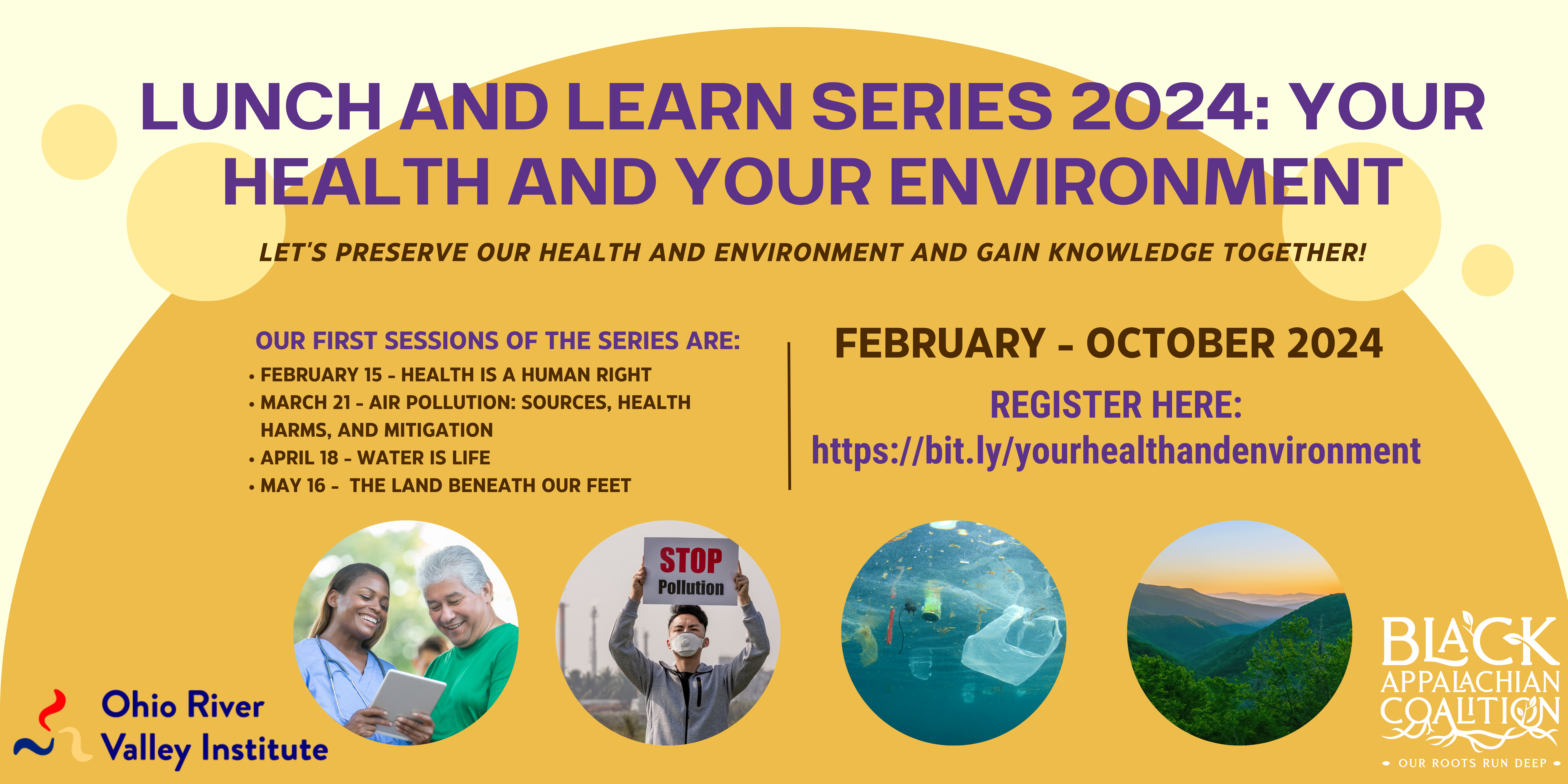
Growing from the Petrochemical Lunch and Learn Series of 2023, we saw great interest in further exploration of environmental-related health harms and how to address and prevent them. I am partnered with the Black Appalachian Coalition (BLAC) and with the Ohio River Valley Institute to dive deeper into the connection between environmental pollution and our health. https://blackappalachiancoalition.org/
Our first sessions of the series are:
- February 15 – Health Is a Human Right
- March 21 – Air Pollution: Sources, Health Harms, and Mitigation
- April 18 – Water is Life
- May 16 – The Land Beneath Our Feet
This series of workshops empowers people with information and guidance for action, especially in communities affected by petrochemical and extractive industries. A healthy environment is necessary for healthy people; it is a human right for people to have clean air, water, and access to health care.
Register here: https://us02web.zoom.us/meeting/register/tZApcuqqrz0vGdSlxRBjkfkT4FusY64Cpz_2?blm_aid=0#/registration
Personal Focus for 2024:
I have ended my term as an elected official on December 31st 2023., and I have been appointed to the Forest Hills Community Alliance, the community development corporation for Forest HIlls. To structure and organize my consulting activities, I have joined The Main Street Associates in Braddock as a Principal Associate.https://www.themainst.org Work here includes developing Community Benefit Plans and Agreements required by grant recipients under the Inflation Reduction Act and the Bipartisan Infrastructure Law. I have a focus on the regulatory infrastructure necessary to promote and enable renewable energy systems to thrive in PA. Shifting from a central fossil fueled power station with distant customers must give way to a Distributed Energy System. We are working to build a shared prosperity for our communities.
I continue writing as a Pittsburgh centered author. ReImagine Appalachia- Healing the Land and Empowering the People is In Press now. I have two new writing projects. I am collecting stories and resources to develop the story of the Mon Valley- its past and its future as a journey from the industrial extractive era to the clean manufacturing era. With the passing of my Aunt Rosa, I received the mantle of Matriarch of our Family. With this honor, I will be collecting the multi-generational story of our family from the mountains of Campolieto Campobasso in the Abruzzi region of Italy to the interwoven branches across America.
This will be a year of challenges and trials. Our country seems painfully divided and polarized. But we can come together as a people affirming what is good and true in our culture; learning and sharing with those who bring tradition and wisdom to bear on our common problems, and restore the attribute of treating each person politely with dignity and respect. Without justice, there is no peace. Without compassion, there is no healing. We can build a shared prosperity, a better future, if we work together and respect the laws of Nature as a guide to our way forward.
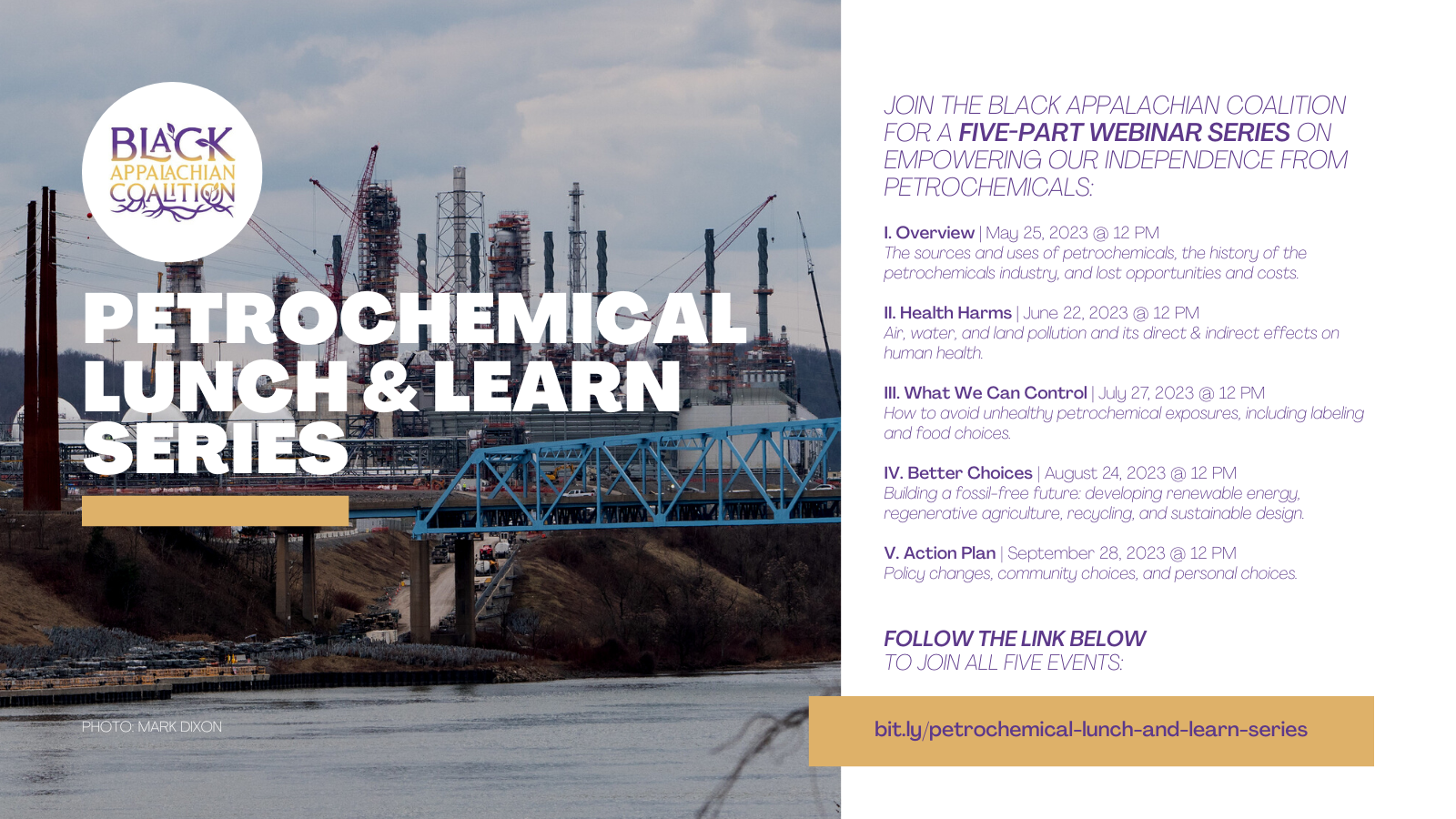
Empowering Independence from Petrochemicals
Archbishop Marcia Dinkins, founder and leader of the Black Appalachia Caucus, Patricia DeMarco, with ReImagine Appalachia, Ben Hunkler of the Ohio River Valley Institute have come together to present a five-part webinar series- “Petrochemical Lunch and Learn.” We hope to give people the information they need and some guidance and direction for responding to the climate crisis and the global pollution associated with burning fossil fuels. This informational series is designed to empower people, especially people of color who are most likely to experience the environmental, health and economic harms from proximity to petrochemical facilities. We will discuss how the petrochemical industry came to be such an integral part of our lives, how we can reduce dependence on burning fossil fuels, and how we can build a resilient, equitable and shared prosperity as we move toward a bio-based economy that can be sustained.

You can register for the whole series or any session here bit.ly/petrochemical-lunch-and-learn-series
May 25, 2023 Session I: Overview: the sources and uses of petrochemicals; the history of the petrochemicals industry; how we can move away from fossil fuels and some of the environmental and social justice issues associated with petrochemical extraction, transportation and use.
May 25, 2023 Session I Overview slide presentation is here:
Here is the recording of Session I: Overview https://www.youtube.com/watch?v=O-a2V0ztRrs
June 22, 2023 Session II: Health Harms– This session explains how petrochemical industry pollution of air water and land affects our health; and some of the environmental justice issues that result from petrochemical industry operations. Presentation by Patricia DeMarco is here :
The recording of Session II: Health Harms including the presentation and discussion by Dr. Claire Cohen is here: https://www.youtube.com/watch?v=kN73DBK4S50
If you have questions, you can e-mail me at demarcop6@gmail.com
July 27, 2023 Session III: What We Can Control. Patricia DeMarco will be joined by experts from Women for a Healthy Environment for practical things you can do to protect your exposure to petrochemical health harms. https://www.youtube.com/watch?v=B8e8fUSzWeM
August 25, 2023. Session IV. Empowering Independence from Petrochemicals- Better Choices. Building a fossil-free future: developing renewable energy, regenerative agriculture, recycling, and sustainable design.
We hear from Derrick Tillman, passive solar developer to share the impetus for passive solar design for affordable housing. https://www.youtube.com/watch?v=3o_ZUd5eqRE
September 28, 2023. Empowering Independence from Petrochemicals. Call To Action We end the 2023 Petrochemical Lunch & Learn series with a Call to Action for communities, for individuals, and of all concerned about having a healthier, more robust shared prosperity. The presentation is here:
and the video is here.https://www.youtube.com/watch?v=6r1JqISylJk
This series has Brough people together across the United States from communities suffering long years, decades from the silent and slow toxic suffusion of pollution of air, water and land from petrochemical operations.
We continue this series in 2024 with a deep dive into the health harms of the petrochemical industry. See Petrochemical Lunch & Learn 2024: Your Health and Your Environment.

“Make It in America” …A Challenge for a Shift in Values
Patricia M. DeMarco
March20,2023
I spent some time this week with a group of students from the Carnegie Mellon University Urban Systems Studio and the North Braddock Residents For Our Future thinking together about the Past, Present and Future of the Edgar Thompson Steel Plant. It was a remarkable conversation, because the students reconstructed the history of this industrial operation from archives and historic records but wanted to include the lived experience of the people from the community. As the community conversation progressed, I began to reflect that we are once again at a major inflection point in the history of this place.
The Edgar Thompson Steel plant has been in operation since 1875, originally owned by Carnegie Steel Company. Generations of people have lived in the communities surrounding this 200-acre industrial site. At first, they were the workers, mostly immigrants who walked from homes on the hillsides and streets that bordered the plant to take their shifts. The Edgar Thompson plant was the site of the Battle of Homestead in 1982 when workers went on strike for better wages and working conditions. Carnegie famously broke the strike with Pinkerton Guards and scab workers. But the legacy of organizing and workers challenging managers for more equitable treatment stands as a hallmark in the struggle for workers’ rights. Even as they were reaping tremendous profits, Andrew Carnegie and Henry Frick successfully suppressed the movement for more equitable treatment of workers.[i] They treated workers as units of production to be paid as little as possible to maximize the profit margin. This industry has been the epitome of the extractive industry era that supported the Industrial Revolution.
Is there a better way forward for the future?
The Braddock Residents for Our Future believe there is. When invited to add their ideas to the scenario for the future of the Edgar Thompson Works site, several expressed the apprehension that US Steel would leave, and walk away from the mess that local taxpayers would have to clean up. Others were concerned that the operation could be taken over by an even less responsible foreign operator and conditions could become even worse. But several people thought about converting the area to farmed land, or to place a solar array with pollinator-friendly ground cover and beehives on the site to power the surrounding communities. Some thought there would be a good space for “green steel” instead. The possibility for non-polluting industries emerged as inquiries.
I felt that a pebble had been dropped in a still pool of despair and was now sending out ripples of hope. U.S. Steel ultimately owns this land, but perhaps there will be a moment of enlightenment with the catalyst of new federal dollars and programs to allow a new concept for industrial development to emerge. A new industrial operating system that includes community benefit agreements to build truly shared prosperity. A way forward that moves away from the extractive industries as a base of operation and adopts a system based on recovery of resources. Steel is ideally suited to a recovery and reshape operation. I thank the students of the CMU Urban Systems Studio for opening this avenue for imagination. Without a vision, nothing changes, but with a new vision, inspired innovation follows. If we are to achieve a vision for manufacturing based on “Made in America” it will be important to restructure the process. We cannot continue to use fossil fuels to power production- we need to look at technologies such as direct reduction using hydrogen from renewable resources to support manufacturing.[i]
Beyond looking at non-fossil fueled technologies, we need to examine the entire approach to generating economic activity. The process of producing inexpensive goods to be replaced frequently, with designed obsolescence, is inherently wasteful. To thrive into the future, we can return to a society that values durability, high quality and lasting usefulness, instead of the immediate gratification of convenience and buying things designed to be discarded. Made in America can be “Made to last.” It can be a hallmark of quality and legacy.
Read the full article here:
Rachel Carson as a Model For a Purpose-driven Life
Patricia M. DeMarco
23 February 2023
Presented at Chatham University, Mellon Administration Building on the occasion of the formal book launch for In the Footsteps of Rachel Carson – Harnessing Earth’s Healing Power.
Thank -you to President David Finegold, Dean Lou Leonard and Rev. David Carlisle to my friends, colleagues, students. Thank you for joining me today to formally launch my second book.
I begin with a Land Acknowledgment recognizing the people who lived in this place for generations before colonial times, and whose influence remains here, interwoven with our own history in many ways. We stand on the ancient tribal lands of the Haudenosaunee, Lenape, Osage, and Shawnee Peoples of the Iroquois Federation. We honor their legacy.
We are gathered here on the campus of Chatham University, called Pennsylvania College for Women when Rachel Carson attended here, graduating in the class of 1929. It is an honor and an obligation to follow the footsteps of Rachel Carson. She has been a formative force in my life from childhood, when I read The Sea Around Us as my family traveled back to the US from Brazil on an ocean liner. Awed and daunted by the vast mystery of the sea over which the boat traveled, I discovered Rachel Carson’s poetic descriptions of what lay under the waves, beyond the horizon and into the depths where only my imagination could penetrate.
Her book Silent Spring came to me as a high school graduation present, and inspired me to study to be a biologist, but with a sensitivity to contaminants in the environment. Her prescience in urging precaution in the production and dissemination of chemicals without knowing fully their effects on living systems stands as a challenge to us today. We cope all the time with spills, leaks, production pollution so that pollution from man-made toxins has become ubiquitous to the ends of the earth.
Now in my late life, as I have engaged four battles with various forms of cancer, I realized that Rachel Carson’s greatest triumph and manifestation of her courage and strength was in her own silent battle with cancer. Only as a scholar of her life did discover that as she wrote Silent Spring, she was in a life-or-death battle with breast cancer. What drove her to finish that book in the face of her daily misery? Why did she persist even when others had to read her words back to her and type her dictation? Rachel Carson lived every day to complete her mission, her moral obligation to speak out in the face of what she knew to be a clear path toward destruction.
In one of the last public speeches of her life, she spoke “On the Pollution of the Environment” to the Kaiser Permanente Foundation. She said, “Underlying all of these problems of introducing contamination into our world is the question of moral responsibility – responsibility, not only to our own generation, but to those of the future…to those who have no voice in the decisions of today, and that fact alone makes our responsibility a heavy one.” (Lost Woods. P 242.)
For my own perspective, I know I live on borrowed time. But for the wonders of modern medicine I would have been overcome by cancer long ago. I take my life as a gift to be spent in the service of the mission I share with Rachel Carson- to do all I can to make this world a place where our children, and their great-grandchildren- may thrive. A place where living in harmony with Nature is the mainstream. Where we are organized around renewable and sustainable energy systems; regenerative agriculture and food systems that restore the fertility of the land and sequester carbon too; where we value quality and legacy and make things to last with a circular system for managing materials.
I wrote this book to share what got me through my battles with cancer- connecting with Nature and opening myself to the healing power of the Earth. The essays in this book were condensed from a ten inch stack of hand-written journals. I did not speak of my misery while I was going through cancer treatments, but wrote out my fear, my anger, my sense of frustration and despair. And I wrote of the observations of the natural world around me and gathered joy from the intimate views of Nature, or the grand sweeping phenomena I encountered along the way. I did not give Cancer my words, and I kept my conviction that we are each on this world to make it better for those who come after.
The first part of the book draws vignettes from my childhood, motherhood and early life. Here I found the close grounding and connection to Nature as a part of myself, as a source of strength and a source of endless wonder in the intricacies of the living Earth around me.
The second part written during my time in Alaska reflects the time I spent healing from chemotherapy and surgery, absorbing with fascination the grandeur of the scenery and the intimate interactions with the wildlife that I live with, even in the city.
The third part is set here in Pittsburgh, in the experiences of my cancer battles in 2017 and 2018. I sheltered in the care of the two 100-year old pin oaks that preside as the elders of the neighborhood. Their wisdom and strength sustained me.
The fourth part is a selection of my blog posts written during this time and more recently. Here my writing urges pathways to a just transformation of our society to live in harmony with Nature. I continue on this journey through teaching, so I may keep my ideas fresh through interaction with curious minds; through my work with ReImagine Appalachia to give voice to the people who see a better way forward than plastic and hydrogen hubs that mire us in another thirty years of fracking; and I write for reflection on the wisdom of Rachel Carson in a look back at Silent Spring after 60 years.
I dedicate my work to the children of the 21st century, in honor of Rachel Carson with the hope that they will thrive in a beautiful, bountiful Earth for generations to come.
I see so many of you gathered here this evening, from such different parts of my life. I urge you to step away from the people you came here with and to meet and speak with three people you did not know before. Share you own stories and expand this community of caring. It is by extending the hand of friendship beyond our own circle of comfort, and by knowing that the living parts of this Earth are part of us too that we will find common ground to heal the hurts in our world.
Blessed Be
Out of the Shadows and Into the Light: 2022-2023
On this Winter Solstice, I reflect on a time of closure, and a time for planning new beginnings. I have shared my life for the last 15 years with my partner, Tom Jensen as we had adventures to other countries, explored the places of his ancestors, and significant historical places. We found spontaneous dancing happened at any time, especially when we were both working at home. We took on several construction and reconstruction projects – and we laughed a lot…until he fell to a long and valiant battle with cancer. Chronic terminal illness challenges the character and erodes at the very soul of a relationship, but in lucid moments between bouts of delirium and rage, we were as close as ever. I will treasure those few precious times and remember the wonderful experiences we shared, and let the pain and sadness recede slowly into the past. I know I will miss Tom every day of the rest of my own life.
He was always there to cheer me on and encourage my work. It is ironic that my second book came to print the week of his passing. Writing “In the Footsteps of Rachel Carson- Harnessing Earth’s Healing Power” captured my own struggle to recognize my mortality. I am acutely aware that as a four times cancer survivor I am living on borrowed time. So, I make the most of every day.
All of the crises of the world have continued swirling around me as I have been in a cocoon of slow grieving and caregiving as Tom receded into the clutches of the tumors that consumed him over 18 months. I have swatted at them like irritating flies, keeping focus only on the most immediate and pressing needs. Now, I reflect on what is ahead, and set my priorities for this coming year.
Recognizing the amazing accomplishments of our collective action over the last year sets the stage for what comes next. Much of the ReImagine Appalachia Blueprint is now incorporated into law! (See https://reimagineappalachia.org ) Climate action policy, recovery of abandoned mine lands, broadband expansion, assistance for neglected communities, support for regenerative agriculture, requirements for community benefit agreements attached to federal grants, and many more actions now have the force of law. The tools for creating a more just, equitable and sustainable future are at hand. Now comes the challenge of implementing with intent and keeping the goals in the forefront.
The success story of ReImagine Appalachia needs to be celebrated, and documented. This is the subject of my next book, to be published through the Association of Environmental Studies and Sciences. ReImagine Appalachia is quite a testament to the power of the people. It began with 45 listening sessions in which 1,500 people contributed ideas, concerns, life experiences, hopes and dreams – all on zoom because of COVID-19. With only a few paid staff and with amazing leadership from Amanda Woodrum, Stephen Herzenburg, Ted Boetner and Dana Kuhlein, and Natalia Rudiak, teams of working groups sorted the issues and ideas into issue papers, documented policy proposals and case studies illustrating the need for new laws. Visionary leaders like Rev. Marcia Dinkins inspired us to act. Fifty collaborating organizations across four states- Ohio, Pennsylvania, Kentucky and West Virginia – worked together to brief critical members of Congress, and their key staff. We were at the table when the laws were being crafted, when the budgets were being set, and we turned out hundreds of engaged citizens at all stages for comments, support, and intervention when things got sticky. Faith communities, people of color, local government officials came together to press for changes that would heal the land and empower the people.
As I sit in my 76th year of life, I recognize the need to mentor and coach successors in my path as a compelling drive. All of my activities and engagements align to build a better future for the coming generations. The legacy of the Baby Boomers has been a mixed bag, and I feel a responsibility to show a vision forward that corrects some of the mis-steps. I think our civilization is ready for a renaissance of attention to cultural and spiritual values reflected in care for the natural capital of the Earth – fresh air, clean water, fertile ground and the vast diversity of species that constitute the great Web of Life. Restoring our life support system ties so many conflicting factions together. Seeking common ground and shared purpose in building a better future for our children and for their grandchildren allows us to rise above the petty conflicts that impede progress.
I am honored to be drawn in to the efforts of my colleagues and friends in the Mon Valley- Tina Doose, Lisa Franklin-Robinson, Chad FitzGerald, Lori Rue, and Derrick Tillman. Rather than moaning with horrors hidden behind a veil of nostalgia for the “heyday of Steel,” we are working for a new vision for the Mon Valley. Rising from the ashes of the extractive industries of the past, we are creating a future built around renewable resources, non-toxic production systems that are compatible with healthy neighborhoods, and circular supply chains that conserve resources and build local and regional resilience. We are developing major projects with community benefit agreements, and including workforce development pathways to careers that include returning citizens, high school students, and recovered addicts. People will not move to a vacuum. But they will embrace a movement that meets community needs and builds on the endurance, resilience and determination of people long ignored and suppressed. The Mon Valley will rise like a phoenix from the ashes of the past and soar to a finer future.
For this New Year of 2023, we step out of the dark shadows and into the light.