Patricia DeMarco Ph.D.

"Live in harmony with nature."


EPA Reconsideration of 2009 Endangerment Finding and Vehicle Efficiency Standards

The EPA is currently holding public hearings on its proposed reconsideration of the 2009 Endangerment Finding and Vehicle Efficiency Standards that authorized action to curtail greenhouse gases that cause climate change.
Eliminating this regulatory authority will nullify climate change actions to control emissions from power plants, vehicles and industrial operations. EPA is accepting comments until Sept 22,2025. Please consider filing a statement.

Reconsideration of 2009 Endangerment Finding and Greenhouse Gas Vehicle Standards
AGENCY: Environmental Protection Agency (EPA).
Docket ID No. EPA–HQ–OAR–2025–0194
https://www.regulations.gov/docket/EPA-HQ-OAR-2025-0194

My testimony is here:


A Moral Outrage: It may be legal, but it is not right!

Patricia M. DeMarco

     I sit in my sunroom at dawn this midsummer day listening to the insistent trill of the Carolina wren in the rose of Sharon bush just outside my door. The sight of Pasha Pussycat, safely behind the screen, is sending the apprehensive mother bird into a frenzy in fear of a threat to her nest in the niche above the doorway. It is natural for a creature to shriek at a threat in alarm and warning.As I attended  Reclamation! the 2025 Black Appalachian Coalition Storytelling and Policy Summit July 17 to 20, 2025, I heard many people share their experiences and their fears for the impact of the cuts to so many services. I wonder why we all are not shrieking in alarm and warning at the “One Big Beautiful Budget Act” that was signed into law on July 4th this year.

The major cuts to health care and food support will cast millions of Americans into poverty and even death. The major beneficiaries of this OBBBA are corporations whose taxes fall from 35% to 21%, and individuals with net income over $400,000 per year. The budget is the best representation of policy. This budget codifies a shift in values away from standards that long defined America. Here, greed and privilege displace equal opportunity and shared prosperity.

We must restore trust in each other and rebuild confidence in the representative democracy system of governance:

We must restore the sense of dignity and respect for people regardless of their income level, race, gender, religion, or even political affiliation.

We must recognize our responsibility to engage as active citizens.

We must commit to preserving a future for our children, and care for today’s children.

We must face the reality of climate change.  The laws of Nature are not negotiable. 

We must raise our voices in protest. Every Congressional Representative is up for election in 2026. The time to weigh in with them is NOW! 

We the People must take back the narrative of what this country is about. We do not judge our greatness by the number and fame of the billionaires but by how well the children, the elderly, the infirm and the poorest among us are doing. We can build a finer future that is people centered, not profit centered, and recognize that we live in a state of abundance. Shared prosperity will emerge when we shift our values to place priority on people above profits and planet health over the next quarter bottom line. This OBBBA makes a mockery of the message of the Statue of Liberty that has welcomed so many millions to our shores. Our diversity is our strength. We the People must raise our voices in moral outrage at what has become legal but is not right. 

See the full article below. I welcome your thoughts.

Patty


Made In America- Made to Last

Earth Day 2024 – A reflection from Earth Day in 1970

by Patricia DeMarco

This Earth Day 2024 places a spotlight on plastic – a man-made counterpoint to the wonders of the natural world. Plastic brought apparent convenience and inexpensive goods to America, but the consequences resonate for hundreds of years in global pollution from often toxic synthetic materials. The shared sense that the living world has intrinsic value critical to the health of all interconnected living beings gave common ground in the first Earth Day in 1970, but has been eroded and even derided today.

If people are to thrive together on a finite planet, we must adjust our consumption patterns to be more sustainable. We must restore the central value of preserving the health of the environment- air, water and land that support all of the ecosystem services we depend on. Manufacturers accountability legislation has been introduced in the Senate by Senator Jeff Merkley as The Break Free From Plastic Pollution Act of 2021. We can start by passing this important initiative .

For more information and a fuller argument for Breaking Free From Plastic in our lives, download the full paper:


Topics included in the full paper:

Earth Day 1970- a Retrospective

Earth Day 2024 Parallels and Contrasts

There is no longer a national bipartisan consensus for the value of environmental and climate policy.

Three Existential Crises: Global warming, global biodiversity loss; global pollution

Global Pollution- Plastic Everywhere!

System Solutions:

  1. Accelerate the transformation to a renewable energy resource system.
  2. Regenerative agriculture and restorative land use
  3. Circular Materials management from non-fossil feedstocks

Call to Action: Sustainability as a Goal

First, manufacturers must be held accountable: Break Free From Plastic Pollution Act of 2021

Second, Test for health effects before commercial production.

Third, educate chemists, engineers and industrial manufacturers about living systems.

Finally, be an active citizen. We can all act as empowered consumers. Americans discard 33.6 million tons of plastic a year average of 286 pounds of waste per person per year.  Use your consumer power more wisely:

  • Refuse-single-use items
  • Reduce– Buy in bulk, substitute recyclable and non-toxic materials for non-recyclable
  • Reuse– select refillable products; buy recycled materials-replace single-use items with reusable items-exchange toys, clothing, household décor
  • Recycle– know the rules in your area and separate clean items
  • Rot– compost food waste and organic material

Use your voice as an engaged citizen. Advocate for policies that will address these issues directly in your community, in your state legislature and with your Congressional Senators and Representatives. Your vote is your voice, and you have a responsibility as a citizen to hold the people who purport to represent you to account. Apathy is our enemy.

On this Earth Day 2024, I savor the beauty of the world around me now, and I pray again in my old age for the surge of care and concern for the Living Earth and for our future that will override partisan politics and corporate greed.


2024: A Pivotal Year for Action

This is a pivotal year in many ways, especially in the urgent need to make the policy U-turn from an extractive to a regenerative economy. Without the restructuring of our economy, and indeed our civilization, away from fossil fuel combustion within the next five or six years, the climate tipping point may be irreversibly crossed. 2023 was the hottest year in recorded history, with many regions experiencing unlivable conditions for at least part of this year. https://climate.copernicus.eu/copernicus-2023-hottest-year-record Conditions will only worsen if we continue the slow walk on climate action.

Engaged and informed citizen action has never been more important.

Growing from the Petrochemical Lunch and Learn Series of 2023, we saw great interest in further exploration of environmental-related health harms and how to address and prevent them. I am partnered with the Black Appalachian Coalition (BLAC) and with the Ohio River Valley Institute to dive deeper into the connection between environmental pollution and our health. https://blackappalachiancoalition.org/
Our first sessions of the series are:

  • February 15 – Health Is a Human Right
  • March 21 – Air Pollution: Sources, Health Harms, and Mitigation
  • April 18 – Water is Life
  • May 16 –  The Land Beneath Our Feet

This series of workshops empowers people with information and guidance for action, especially in communities affected by petrochemical and extractive industries. A healthy environment is necessary for healthy people; it is a human right for people to have clean air, water, and access to health care.

Register here: https://us02web.zoom.us/meeting/register/tZApcuqqrz0vGdSlxRBjkfkT4FusY64Cpz_2?blm_aid=0#/registration

Personal Focus for 2024:

I have ended my term as an elected official on December 31st 2023., and I have been appointed to the Forest Hills Community Alliance, the community development corporation for Forest HIlls.  To structure and organize my consulting activities,  I have joined The Main Street Associates in Braddock as a Principal Associate.https://www.themainst.org Work here includes developing Community Benefit Plans and Agreements required by grant recipients under the Inflation Reduction Act and the Bipartisan Infrastructure Law. I have a focus on the regulatory infrastructure necessary to promote and enable renewable energy systems to thrive in PA. Shifting from a central fossil fueled power station with distant customers must give way to a Distributed Energy System. We are working to build a shared prosperity for our communities.

I continue writing as a Pittsburgh centered author. ReImagine Appalachia- Healing the Land and Empowering the People is In Press now. I have two new writing projects. I am collecting stories and resources to develop the story of the Mon Valley- its past and its future as a journey from the industrial extractive era to the clean manufacturing era. With the passing of my Aunt Rosa, I received the mantle of Matriarch of our Family. With this honor, I will be collecting the multi-generational story of our family from the mountains of Campolieto Campobasso in the Abruzzi region of Italy to the interwoven branches across America.

This will be a year of challenges and trials. Our country seems painfully divided and polarized. But we can come together as a people affirming what is good and true in our culture; learning and sharing with those who bring tradition and wisdom to bear on our common problems, and restore the attribute of treating each person politely with dignity and respect. Without justice, there is no peace. Without compassion, there is no healing. We can build a shared prosperity, a better future, if we work together and respect the laws of Nature as a guide to our way forward.


“Make It in America”  …A Challenge for a Shift in Values

Patricia M. DeMarco

March20,2023

I spent some time this week with a group of students from the Carnegie Mellon University Urban Systems Studio and the North Braddock Residents For Our Future thinking together about the Past, Present and Future of the Edgar Thompson Steel Plant. It was a remarkable conversation, because the students reconstructed the history of this industrial operation from archives and historic records but wanted to include the lived experience of the people from the community.  As the community conversation progressed, I began to reflect that we are once again at a major inflection point in the history of this place.

The Edgar Thompson Steel plant has been in operation since 1875, originally owned by Carnegie Steel Company. Generations of people have lived in the communities surrounding this 200-acre industrial site. At first, they were the workers, mostly immigrants who walked from homes on the hillsides and streets that bordered the plant to take their shifts.  The Edgar Thompson plant was the site of the Battle of Homestead in 1982 when workers went on strike for better wages and working conditions.  Carnegie famously broke the strike with Pinkerton Guards and scab workers.  But the legacy of organizing and workers challenging managers for more equitable treatment stands as a hallmark in the struggle for workers’ rights. Even as they were reaping tremendous profits, Andrew Carnegie and Henry Frick successfully suppressed the movement for more equitable treatment of workers.[i]  They treated workers as units of production to be paid as little as possible to maximize the profit margin.  This industry has been the epitome of the extractive industry era that supported the Industrial Revolution.

Is there a better way forward for the future?

     The Braddock Residents for Our Future believe there is.  When invited to add their ideas to the scenario for the future of the Edgar Thompson Works site, several expressed the apprehension that US Steel would leave, and walk away from the mess that local taxpayers would have to clean up.  Others were concerned that the operation could be taken over by an even less responsible foreign operator and conditions could become even worse.  But several people thought about converting the area to farmed land, or to place a solar array with pollinator-friendly ground cover and beehives on the site to power the surrounding communities.  Some thought there would be a good space for “green steel” instead. The possibility for non-polluting industries emerged as inquiries.

      I felt that a pebble had been dropped in a still pool of despair and was now sending out ripples of hope.  U.S. Steel ultimately owns this land, but perhaps there will be a moment of enlightenment with the catalyst of new federal dollars and programs to allow a new concept for industrial development to emerge.  A new industrial operating system that includes community benefit agreements to build truly shared prosperity. A way forward that moves away from the extractive industries as a base of operation and adopts a system based on recovery of resources. Steel is ideally suited to a recovery and reshape operation. I thank the students of the CMU Urban Systems Studio for opening this avenue for imagination.  Without a vision, nothing changes, but with a new vision, inspired innovation follows. If we are to achieve a vision for manufacturing based on “Made in America” it will be important to restructure the process.  We cannot continue to use fossil fuels to power production- we need to look at technologies such as direct reduction using hydrogen from renewable resources to support manufacturing.[i]

     Beyond looking at non-fossil fueled technologies, we need to examine the entire approach to generating economic activity.  The process of producing inexpensive goods to be replaced frequently, with designed obsolescence, is inherently wasteful.  To thrive into the future, we can return to a society that values durability, high quality and lasting usefulness, instead of the immediate gratification of convenience and buying things designed to be discarded. Made in America can be “Made to last.” It can be a hallmark of quality and legacy.

Read the full article here:


Out of the Shadows and Into the Light: 2022-2023

On this Winter Solstice, I reflect on a time of closure, and a time for planning new beginnings.  I have shared my life for the last 15 years with my partner, Tom Jensen as we had adventures to other countries, explored the places of his ancestors, and significant historical places.  We found spontaneous dancing happened at any time, especially when we were both working at home. We took on several construction and reconstruction projects – and we laughed a lot…until he fell to a long and valiant battle with cancer.  Chronic terminal illness challenges the character and erodes at the very soul of a relationship, but in lucid moments between bouts of delirium and rage, we were as close as ever.  I will treasure those few precious times and remember the wonderful experiences we shared, and let the pain and sadness recede slowly into the past. I know I will miss Tom every day of the rest of my own life.

He was always there to cheer me on and encourage my work. It is ironic that my second book came to print the week of his passing. Writing “In the Footsteps of Rachel Carson- Harnessing Earth’s Healing Power” captured my own struggle to recognize my mortality.  I am acutely aware that as a four times cancer survivor I am living on borrowed time. So, I make the most of every day.

All of the crises of the world have continued swirling around me as I have been in a cocoon of slow grieving and caregiving as Tom receded into the clutches of the tumors that consumed him over 18 months.  I have swatted at them like irritating flies, keeping focus only on the most immediate and pressing needs.  Now, I reflect on what is ahead, and set my priorities for this coming year.

Recognizing the amazing accomplishments of our collective action over the last year sets the stage for what comes next.  Much of the ReImagine Appalachia Blueprint is now incorporated into law! (See https://reimagineappalachia.org ) Climate action policy, recovery of abandoned mine lands, broadband expansion, assistance for neglected communities, support for regenerative agriculture, requirements for community benefit agreements attached to federal grants, and many more actions now have the force of law.  The tools for creating a more just, equitable and sustainable future are at hand.  Now comes the challenge of implementing with intent and keeping the goals in the forefront.

The success story of ReImagine Appalachia needs to be celebrated, and documented.  This is the subject of my next book, to be published through the Association of Environmental Studies and Sciences. ReImagine Appalachia is quite a testament to the power of the people. It began with 45 listening sessions in which 1,500 people contributed ideas, concerns, life experiences, hopes and dreams – all on zoom because of COVID-19. With only a few paid staff and with amazing leadership from Amanda Woodrum, Stephen Herzenburg, Ted Boetner and Dana Kuhlein, and Natalia Rudiak, teams of working groups sorted the issues and ideas into issue papers, documented policy proposals and case studies illustrating the need for new laws. Visionary leaders like Rev. Marcia Dinkins inspired us to act. Fifty collaborating organizations across four states- Ohio, Pennsylvania, Kentucky and West Virginia – worked together to brief critical members of Congress, and their key staff. We were at the table when the laws were being crafted, when the budgets were being set, and we turned out hundreds of engaged citizens at all stages for comments, support, and intervention when things got sticky. Faith communities, people of color, local government officials came together to press for changes that would heal the land and empower the people.

As I sit in my 76th year of life, I recognize the need to mentor and coach successors in my path as a compelling drive. All of my activities and engagements align to build a better future for the coming generations.  The legacy of the Baby Boomers has been a mixed bag, and I feel a responsibility to show a vision forward that corrects some of the mis-steps.  I think our civilization is ready for a renaissance of attention to cultural and spiritual values reflected in care for the natural capital of the Earth – fresh air, clean water, fertile ground and the vast diversity of species that constitute the great Web of Life.  Restoring our life support system ties so many conflicting factions together.  Seeking common ground and shared purpose in building a better future for our children and for their grandchildren allows us to rise above the petty conflicts that impede progress.

I am honored to be drawn in to the efforts of my colleagues and friends in the Mon Valley- Tina Doose, Lisa Franklin-Robinson, Chad FitzGerald, Lori Rue, and Derrick Tillman. Rather than moaning with horrors hidden behind a veil of nostalgia for the “heyday of Steel,” we are working for a new vision for the Mon Valley. Rising from the ashes of the extractive industries of the past, we are creating a future built around renewable resources, non-toxic production systems that are compatible with healthy neighborhoods, and circular supply chains that conserve resources and build local and regional resilience. We are developing major projects with community benefit agreements, and including workforce development pathways to careers that include returning citizens, high school students, and recovered addicts. People will not move to a vacuum.  But they will embrace a movement that meets community needs and builds on the endurance, resilience and determination of people long ignored and suppressed. The Mon Valley will rise like a phoenix from the ashes of the past and soar to a finer future.

For this New Year of 2023, we step out of the dark shadows and into the light.


What will it take to make a policy U-Turn on Climate Action in America? 

By Patricia M. DeMarco

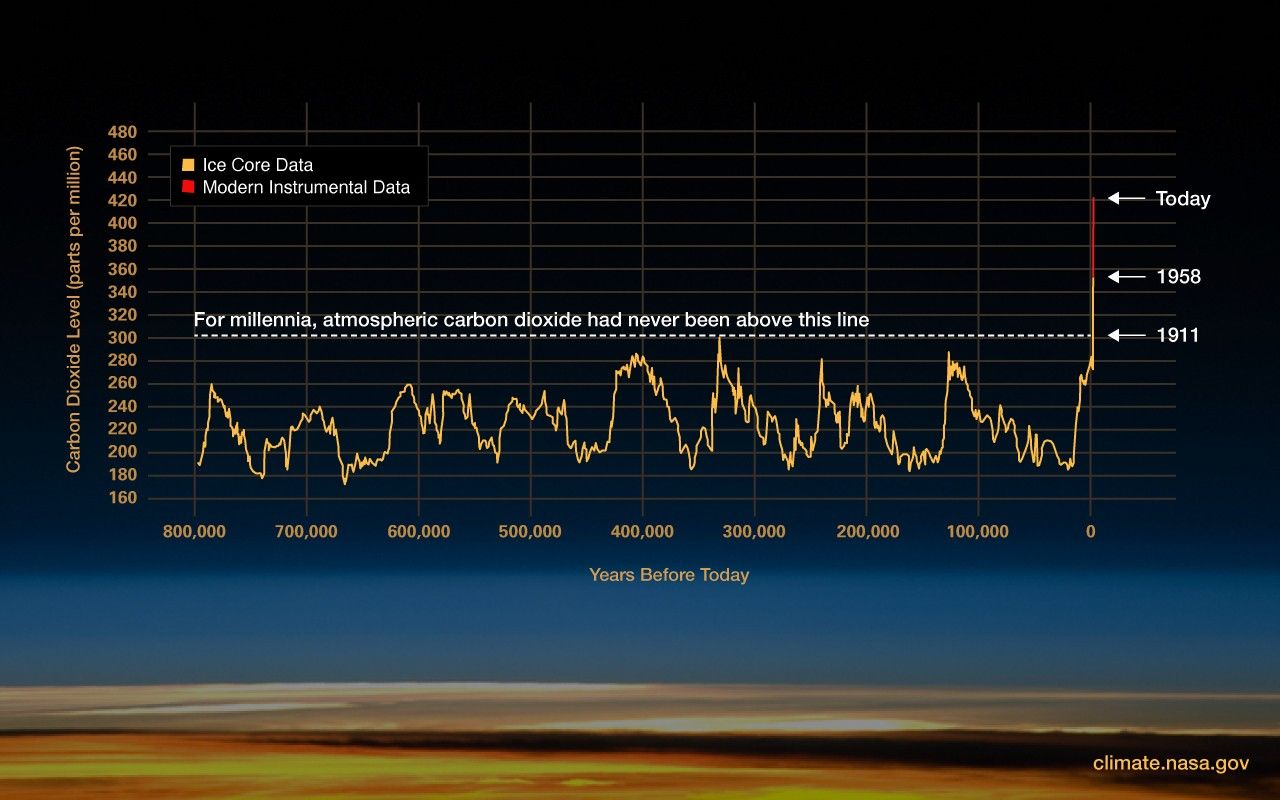
We, the people of 2022 are experiencing already the irreversible effects of global warming, global pollution and loss of biodiversity that herald the degradation of our life support system. Presented in the form of data, the statistics are frightening.[1] Carbon dioxide measured at NOAA’s Mauna Loa Atmospheric Baseline Observatory peaked for 2022 at 421 parts per million in May, now 50% higher than before the Industrial Revolution.[2]

IPCC Report “Code Reds for the Planet”

     Most people notice incremental changes in the weather, and in trends in warming compared to recent past experience, but the gradual change does not cause a sense of danger for most people. The reality of the climate situation calls for an urgent transformative response, a Policy U-Turn. But the reality of the political situation portends the reverse of what is needed – a resurgence of regulation in favor of the fossil extractive industries. The oil, coal and gas magnates press for new investments based on hydrogen from fracked fossil methane and a further push for single use plastics to bolster the industrial petrochemical complex.[3] These are false solutions perpetrated by short–term economic interests which, if pursued, will assure the even more rapid destruction of this living earth.

     I want to scream in frustration at the misinformation and greed that perpetuates these disasters. I want to lash out in anger that so many in power refuse to see the needs of the people for now and for the future. I weep for what has been lost already, and for what will yet be exterminated from the face of the earth. Yet, out of this frustration, anger and grief comes a passion to intervene, to give voice to the solutions that are in hand, to organize for political action. This election. This summer. Now. Before it is too late.

     No elected official would ever deliberately send hundreds of people into homelessness, but they decide that preventing wildfires is too expensive. No elected official would deliberately poison people, but every day decisions are made to allow uncontrolled pollution to continue in neighborhoods of marginalized people. We let injustice continue like a creeping blight – 

  • Air pollution spreads asthma to one in five adults and one in four children in Clairton PA;
  • Chemical contamination spreads endocrine disruptors throughout the population until 93% of Americans have detectable levels of Bis-Phenyl A in their blood and a body burden of hundreds of synthetic chemicals in our bodies, even in newborn infants; 
  • Obesity afflicts 33% of Americans who live in food desserts; 
  • Water supplies in most major cities are contaminated with lead and other infrastructure failures. 

The government has become powerless to change the laws to protect people now, and even less to protect people and other living things for the future. 

     If we were to govern FOR THE PEOPLE, the opinion of the majority of Americans clamors for urgent action on climate. “63% of Americans favor broad government action on climate. At a time when partisanship colors most views of policy, broad majorities of the public – including more than half of Republicans and overwhelming shares of Democrats – say they would favor a range of initiatives to reduce the impacts of climate change, including large-scale tree planting efforts, tax credits for businesses that capture carbon emissions and tougher fuel efficiency standards for vehicles, according to a new Pew Research Center survey.”[4] Even in the face of national opinion polls indicating that a majority of Americans believe that addressing climate change is important, Congress remains deadlocked. Inert. Ineffective. A few Senators, Manchin and Collins and McConnell, successfully block action on climate policy to protect fossil industry interests.  Now the Supreme Court is eroding the authority of the Environmental Protection Agency to rule on carbon emissions.[5]

      Local governments end up on the front line for dealing with the effects of climate change and protecting people where they live. Efforts at the local level can move forward a bit with climate action plans, however, for the sweeping structural changes from fossil fuels to renewable energy systems, there need to be changes in the underlying laws. This will not happen unless there can be a veto-proof majority of Senators willing to stand up for the future of our planet, for our children, and for the emerging industries of the clean economy: renewable energy systems; regenerative agriculture and permaculture; and circular materials management for consumer goods.

     Many local and regional communities have put forward a vision for a better future critically needed to ameliorate the inevitable disaster that will occur if we continue on the current path. The ReImagine Appalachia Blueprint, the Marshall Plan for Middle America, internationally The Natural Step Framework, the German Energiewende and many others lay out a sustainable future. We know what the solutions are. We know they work. We need to amass the political will to make it happen. The laws of Nature are not negotiable: if we continue to add to the greenhouse gas burden in the atmosphere, we will experience global warming, ocean acidification and the consequences of ecosystem failure. Indeed, we are already seeing these effects beginning to accumulate.

     We suffer from a failure to communicate effectively not only the urgency of the situation but the availability of the solutions.  We cannot spare our children from the effects of climate change already in motion, but we can still shift to adaptations that can slow the progression and lead to a less disastrous fate.

Earth Day 1970

     What will it take to change the direction of the country?  Earth Day 1970 brought 10 million Americans into the streets, the halls of Congress, the union halls, the city chambers to demand clean air, safe drinking water and protection from toxic chemicals.  The Climate Convergence has mobilized fewer than five million, and the effort is scattered, fractured and fraught with infighting. Scientists leap to challenge, critique and shred each other, as good scientists do in the rigor of academic pursuit. But that very rigor of the scientific process is turned against the message in the public eye. The message of science is discredited successfully by pseudo experts and mouthpieces for the industry who cast doubt on climate findings and disparage the solutions by exaggerating minor flaws and disagreements.

Climate Denial = “Patriotic”

     We are indeed in a battle for survival as a species, as a civilization of Humanity. It is time to pull together and lift our eyes to what it is possible still to preserve for our children. It is time to see the vision of a finer future with a shared prosperity, equity and dignity for all people, a style of living that is sufficient but not profligate, where we can celebrate the richness of talent and spirit rather than race to consume and throw away more and more stuff we do not need.

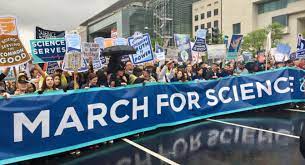
March for Science- Pittsburgh 2017

     Every election this November of 2022 presents a choice for decision makers and policy makers who will determine the fate of our country and our world.  It is time for all of us in the science world, in the sustainability movement, in the arena of believers in the best that people can be to stand up and be counted.  We need to make our voices heard and our demands recognized.  Put climate on the agenda in the public debates.  Build momentum to demand action on behalf of our children.  Those who cannot vote yet are excellent ambassadors for climate change.  We must stand for our youth and demand accountability from those in power or who wish to sit in seats of power.

     And scientists- real ones – need to run for office and win.


[1] : (https://www.ipcc.ch/assessment-report/ar6/ )

[2] https://www.noaa.gov/news-release/carbon-dioxide-now-more-than-50-higher-than-pre-industrial-levels

[3]  “Our Region’s Energy Future” Allegheny Conference Energy Task Force Report April 2022. https://www.alleghenyconference.org/energy-report/

[4]   ALEC TYSON AND BRIAN KENNEDY. Two-Thirds of Americans Think Government Should Do More on Climate. Pew Research Center. June 23, 2020. 

[5] West Virginia vs EPA before the Supreme Court https://www.law.cornell.edu/supct/cert/20-1530


Leave a comment

Hold AMAZON Accountable

Published in the Pittsburgh Post-Gazette, “Other Opinions” on Sunday, July 25, 2021

by Patricia M. DeMarco, Ph.D.

In September 2019, AMAZON made a public commitment to become carbon neutral in all of its operations worldwide by 2040 and launched a $2 billion fund to implement it.[i]

As The Borough of Churchill and other communities around Pittsburgh see advances of AMAZON interest in locating distribution centers in the area, those making the decisions and responsible for granting the building permits must stand to hold them accountable to their rhetoric.

Taking the former Westinghouse Research Park in Churchill as an example, there are three things that can be done on this site to ameliorate the climate impact of this proposed new facility.  Many of my constituents and neighbors have expressed concerns about diesel pollution and emissions from the operation of this facility and outrage over the destruction of hundreds of mature trees on the site.  Air quality, stormwater run-off, and destruction of carbon reducing trees are serious issues. Remedies to mitigate these issues are readily available and should be required in the permitting process.

First: This new construction should be based on a passive solar design with geothermal earth tube and heat pump systems for heating and cooling.  The electric load of the facility should be met by installing a photovoltaic solar array on the roof. This will reduce emissions both from burning a fossil fuel on site for heating and from the regional power supply to produce electricity to serve the facility. A well-designed new building can be cost effective to build, cheaper to operate, and have a net zero energy profile.[ii]

Second, AMAZON has touted its electric fleet as one of its innovations for climate action.[iii]  This new facility should be required to use electric vehicles, with charging stations at the facility to prevent the diesel emissions that will otherwise certainly inundate the area with particulate and organic compounds in the air.

Third, the site should be required to install bioswales and permeable paving in the parking areas and along the roadways.  Stormwater runoff from this site is already an issue for neighboring areas, and the removal of the large trees to accommodate this facility will only worsen this effect.  Sloping the parking areas toward bioswales and designing the area around the building to capture runoff will help to mitigate stormwater effects.

Finally, the removal of mature trees should be kept to an absolute minimum with careful siting of the facility on the land.  Preserving the remnants of an Indigenous People trail and maintaining trees as visual and noise screening from the surrounding residential areas should be a priority for the site design. The Borough of Churchill has the opportunity to hold AMAZON accountable to its own rhetoric.  This new facility can become a model for innovation and adaptation to the reality of our climate crisis, not a capitulation to the lure of “jobs” at any co


[i] AMAZON Climate Pledge and Climate Pledge Fund. https://sustainability.aboutamazon.com/about/the-climate-pledge  https://sustainability.aboutamazon.com/about/the-climate-pledge/the-climate-pledge-fund

[ii] The Forest Hills Borough municipal building completed in 2018 has generated more energy than it uses for a net zero operating profile.

[iii] “AMAZON’s custom electric vehicles are starting to hit the road.” https://www.aboutamazon.com/news/transportation/amazons-custom-electric-delivery-vehicles-are-starting-to-hit-the-road

Patricia M. DeMarco, Ph.D. is the author of Pathways to Our Sustainable Future- A Global Perspective from Pittsburgh. University of Pittsburgh Press. 2017. She is a Senior Scholar at Chatham University and writes a blog “Pathways to a Just Transition” at https://patriciademarco.com  She is Vice President of the Forest Hills Borough Council and Chair of CONNECT – The Congress of Neighboring Communities surrounding Pittsburgh.


Leave a comment

Green New Deal – Pittsburgh Discussion Group

Pittsburgh Green New Deal (PGND)is committed to building a mass movement – locally, nationally and globally – to secure implementation a Green New Deal.  This must involve ending and reversing the damage to our environment, while at the same time ensuring union scale jobs with a special focus on Black and Brown people and displaced fossil fuel industry workers, racial justice, health care, housing, mass transit systems, education, and cultural opportunities – in short mutual respect and quality of life for all people. We will work with organizations and individuals who share this commitment. We envision these areas of activity:

(1) educational activity (starting with the summer reading group, then reaching out with broader popular education efforts in community groups, churches, unions, etc.), spreading knowledge and consciousness to advance the Green New Deal;

(2) immediate environmental activity — tree planting and other practical work that can immediately benefit the environment;

(3) building a local coalition, linking up with national forces, to mobilize vigorous on-the-ground campaigns on behalf of the Green New Deal, most immediately seeking to build popular support and momentum for the THRIVE Act.

The structure of PGND is very simple.  It is open to those in agreement with this statement of purpose.  It operates on the democratic principle of one-person-one-vote, with regular membership meetings being the highest decision-making body of our organization, to which all committees or sub-committees established by the organization shall be answerable.

Adopted May 25, 2021

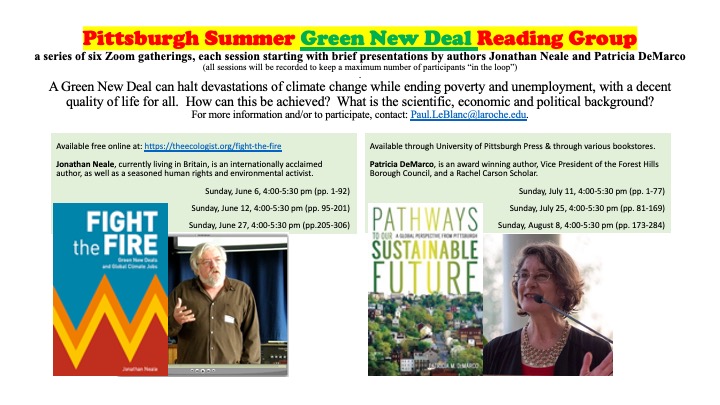
Summer Reading Group: There were three discussions with author Jonathan Neale based on his book “Fight the Fire: Green New Deals and Global Climate Jobs.” available here  https://theecologist.org/fight-the-fire. Recordings of the completed sessions are below:

1st Session, June 6 — Parts I and II (pages 7-92)https://us02web.zoom.us/rec/share/5UzaJdf35fChj683F-Dt447WacpXk09V_wSK6AvEqcC6zGT1yQcdRAPwyBb7DtAz.v1PVDvnsMPrGHREc
Access Passcode: Y2gixt%p

2nd Session, June 13 — Parts III and IV (pages 9-201)https://us02web.zoom.us/rec/share/n0ti0ILEWSr4j819w4V9qARopCebNCQJFQPyY2UtWgJUIY17HbIB1HqxzT2q1W9X.H75FKfG2tCmyfbWi
Access Passcode: RZ!B9fs?

In the month of July and August, The Green New Deal- Pittsburgh group will be discussing Pathways to Our Sustainable Future as a way to evaluate actions in the Green New Deal for implementation. We are looking at both the substantive changes necessary and the social and institutional infrastructure for driving change.

order here: Pathways to Our Sustainable Future: A Global Perspective from Pittsburgh. with author Patricia M. DeMarco available from University of Pittsburgh Press or order here https://patriciademarco.com
https://upittpress.org/books/?s=Pathways+to+Our+Sustainable+Future&submit=

Sunday July 11, 2021 at 4:00 to 5:30 PM Part I Connecting to the Living Earth – This discussion centers on the moral and ethical dimensions of transforming the economic and political systems to address climate change and social justice.

See the recorded session I here: https://us02web.zoom.us/rec/share/RZ0MsittrNb8UssGTLoZjGUmYhsMgVEBTukerLRPAqd31jBP0xUSNspwxY5iLSZM.8NQyiqRJYba1F4I1?startTime=1626305570000 

Sunday, July 25, 2021 at 4:00 to 5:30 PM Part II Choosing Sustainable Pathways – This discussion covers transformation of major systems: energy, agriculture and materials management. There are contrasting approaches to those taken in Fight the Fire, and there are specific ties to pending legislative initiatives in the U.S. Congress.

See the recorded Session II here https://us02web.zoom.us/rec/share/AbR_3TWBzg9E3QT04j4KZmFkQddjLeBpGqe1JaiP3a1H5RnlklhGsUpZKgnnyUSA.FcgFw9G7FlavmT-C?startTime=1627243338000

Sunday, August 8, 2021 at 4:00 to 5:30 PM. Part III Empowering Change – This discussion will evaluate the role of leadership in driving change; what are the critical components for success? What are the pitfalls and impediments? Discussion based on evaluating the effectiveness of activists in driving change.

Listen to the recorded session here https://us02web.zoom.us/rec/share/voC6aV9VJlZPN8Vg-sJwf-CulwvAhbM9RbzarzU2L-zviYAf22d-6BlwGLAo8mX0.kpyzApZE5qzbQQls?startTime=1628453275000

To Participate in this discussion series, CONTACT: Paul LeBlanc <Paul.LeBlanc@laroche.edu>

Join the discussion for our consideration of Mike Stout’s book “Homestead Steel Mill: The Final Ten Years- USWA Local 1397 and the fight for union democracy”


Leave a comment

Under All Is the Land- ReImagine Appalachia

Reinvesting in communities depleted by the extractive industries of the Industrial Revolution can reclaim the wealth of the land, re-employ the skilled workers and restore the shared prosperity of a region rich in culture and pride. For a discussion with local PA government officials about the potential for Pennsylvania, listen to this recorded presentation from July 29, 2021: https://us06web.zoom.us/rec/play/tfhtXET5ODZV2I-18Su9DOTIMcLJYseUxZKZD5bF-dMWAyBTlb0g27QrvrfsZ-QzONOyGCl1WFCtFFor._FTj918qXNBbFqcA?continueMode=true&_x_zm_rtaid=hmM8DECLS6-cP4zdnGNA9Q.1628167329661.a6e4b594f957020e1b17fc5238b0acc0&_x_zm_rhtaid=357

Re-invest in the communities of Appalachia -restore the land, heal the people

Earth Day 2021

In this second decade of the 21st century, we see the beginning of the transformation of our society and our economy away from the extractive fossil fuel base that is driving the climate emergency toward a more resilient, equitable and sustainable, shared prosperity based on renewable resources. The Spring comes as a welcome burst of hope after a long winter of COVID isolation, illness and fear. The living earth emerges once again with flowering trees, verdant woodlands and grasslands, and the manifestations of the cycles of life. These assurances of the resilience and certainty of the natural world offer hope, but also a caution. The laws of Nature are not negotiable. Preserving our life support system of oxygen-rich air, fresh water, fertile ground and the biodiversity of species depends on shifting from extractive fossil fuel industries to regenerative systems for energy, food and materials.

We must focus on the needs of society and the work needed to sustain it rather than on replacing fuels. Technologies from the 1800s – the Rankine steam cycle for electricity generation and the internal combustion engine for transportation – need to be updated with modern, cleaner and more efficient technologies appropriate to the needs of the 21st century.[1]

We have heard President Biden call for an Infrastructure and Jobs Plan which strongly mirrors the ReImagine Appalachia Blueprint for a new economy that works for all of us.[2] Similar to the THRIVE Agenda of Southeastern PA and neighboring states and the Mayors Marshall Plan for Middle America, the ReImagine Appalachia Blueprint has a focus on good-paying union jobs and offers tangible and realistic steps to reach a sustainable future for our state and region.

The ReImagine Appalachia Blueprint expands opportunity through public investments in local communities; builds a 21stcentury sustainable economy; and rebuilds the middle class.[3]

  • First the plan maximizes good union jobs and provides fossil industry workers with genuine opportunities for doing this work. It ensures access to union jobs for Black, Indigenous, female and low-wage workers. And it ensures community benefits from federal investments through public input and oversight.  
  • Second, the plan restores our damaged lands and waters, modernizes the electric grid, grows manufacturing by making it more efficient and cleaner, builds a sustainable transportation system and revives the Civilian Conservation Corps.  
  • Third the Blueprint promotes union rights, better pay, benefits and local ownership models for working people across all industries in the region.

The jobs impact of this Blueprint is significant for Pennsylvania. A federal investment package with annual average allocations of $11.3 billion to Pennsylvania, from 2021 to 2030, along with an additional $19.7 billion in private investments, would generate approximately 243,000 jobs in Pennsylvania— enough to bring Pennsylvania’s high unemployment rate back down towards 4 percent.[4]   

  1. Repair the damage done over the last century– $1.2 Billion federal investment and 9,283 jobs per year from plugging orphaned oil and gas wells, repairing leaks in gas distribution pipelines, and repairing dams and levees.
  2. Modernize the electric grid with a $3.2 Billion federal investment, leveraging $18 Billion in private investment to create 142,999 jobs per year through electric grid updates; building retrofits; solar installations; onshore and offshore wind generation; low-emissions bioenergy (anaerobic digestion); geothermal HVAC systems; and broadband expansion. 
  3. Expand Manufacturing by making it more Energy Efficient and Clean– requires 1.28 Billion in federal investment, leveraging $1.08 Billion in private investment and will create 18,016 jobs per year through industrial efficiency upgrades, including combined heat and power; manufacturing research and development; and bioplastics research and development
  4. Build a more sustainable transportation system with a federal investment of $928 million leveraged with $522 million in private investment will create 16,182 jobs per year through public transportation expansion and upgrades including rail; and expanding a high efficiency automobile fleet.
  5. Absorb carbon and Re-launch the Civilian Conservation Corps with a federal investment of $4.7 billion to create 56,700 jobs per year through regenerative agriculture; farmland preservation; land restoration, especially for abandoned mined lands; and restoration of watersheds, waterways and wastewater systems.

The ReImagine Appalachia initiative aims to consolidate our regional Congressional delegation to argue for federal resources directed toward our region because we have built the wealth of the industrial age through industries now in decline, and we need to move to a clean and efficient future. The jobs program presented here relies on the skills and capability of our union workers in electrical system upgrades and new generation integration into a smart micro-grid system. We see good union carpenters, pipefitters, boilermakers and steamfitters employed in anaerobic digestion and fuel cell operations as well as in constructing solar powered buildings that make more energy than they use.  The possibilities are real, and only beginning.  

No technological breakthroughs are necessary for this new economy to operate building a prosperity that can last without the boom/bust cycles of depleting extractive industries. We can muster the political will to make the necessary changes in policy and practice to support a new economy for the 21st century. Pennsylvania can assume a leadership role in building the new economy in three primary ways:

  1. Adjust the regulatory infrastructure to enable rather than inhibit expansion of renewable energy systems and practices.  Adopting practices such as uniform building standards for solar and wind installations, enabling a utility tariff system for virtual net metering and community shared power, joining the Regional Greenhouse Gas Initiative, and adopting a universal passive solar design building code for all new commercial and residential buildings are part of this process. Conduct a comprehensive review of regulations to enable sustainable practices and empower workers.
  2.  Shift Pennsylvania state subsidies toward private investment in the newer clean technologies addressed in the jobs scenarios above. Pennsylvania provided $3.8 billion in fossil fuel subsidies in Fiscal Year 2019 by systematically disabling many of its standard tools for collecting tax revenues, allowing the industry to extract public resources at little to no charge, and awarding the industry grants and tax credits. Meanwhile, in the same time period, the industry imposed $11.1 billion worth of external costs to the state and its residents.[5] Pennsylvania can use these subsidies to entice private investment into the green jobs arena instead.
  3. Empower local communities to attract investment in innovation.  Establishing enterprise zones around re-purposed industrial or marginal commercial spaces before the tax base erodes to the point of bankruptcy will enable communities to offer resources for reinvigorating their economy before they fall into despair. Provide support for planning together around regional efforts to coordinate resource allocation and opportunities.

I would like to speak to the role of the gas industries in the sustainable future.  The gas industries, especially in the Marcellus Shale region and the sectors pressing for plastics production, pose mighty and well-funded opposition to any perceived competition from renewable resources. Preserving the historic business model of extraction, combustion, or using fossil-based raw materials for single use commodities is not compatible with a sustainable future. The expertise and infrastructure of the gas industry is uniquely suited to developing methane from anaerobic digestion of municipal waste and sewage. Methane produced from these sources, as well as from manure pools of farm animals, stays in the contemporary carbon cycle and does not draw from carbonized remains of living plants that created the 20% oxygen in our atmosphere millions of years ago. Using anaerobic digestion creates methane biogas that can be sent into the existing gas distribution system for home heating.  This would shift home heating from a fossil base to a sustainable base.  In addition, biogas can be used to create hydrogen for fuel cells to generate electricity through a chemical reaction similar to a battery, without combustion.  This technology is mature and operating efficiently in Germany, Japan, Korea and France based on American technology developed through space exploration research and commercialized in the 1990s.(6) The gas industry would rightly enjoy a leadership position in building a truly sustainable economy by making this kind of a shift in focus. 

The true wealth of Pennsylvania lies in the land that supports us.  Not the fossil resources buried deep within the crust of the Earth, but the living earth, the fertile ground that gives life to our planet through binding essential elements to create food, fiber, fuel, and oxygen. When we restore the land and empower the people, we set the foundation for a long-lasting prosperity for all of our citizens.

Citations and Resources:


[1] Patricia M. DeMarco. Pathways to Our Sustainable Future- A Global Perspective from Pittsburgh. University of Pittsburgh Press. 2017.

[2]President Joseph Biden. Remarks on the American Jobs Plan. March 31, 2021.  https://www.whitehouse.gov/briefing-room/speeches-remarks/2021/03/31/remarks-by-president-biden-on-the-american-jobs-plan/

[3] ReImagine Appalachia Blueprint. https://reimagineappalachia.org/wp-content/uploads/2021/03/ReImagineAppalachia_Blueprint_042021.pdf

[4]  Robert Pollin, Jeanette Wicks-Lim, Shouvik Chakraborty, and Gregor Semieniuk. Impacts of the ReImagine Appalachia and Clean Energy Transition Programs for Pennsylvania. Political Economy Research Institute, University of Massachusetts, Amherst. January 2021.   https://reimagineappalachia.org/wp-content/uploads/2021/01/Pollin-et-al-PA-Final-Report-1-22-21.pdf

[5] Penn Future Subsidies and Externalities Report https://www.pennfuture.org/Files/Admin/PF_FossilFuel_Report_final_2.12.21.pdf

6. Fuel Cell Energy, Inc. Danbury, CT https://www.fuelcellenergy.com/about-us-basic/manufacturing/