Patricia DeMarco Ph.D.

"Live in harmony with nature."


EPA Reconsideration of 2009 Endangerment Finding and Vehicle Efficiency Standards

The EPA is currently holding public hearings on its proposed reconsideration of the 2009 Endangerment Finding and Vehicle Efficiency Standards that authorized action to curtail greenhouse gases that cause climate change.
Eliminating this regulatory authority will nullify climate change actions to control emissions from power plants, vehicles and industrial operations. EPA is accepting comments until Sept 22,2025. Please consider filing a statement.

Reconsideration of 2009 Endangerment Finding and Greenhouse Gas Vehicle Standards
AGENCY: Environmental Protection Agency (EPA).
Docket ID No. EPA–HQ–OAR–2025–0194
https://www.regulations.gov/docket/EPA-HQ-OAR-2025-0194

My testimony is here:


A Moral Outrage: It may be legal, but it is not right!

Patricia M. DeMarco

     I sit in my sunroom at dawn this midsummer day listening to the insistent trill of the Carolina wren in the rose of Sharon bush just outside my door. The sight of Pasha Pussycat, safely behind the screen, is sending the apprehensive mother bird into a frenzy in fear of a threat to her nest in the niche above the doorway. It is natural for a creature to shriek at a threat in alarm and warning.As I attended  Reclamation! the 2025 Black Appalachian Coalition Storytelling and Policy Summit July 17 to 20, 2025, I heard many people share their experiences and their fears for the impact of the cuts to so many services. I wonder why we all are not shrieking in alarm and warning at the “One Big Beautiful Budget Act” that was signed into law on July 4th this year.

The major cuts to health care and food support will cast millions of Americans into poverty and even death. The major beneficiaries of this OBBBA are corporations whose taxes fall from 35% to 21%, and individuals with net income over $400,000 per year. The budget is the best representation of policy. This budget codifies a shift in values away from standards that long defined America. Here, greed and privilege displace equal opportunity and shared prosperity.

We must restore trust in each other and rebuild confidence in the representative democracy system of governance:

We must restore the sense of dignity and respect for people regardless of their income level, race, gender, religion, or even political affiliation.

We must recognize our responsibility to engage as active citizens.

We must commit to preserving a future for our children, and care for today’s children.

We must face the reality of climate change.  The laws of Nature are not negotiable. 

We must raise our voices in protest. Every Congressional Representative is up for election in 2026. The time to weigh in with them is NOW! 

We the People must take back the narrative of what this country is about. We do not judge our greatness by the number and fame of the billionaires but by how well the children, the elderly, the infirm and the poorest among us are doing. We can build a finer future that is people centered, not profit centered, and recognize that we live in a state of abundance. Shared prosperity will emerge when we shift our values to place priority on people above profits and planet health over the next quarter bottom line. This OBBBA makes a mockery of the message of the Statue of Liberty that has welcomed so many millions to our shores. Our diversity is our strength. We the People must raise our voices in moral outrage at what has become legal but is not right. 

See the full article below. I welcome your thoughts.

Patty


55th Celebration of Earth Day

My Dear Colleagues and Friends.
The passion for preserving our life support system – the living earth – runs as an elixir of inspiration through our work as teachers, guides and models of living in harmony with Nature. Regardless of any pronouncements or Executive Orders, the laws of Nature are not negotiable.

Earth Day has marked annual community clean-up days, opening farmer’s markets, flower displays and recycling events. But really in this year where the EPA Administrator gleefully proposed rolling back 31 environmental protection regulations that were intended to curtail toxic air emissions like mercury and proliferation of forever chemical materials like PFOS, we need more than one-time reminders and displays. We need to take the issue of actively protecting our life support system seriously. That means addressing climate change with leadership and courage. That means curtailing pollution from man-made materials, especially plastics. And that means looking at our own lifestyle for ways to live with less burden on the earth.

On this Earth Day I share with you Rachel Carson’s words:
“…man, far from being the overlord of all creation, is himself part of nature, subject to the same cosmic forces that control all other life. Man’s future welfare and probably even his survival depend upon his learning to live in harmony, rather than in combat, with these forces.” {From Rachel Carson’s essay on Biological Sciences for the National Council of Teachers. In Lost Woods- the Discovered Writing of Rachel Carson. Linda J. Lear (Ed.)Beacon Press. Boston. 1998.Page 165.}


As we celebrate this 55th Earth Day, may we remember that the greatness of a nation is not determined by the number and fame of its billionaires but by the well-being and shared prosperity of its children, the elderly, the infirm and the poorest among us. We cannot have healthy people in a polluted environment. We must offer leadership and give voice to the 73% of Americans, of both parties, who want more direct action on climate change. We who know cannot remain silent in defense of the Living Earth that provides fresh water, oxygen-rich air, fertile ground and the millions of species that constitute the great web of life, of which we humans are but one part.

On this Earth Day re-dedicate yourself to stand as a strong advocate for preserving our living earth…every day! Call you Senators and Congressional Representative today and remind them that our quality of life, indeed our survival, depend on preserving and restoring a healthy environment.

One tulip spared by the rabbits and deer!

Here is the link to my presentation for Earth Day at the Duquesne University Law School

and my interview with Dr. Dana Noescue.
4-22-2025Duquesne_Law-Earth_Day.pptx
 (11054 kB)
Healing the Land and Empowering the People: A Message for Earth Day

DKLL LEGAL TALK SERIES Patricia Demarco-Event.pdf  (255 kB)
Event Sponsored by DKLL and the 2025 Students of Climate Change Law, Research, and Writing

The interview with Dr. Dana Neascu can be found here.

https://dsc.duq.edu/law-dcli-speakers/10/


4 Comments

Empowering the Sustainable Energy System of the 21st Century

It is time for a new National Energy Policy to support a clean, modern energy system. The energy sector is the largest contributor to emissions of greenhouse gases that are causing climate change.[i] Consumers see rising prices for electricity and hear industry complaints about onerous regulations and government curtailment.[ii] Utility companies struggle to address reliability of service requirements and universal service standards even as data centers and AI applications add intense demands for electricity.[iii] Much of the focus on climate action involves shifting to electricity for buildings, transportation and even industry. If the country is to meet climate goals, the shift from burning coal, natural gas and petroleum for power generation must occur much more rapidly.[iv]

Transforming the nation’s energy system to one based on renewable and sustainable resources is a critical element in responding to climate change mitigation and adaptation. Unfortunately, practitioners in the renewable energy systems space currently encounter significant regulatory and institutional barriers to rapid and efficient implementation of new technologies and practices.[v]  National energy policy is needed, including an update to the energy industry’s regulatory framework, to advance the modernization of our country’s electricity delivery system.  

The current regulatory framework is built around centralized energy generation from utility monopolies that deliver electricity to customers residing across a wide geographical territory. Under the National Energy Act of 1992, partial deregulation of the nation’s electricity system took place, leaving a patchwork quilt of conditions in place across the country: 17 states are fully competitive with customer choice for electricity generation and gas supplies; 9 are deregulated for gas suppliers only; and 23 remain fully regulated for electricity and gas.

Data Source: US EPA    https://www.epa.gov/greenpower/understanding-electricity-market-frameworks-policies

Modernizing the nation’s electrical grid system means moving away from this current model of centralized energy generation towards generating energy on site or nearer to the consumer. In this emerging, more distributed energy system, customers may also be generators of the power they consume, they may have on-site storage for all or part of their demand, and buildings can even become virtual power plants by generating excess electricity that can be shared with others in need of that energy. This empirically straightforward approach that is technically feasible, economically beneficial and widely available unfortunately faces enormous difficulties when put into practice.  For example, in a Pittsburgh community three municipal buildings adjacent to each other – the volunteer fire department, public works garage and storage shed and emergency management service – cannot share a common battery storage installation or share the solar photovoltaic electricity generated on three of the four roofs because a “public way” divides the space, and the buildings are wired to three different distribution grids, but not to each other.  The cost to re-wire was more than the cost of installing all of the solar arrays! There is no standard interconnection protocol, and no tariff that fairly allocates costs and benefits. Grid-interactive Efficient Buildings are technically feasible.[i],[ii] We need to clear the regulatory hurdles to expand deployment to make buildings perform as virtual power plants.

Manufacturers and large-scale energy users explore the increasing benefits of co-generation, combined heat and power operations, and on-site storage. New high energy intensity operations like data centers and AI operations could benefit from co-locating efficient power generation on site and piping excess heat to neighboring facilities in need of that heat.[iii] A new regulatory system that accommodates customer generation can accelerate the necessary large- scale advance of renewable energy systems. However, there are few models for regulatory interface among producers and users of steam plus electricity, or waste heat and power.  Such arrangements usually involve complicated business negotiations and are unique to each project.  If distributed energy systems are to become mainstream and accessible to a multitude of energy system configurations, a regulatory system that defines the relationships and possibly new utility services and functions can expedite and streamline such transactions.

Major existing regulatory and institutional barriers

The regulatory system has accumulated policies and practices over decades, proving resistant to change even as technology advances have accelerated.[iv] The most significant regulatory and institutional barriers to modernization include:

  • Policy fragmentation across jurisdictions. Federal, state, and local jurisdictions have differing and sometimes conflicting requirements making national markets difficult to pursue. To correct policy fragmentation, we need more standardization of methods and processes in a systems-oriented approach to regulatory infrastructure modernization.
  • Permitting complexity. Multiple agencies require differing and overlapping permit requirements, poorly sequenced with no clear path among multiple authorities. Grid integration challenges face transmission and distribution capacity constraints, as well as interconnection and Regional Transmission Organization  [AW1] market rules, that pose barriers to renewable energy implementation, in modern utility operations, and impede net-zero greenhouse gas emissions outcomes.
  • Grid integration challenges. Utility systems have capacity constraints as well as a lack of interconnection infrastructure to support “two-way traffic” among customer/generators with or without on-site storage.
  • Lack of uniformly recognized guidelines for RECs. There is no standard framework for defining Renewable Energy Certification (REC) credits that track and verify demand reduction or customer renewable energy generation across jurisdictions. Different states, and sometimes different utilities within states, have differing definitions, pricing and verification methods applied to RECs.
  • Erratic and unstable incentives. Production tax credits, investment tax credits, subsidies, land use allocations for federal land are subject to change with budget cycles unless established in law. The unstable incentives send the wrong pricing signals to the economy and foster inefficient choices for decades, impeding the progress to market transformation and decarbonization.

The current electricity system was designed for one-way flow of electricity from central power generation stations to distant residential, commercial and industrial customers.  Now, several categories of customers also have the opportunity to generate electricity, and send it back into the electric grid.  The electricity system, and the rules that govern it , are not designed for this two-way travel of electrons. In addition, standard interconnection procedures are needed for 1) virtual community power plants with or without storage; 2) standards regarding energy storage, steam/heat distribution or sale from combined heat and power operations, whether by a utility or a non-regulated entity; and 3) demand side management tied to time of use cost savings.[v] The integration of such services into the electric grid would benefit from innovations in communication technology and AI for real-time synchronization of both supply and demand side resources over daily and seasonal cycles.[vi] Many states have explored various approaches to regulatory incentives for renewable energy which provides a good place to begin to assemble the best practices across the country.[vii]

Opportunity for legislative action on national energy policy:

Three federal legislative initiatives will be pending over the next two years and could be legislative vehicles for the adoption of a national energy policy: 

  • Reauthorization of Tax Reform Act of 2017
  • Regulatory Modernization and Permitting (especially shortening timelines)
  • Funding decarbonization and electrification initiatives from the Inflation Reduction Act
  • Budget authorization for programs under the Bipartisan Infrastructure and Jobs act and the Inflation Reduction Act.

Updating a National Energy Policy to address the urgency of climate action as well as the complexity imposed by the accumulated regulatory fabric of past decades offers a unique opportunity to a new Administration.  It is important for the next President to address a forward-looking energy policy that empowers and accelerates the critically necessary modernization of the energy system.  Every citizen is affected every day by how cost-efficient, safe and reliable the energy system serves daily needs. Resolving the regulatory quagmire will pave the way for a clean and sustainable energy future.


[i] National Association of Regulated Utility Commissioners and National Association of State Energy Officials https://www.naseo.org/issues/buildings/naseo-naruc-geb-working-group

[ii] National GEB Roadmap: U.S. DOE, A National Roadmap for Grid-interactive Efficient Buildings (May 2021)

[iii] U.S. DOE. Office of Energy Efficiency and Renewable Energy.  Connected Communities presentation December 2, 2021.https://www.naseo.org/data/sites/1/documents/tk-news/connected-communities-for-geb-working-group.pdf    

[iv] Seetharaman, Krishna Moorthy, Nitin Patwa, Saravanan, and  Yash Gupta. Breaking barriers in deployment of renewable energy. Heliyon 5 (2019) e01166. doi: 10.1016/j.heliyon.2019. e01166 

[v] G. Olabi, Khaled Alsaid, Khaled Obaideen, Mohammad Ali Abdelkareem, Hegazy Rezek, Tabbi Wilberforce, Hussein M. Maghrabi, Enas Taha Sayed. Renewable Energy Systems: Comparisons, challenges and barriers, sustainability indicators, and the contribution to UN sustainable development goals. International Journal of Thermofluids. 20(2023) 100498.  www.sciencedirect.com/journal/international-journal-of-thermofluids

[vi] NASEO, “Demand Flexibility and Grid-interactive Efficient Buildings 101” (September 2022) and “Grid-interactive Efficient Buildings: State Briefing Paper” (October 2019)

[vii] Database of State Incentives for Renewables and Efficiency. https://www.dsireusa.org


 [AW1]Spell out acronyms


[i] United States Environmental Protection Agency. Sources of Greenhouse Gas Emissions. Total U. S. Greenhouse Gas Emissions by Sector in 2022. https://www.epa.gov/ghgemissions/sources-greenhouse-gas-emissions%20Accessed%20September%2022    Accessed September 21,2024.

[ii] Robert Walton. “State Officials Blame Federal Regulators for Higher Energy Prices: ‘Consumers are getting hurt!’” Utility Dive. February 15, 2024. https://www.utilitydive.com/news/state-officials-blame-federal-policy-higher-energy-prices-EPA/707608/   Accessed September 20, 2024.

[iii] North American Electric Reliability Corporation (NERC), Electricity Supply and Demand Data, 2023; Energy Information Administration (EIA) Monthly Energy Review; National Renewable Energy Laboratory (NREL) Pathways to 100% Clean Electricity, 2022. Note that electricity demand includes transmission losses and direct use.  https://www.energy.gov/policy/articles/clean-energy-resources-meet-data-center-electricity-demand   Accessed September 20, 2024.

[iv] Simon Black, Ian Perry, Nate Vernon-Lin. Fossil Fuel Subsidies Surged to $7 Trillion. International Monetary Fund Blog. August 24, 2023. https://www.imf.org/en/Blogs/Articles/2023/08/24/fossil-fuel-subsidies-surged-to-record-7-trillion

[v] Enerdatics. Addressing Policy and Regulatory Challenges in Renewable Energy Projects. July 6, 2023. https://enerdatics.com/blog/addressing-policy-and-regulatory-challenges-in-renewable-energy-projects/   Accessed September 20, 2024.


Made In America- Made to Last

Earth Day 2024 – A reflection from Earth Day in 1970

by Patricia DeMarco

This Earth Day 2024 places a spotlight on plastic – a man-made counterpoint to the wonders of the natural world. Plastic brought apparent convenience and inexpensive goods to America, but the consequences resonate for hundreds of years in global pollution from often toxic synthetic materials. The shared sense that the living world has intrinsic value critical to the health of all interconnected living beings gave common ground in the first Earth Day in 1970, but has been eroded and even derided today.

If people are to thrive together on a finite planet, we must adjust our consumption patterns to be more sustainable. We must restore the central value of preserving the health of the environment- air, water and land that support all of the ecosystem services we depend on. Manufacturers accountability legislation has been introduced in the Senate by Senator Jeff Merkley as The Break Free From Plastic Pollution Act of 2021. We can start by passing this important initiative .

For more information and a fuller argument for Breaking Free From Plastic in our lives, download the full paper:


Topics included in the full paper:

Earth Day 1970- a Retrospective

Earth Day 2024 Parallels and Contrasts

There is no longer a national bipartisan consensus for the value of environmental and climate policy.

Three Existential Crises: Global warming, global biodiversity loss; global pollution

Global Pollution- Plastic Everywhere!

System Solutions:

  1. Accelerate the transformation to a renewable energy resource system.
  2. Regenerative agriculture and restorative land use
  3. Circular Materials management from non-fossil feedstocks

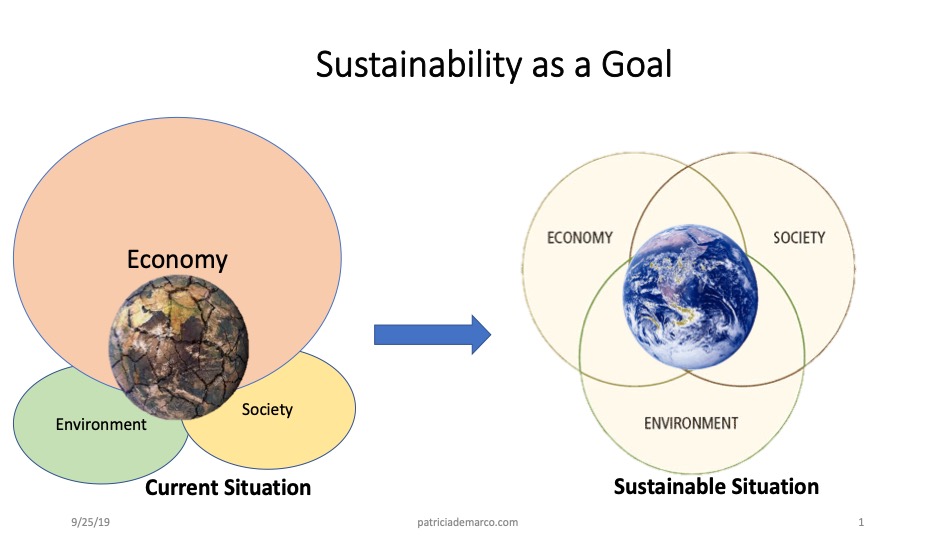
Call to Action: Sustainability as a Goal

First, manufacturers must be held accountable: Break Free From Plastic Pollution Act of 2021

Second, Test for health effects before commercial production.

Third, educate chemists, engineers and industrial manufacturers about living systems.

Finally, be an active citizen. We can all act as empowered consumers. Americans discard 33.6 million tons of plastic a year average of 286 pounds of waste per person per year.  Use your consumer power more wisely:

  • Refuse-single-use items
  • Reduce– Buy in bulk, substitute recyclable and non-toxic materials for non-recyclable
  • Reuse– select refillable products; buy recycled materials-replace single-use items with reusable items-exchange toys, clothing, household décor
  • Recycle– know the rules in your area and separate clean items
  • Rot– compost food waste and organic material

Use your voice as an engaged citizen. Advocate for policies that will address these issues directly in your community, in your state legislature and with your Congressional Senators and Representatives. Your vote is your voice, and you have a responsibility as a citizen to hold the people who purport to represent you to account. Apathy is our enemy.

On this Earth Day 2024, I savor the beauty of the world around me now, and I pray again in my old age for the surge of care and concern for the Living Earth and for our future that will override partisan politics and corporate greed.


Empowering Independence from Petrochemicals

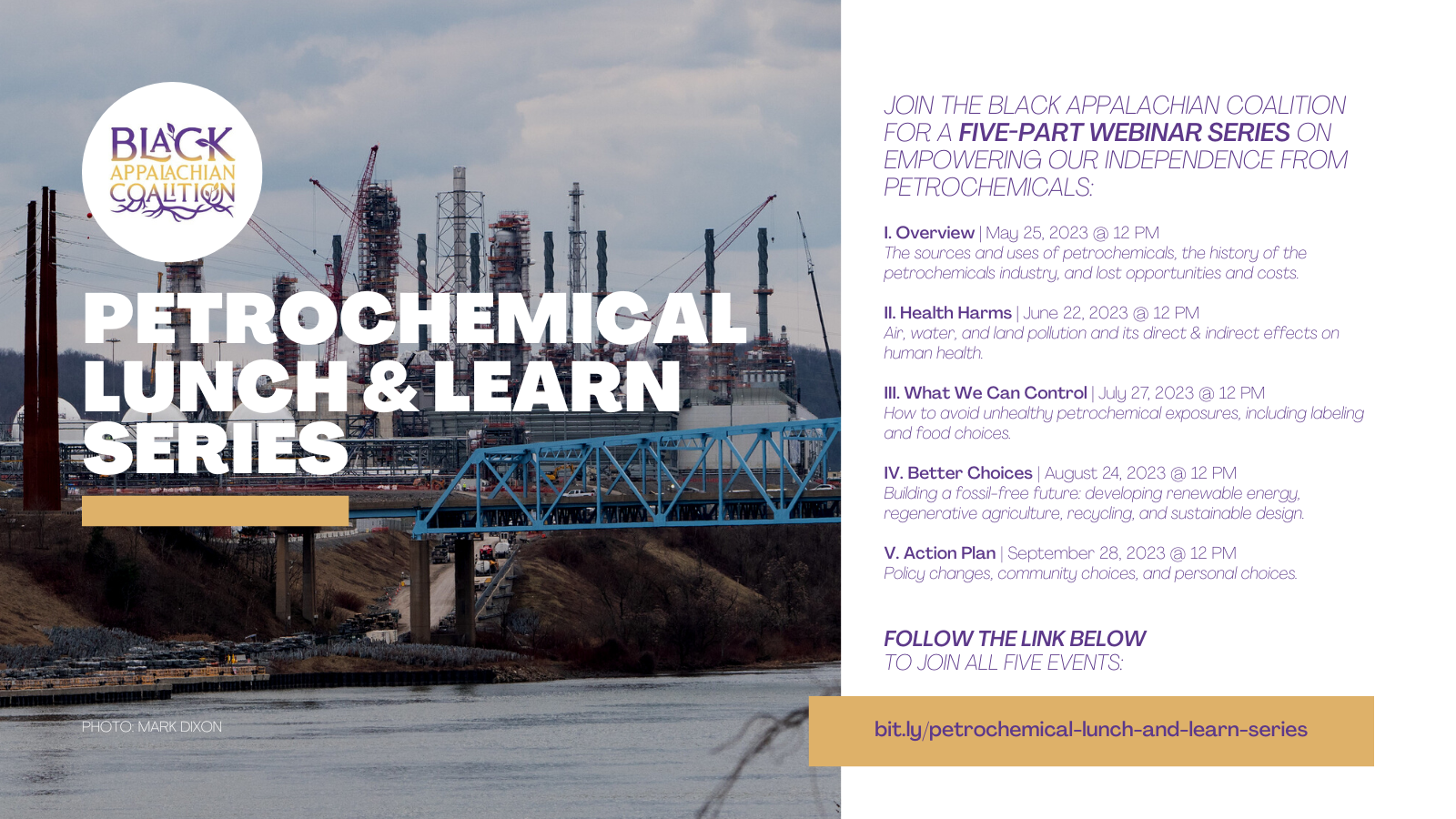
Archbishop Marcia Dinkins, founder and leader of the Black Appalachia Caucus, Patricia DeMarco, with ReImagine Appalachia, Ben Hunkler of the Ohio River Valley Institute have come together to present a five-part webinar series- “Petrochemical Lunch and Learn.” We hope to give people the information they need and some guidance and direction for responding to the climate crisis and the global pollution associated with burning fossil fuels. This informational series is designed to empower people, especially people of color who are most likely to experience the environmental, health and economic harms from proximity to petrochemical facilities. We will discuss how the petrochemical industry came to be such an integral part of our lives, how we can reduce dependence on burning fossil fuels, and how we can build a resilient, equitable and shared prosperity as we move toward a bio-based economy that can be sustained.

You can register for the whole series or any session here bit.ly/petrochemical-lunch-and-learn-series

May 25, 2023 Session I: Overview: the sources and uses of petrochemicals; the history of the petrochemicals industry; how we can move away from fossil fuels and some of the environmental and social justice issues associated with petrochemical extraction, transportation and use.

May 25, 2023 Session I Overview slide presentation is here:

Here is the recording of Session I: Overview https://www.youtube.com/watch?v=O-a2V0ztRrs

June 22, 2023 Session II: Health Harms– This session explains how petrochemical industry pollution of air water and land affects our health; and some of the environmental justice issues that result from petrochemical industry operations. Presentation by Patricia DeMarco is here :

The recording of Session II: Health Harms including the presentation and discussion by Dr. Claire Cohen is here: https://www.youtube.com/watch?v=kN73DBK4S50

If you have questions, you can e-mail me at demarcop6@gmail.com

July 27, 2023 Session III: What We Can Control. Patricia DeMarco will be joined by experts from Women for a Healthy Environment for practical things you can do to protect your exposure to petrochemical health harms. https://www.youtube.com/watch?v=B8e8fUSzWeM

August 25, 2023. Session IV. Empowering Independence from Petrochemicals- Better Choices. Building a fossil-free future: developing renewable energy, regenerative agriculture, recycling, and sustainable design.

We hear from Derrick Tillman, passive solar developer to share the impetus for passive solar design for affordable housing. https://www.youtube.com/watch?v=3o_ZUd5eqRE

September 28, 2023. Empowering Independence from Petrochemicals. Call To Action We end the 2023 Petrochemical Lunch & Learn series with a Call to Action for communities, for individuals, and of all concerned about having a healthier, more robust shared prosperity. The presentation is here:

and the video is here.https://www.youtube.com/watch?v=6r1JqISylJk

This series has Brough people together across the United States from communities suffering long years, decades from the silent and slow toxic suffusion of pollution of air, water and land from petrochemical operations.

We continue this series in 2024 with a deep dive into the health harms of the petrochemical industry. See Petrochemical Lunch & Learn 2024: Your Health and Your Environment.


Turning Dreams to Reality- Addressing Climate Change, Pollution and Species Extinction with Hope and Courage

Patricia DeMarco

November 20, 2022

The landscape has changed with the season from green filled with flowers to brown, red and gold of the deciduous tree canopy in this temperate Pennsylvania community of Forest Hills. As we push forward with budget setting we struggle to implement the plans laid down over the past several years- A Comprehensive Plan for Development, a Climate Action Plan and an Active Transportation Plan. The local governments of America are on the front lines of addressing the great existential challenges of our time. But they do not appear as cataclysmic surges everywhere at once. While coastal areas may struggle with rising sea levels and extraordinary king tides, we in the middle lands have different problems.

Light Up the Hills- Forest Hills Borough 11-19-2022

Here we seek to reinvest in communities long abandoned by the extractive industries of coal and steel and petrochemical production that laid down the wealth of the 20th century. Here we seek to reshape a future built on the foundations of past systems, but with the resilience and ingenuity that has sustained the people of this land for millennia. Adaptations come slowly, but now more quickly as the tools of policy begin to take hold. The grassroots ideas compiled into the ReImagine Appalachia Blueprint during 2020-2022 are now being implemented through successful incorporation into the Infrastructure and Jobs Act and the Inflation Reduction Act adopted by Congress this year. Funds begin to percolate down to the communities, with the new concept of Community Benefit Agreements attached to federal funds. We are slowly dragging equity and inclusion considerations into the policies that drive progress.

What does that look like at the Borough level? Well, we see the prospect of upgrading our sidewalks and public transportation corridors for safer and more frequent bus transit service, and eventually bicycle lanes. We see funds for repairing pedestrian walkways connecting shopping and parks with communities. Walkways and stairways were once prolific in the days when the community was served by electric streetcars, but have fallen into disrepair, overrun with vines and the inevitable succession of saplings growing into the cracks. The remnants of a more active society remain and can be restored.

As the cost of renewable energy systems comes down and is better supported with incentives, more people and businesses are making installations, some linked with their electric vehicle charging stations. The community looks toward establishing micro-grids where solar on business and municipal buildings helps to meet energy requirements, and centrally located battery storage units can ameliorate the cost for the whole community as well as offer better reliability and resilience in storms. The electric grid is being evaluated and upgraded to accommodate the changes that are coming soon. Investment tax credits and production tax credits that are established in law for 10 years, instead of two or three requiring constant budget reauthorization, now make investors more interested in these projects. Stability in the market actually works where exhortation and pleading fell on deaf ears.

As the crises of extended droughts afflict many parts of the world and even significant and growing areas of America, we see the pattern of abundant water from storms in our area instead. Stormwater surges and landslides are our greatest climate change vulnerabilities. This pattern of storm water from climate change carries a huge opportunity and also an obligation. In Pennsylvania and our neighboring Appalachian states, we will have water for growing food, for domestic use and for other purposes. We will not have water to waste, or to contaminate by deliberately adding contaminants for fracking or industrial sewer discharge. Fresh water is essential for life. We must become adept at managing the storm surges, storing water for later use, and conserving its integrity from contaminants. Water can be reclaimed, reused and recirculated endlessly, if the laws that govern its distribution and flow are respected and not abused.

The COVID pandemic that has cost over one million lives in the US alone has reshaped our society. We carry the scars of this pandemic in our loss of social interaction, our pain and grief at losing loved ones, and our economic stress. We have seen our vulnerabilities magnified in the global marketplace when supply chains have been disrupted. People begin to look again to regional and local systems for things that are necessary. Will the homogenized global marketplace yield once again to regional and local specialization? Can we look forward to specialties that make places unique, that mark them as home? I hope so. The handmade homemade craft of folks who made much out of little has earned a place in our history, and may become a hallmark of our future. COVID also revealed the disparities in broadband access and affordability. Here again, new laws begin to address this issue that restrains participation in the virtual marketplace for many people in both urban and rural areas. Is it time for broadband access to be an essential utility service?

I attended the Forest Hills community celebration of Light Up the Hills on Friday evening. There were people from all around the neighborhood and surrounding communities as well. The faces of children telling their wishes to Santa, the people coming in for hot chocolate and donuts after watching young performers all came together to greet each other, and share a few moments of joy. That is what makes communities matter. Shared joy, shared accomplishments, and the sense of belonging in a special place that we can shape, but that also shapes us.

As we prepare for the Thanksgiving Celebration, this week, I think of this time for extending gratitude and appreciation among our kinsfolk, and to our neighbors and friends. And I hope that we can also extend a smile and friendly expressions even to strangers we may meet along the way. We are more alike in our humanity than different in race, gender, culture, religion, or even politics. It is a time to remember the deep history of this land and the Indigenous Peoples who thrived here for thousands of years before the European colonists arrived. Their resilience to changes over millennia gives testament to the ability of people to adapt, to find ways of cooperating through changes, and to share the love and respect for this bountiful land.


What will it take to make a policy U-Turn on Climate Action in America? 

By Patricia M. DeMarco

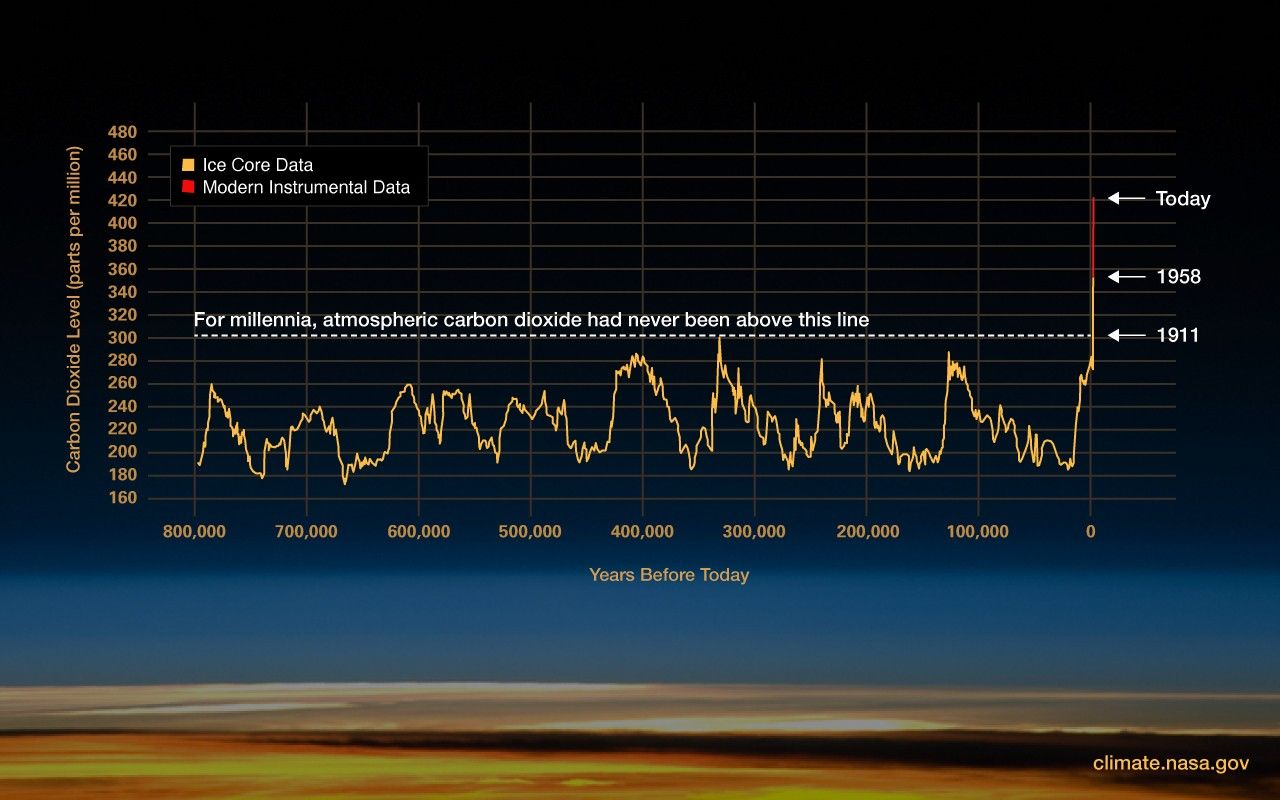
We, the people of 2022 are experiencing already the irreversible effects of global warming, global pollution and loss of biodiversity that herald the degradation of our life support system. Presented in the form of data, the statistics are frightening.[1] Carbon dioxide measured at NOAA’s Mauna Loa Atmospheric Baseline Observatory peaked for 2022 at 421 parts per million in May, now 50% higher than before the Industrial Revolution.[2]

IPCC Report “Code Reds for the Planet”

     Most people notice incremental changes in the weather, and in trends in warming compared to recent past experience, but the gradual change does not cause a sense of danger for most people. The reality of the climate situation calls for an urgent transformative response, a Policy U-Turn. But the reality of the political situation portends the reverse of what is needed – a resurgence of regulation in favor of the fossil extractive industries. The oil, coal and gas magnates press for new investments based on hydrogen from fracked fossil methane and a further push for single use plastics to bolster the industrial petrochemical complex.[3] These are false solutions perpetrated by short–term economic interests which, if pursued, will assure the even more rapid destruction of this living earth.

     I want to scream in frustration at the misinformation and greed that perpetuates these disasters. I want to lash out in anger that so many in power refuse to see the needs of the people for now and for the future. I weep for what has been lost already, and for what will yet be exterminated from the face of the earth. Yet, out of this frustration, anger and grief comes a passion to intervene, to give voice to the solutions that are in hand, to organize for political action. This election. This summer. Now. Before it is too late.

     No elected official would ever deliberately send hundreds of people into homelessness, but they decide that preventing wildfires is too expensive. No elected official would deliberately poison people, but every day decisions are made to allow uncontrolled pollution to continue in neighborhoods of marginalized people. We let injustice continue like a creeping blight – 

  • Air pollution spreads asthma to one in five adults and one in four children in Clairton PA;
  • Chemical contamination spreads endocrine disruptors throughout the population until 93% of Americans have detectable levels of Bis-Phenyl A in their blood and a body burden of hundreds of synthetic chemicals in our bodies, even in newborn infants; 
  • Obesity afflicts 33% of Americans who live in food desserts; 
  • Water supplies in most major cities are contaminated with lead and other infrastructure failures. 

The government has become powerless to change the laws to protect people now, and even less to protect people and other living things for the future. 

     If we were to govern FOR THE PEOPLE, the opinion of the majority of Americans clamors for urgent action on climate. “63% of Americans favor broad government action on climate. At a time when partisanship colors most views of policy, broad majorities of the public – including more than half of Republicans and overwhelming shares of Democrats – say they would favor a range of initiatives to reduce the impacts of climate change, including large-scale tree planting efforts, tax credits for businesses that capture carbon emissions and tougher fuel efficiency standards for vehicles, according to a new Pew Research Center survey.”[4] Even in the face of national opinion polls indicating that a majority of Americans believe that addressing climate change is important, Congress remains deadlocked. Inert. Ineffective. A few Senators, Manchin and Collins and McConnell, successfully block action on climate policy to protect fossil industry interests.  Now the Supreme Court is eroding the authority of the Environmental Protection Agency to rule on carbon emissions.[5]

      Local governments end up on the front line for dealing with the effects of climate change and protecting people where they live. Efforts at the local level can move forward a bit with climate action plans, however, for the sweeping structural changes from fossil fuels to renewable energy systems, there need to be changes in the underlying laws. This will not happen unless there can be a veto-proof majority of Senators willing to stand up for the future of our planet, for our children, and for the emerging industries of the clean economy: renewable energy systems; regenerative agriculture and permaculture; and circular materials management for consumer goods.

     Many local and regional communities have put forward a vision for a better future critically needed to ameliorate the inevitable disaster that will occur if we continue on the current path. The ReImagine Appalachia Blueprint, the Marshall Plan for Middle America, internationally The Natural Step Framework, the German Energiewende and many others lay out a sustainable future. We know what the solutions are. We know they work. We need to amass the political will to make it happen. The laws of Nature are not negotiable: if we continue to add to the greenhouse gas burden in the atmosphere, we will experience global warming, ocean acidification and the consequences of ecosystem failure. Indeed, we are already seeing these effects beginning to accumulate.

     We suffer from a failure to communicate effectively not only the urgency of the situation but the availability of the solutions.  We cannot spare our children from the effects of climate change already in motion, but we can still shift to adaptations that can slow the progression and lead to a less disastrous fate.

Earth Day 1970

     What will it take to change the direction of the country?  Earth Day 1970 brought 10 million Americans into the streets, the halls of Congress, the union halls, the city chambers to demand clean air, safe drinking water and protection from toxic chemicals.  The Climate Convergence has mobilized fewer than five million, and the effort is scattered, fractured and fraught with infighting. Scientists leap to challenge, critique and shred each other, as good scientists do in the rigor of academic pursuit. But that very rigor of the scientific process is turned against the message in the public eye. The message of science is discredited successfully by pseudo experts and mouthpieces for the industry who cast doubt on climate findings and disparage the solutions by exaggerating minor flaws and disagreements.

Climate Denial = “Patriotic”

     We are indeed in a battle for survival as a species, as a civilization of Humanity. It is time to pull together and lift our eyes to what it is possible still to preserve for our children. It is time to see the vision of a finer future with a shared prosperity, equity and dignity for all people, a style of living that is sufficient but not profligate, where we can celebrate the richness of talent and spirit rather than race to consume and throw away more and more stuff we do not need.

March for Science- Pittsburgh 2017

     Every election this November of 2022 presents a choice for decision makers and policy makers who will determine the fate of our country and our world.  It is time for all of us in the science world, in the sustainability movement, in the arena of believers in the best that people can be to stand up and be counted.  We need to make our voices heard and our demands recognized.  Put climate on the agenda in the public debates.  Build momentum to demand action on behalf of our children.  Those who cannot vote yet are excellent ambassadors for climate change.  We must stand for our youth and demand accountability from those in power or who wish to sit in seats of power.

     And scientists- real ones – need to run for office and win.


[1] : (https://www.ipcc.ch/assessment-report/ar6/ )

[2] https://www.noaa.gov/news-release/carbon-dioxide-now-more-than-50-higher-than-pre-industrial-levels

[3]  “Our Region’s Energy Future” Allegheny Conference Energy Task Force Report April 2022. https://www.alleghenyconference.org/energy-report/

[4]   ALEC TYSON AND BRIAN KENNEDY. Two-Thirds of Americans Think Government Should Do More on Climate. Pew Research Center. June 23, 2020. 

[5] West Virginia vs EPA before the Supreme Court https://www.law.cornell.edu/supct/cert/20-1530


Leave a comment

Marshall Plan for Middle America Summit

Next Steps for Local Government

By Patricia DeMarco, Ph.D., Chair of CONNECT, Vice President of Forest Hills Borough Council

The Marshall Plan for Middle America Summit took place virtually on September 27, 28 and October 4,5  in partnership with The City of Pittsburgh, Heartland Capital Strategies, ReImagine Appalachia, and Resilient Cities Catalyst.[1]

As we have been deliberating over these last four days about how the communities of Middle America can address the challenges and opportunities facing us together, we must recognize that we are collectively in an existential battle for the survival of our children. There is no more time to play games, for political posturing and jousting.  If we do not take bold action to address climate change NOW, more people will die. And our children will face a bleak future. The laws of Nature are not negotiable; we must stop burning fossil fuels, or the Earth will continue warming beyond the range of tolerance for life as we know it.

Given that we face a crisis, it is exciting to come together to plan the transformation of our economy and our society so we can address the climate issues in ways that also address equity, build resilience, bring more inclusive practices to our operations, and redress social and environmental injustice. Solving the interlocking problems associated with moving away from fossil fuels also offers the opportunity to take the skills of our workers who built America and re-direct them to re-building America for the 21st century and beyond. We are beginning to count and value not only the next quarter profits but the community benefits: good paying union jobs, cleaner air and water, healthier people, and safer communities.

Capacity building for local communities is a key to the success of our transformation to a resilient sustainable society. Local governments are on the front line when people need help. Yet, many small communities like mine are constrained in the competition for big government funded programs. We have no “Planning Department.” We have no grant writer or development office. We certainly do not have 50::50 or worse 90::10 matching funds to access federal grants. So, we succeed by coalition building. CONNECT- The Congress of Neighboring Communities including the City of Pittsburgh and 42 neighbors- work together to solve common problems and share resources.[2]  We also connect the intellectual capital of the university of Pittsburgh to applied problems in our communities in real time. Problems like opioid addiction and planning for climate change, and shared police, fire, and emergency services. We also join coalitions on a regional basis like ReImagine Appalachia, a Blueprint for a New Deal that works for all of us in Pennsylvania, Ohio, West Virginia and Kentucky to build on our strengths and come together as a block in Congress so we are at the table, not on the menu.[3] Along with the Marshall Plan for Middle America, we will have shovel-ready projects to cue up when federal programs materialize.

In all of this, the workers are essential. When we include workers and labor unions in the discussions about what the future can be and how we can get there, they keep focus on real jobs that pay well. We are not seeking to retrain people for jobs they don’t want in places they don’t want to go. We need to restructure the fossil extractive industry workforce to capture their excellent skills and turn them toward the essential work of the green economy. We need to be sure there are pathways to good union jobs as we create new enterprises for renewable energy systems, a circular materials management system, and regenerative agriculture and permaculture, especially to heal abandoned mined lands. Workers deserve the right to organize and negotiate for fair wages and safe working conditions. When we invest in communities, we invest in building the local workforce too.

Finally, it is critical that we keep building the story. We have a vision of a more just, equitable and inclusive society, a better America. We are already seeing the technology penetrate for net zero energy buildings, for electrified public transit and vehicles, for advanced manufacturing. We do not have a technology problem!  We do have a problem of moral fortitude to commit to making the necessary political choices to move forward.  Ignoring these issues will not solve them but articulating the vision for a better tomorrow will change the tide of obstruction.  People do not move toward what they cannot visualize.  People will not move to something they perceive as a hardship. We are building a better America already. We need to tell the stories of success and multiply the impact of our work by standing together. The power of this country is vested in the People in our Constitution. We must use that power wisely and use it well to solve this crisis and reach the next plateau of excellence in a resilient sustainable future with justice, equity and inclusion for all of the people.


[1] Marshall Plan for Middle America Roadmap https://www.sustainablebusiness.pitt.edu/sites/default/files/marshall_plan_for_middle_america_roadmap_0.pdf

[2] CONNECT- The Congress of Neighboring Communities operated through the University of Pittsburgh Graduate School of Public and International Affairs. https://www.connect.pitt.edu

[3] See the ReImagine Appalachia Blueprint, jobs reports and resources here https://reimagineappalachia.org


Leave a comment

Hold AMAZON Accountable

Published in the Pittsburgh Post-Gazette, “Other Opinions” on Sunday, July 25, 2021

by Patricia M. DeMarco, Ph.D.

In September 2019, AMAZON made a public commitment to become carbon neutral in all of its operations worldwide by 2040 and launched a $2 billion fund to implement it.[i]

As The Borough of Churchill and other communities around Pittsburgh see advances of AMAZON interest in locating distribution centers in the area, those making the decisions and responsible for granting the building permits must stand to hold them accountable to their rhetoric.

Taking the former Westinghouse Research Park in Churchill as an example, there are three things that can be done on this site to ameliorate the climate impact of this proposed new facility.  Many of my constituents and neighbors have expressed concerns about diesel pollution and emissions from the operation of this facility and outrage over the destruction of hundreds of mature trees on the site.  Air quality, stormwater run-off, and destruction of carbon reducing trees are serious issues. Remedies to mitigate these issues are readily available and should be required in the permitting process.

First: This new construction should be based on a passive solar design with geothermal earth tube and heat pump systems for heating and cooling.  The electric load of the facility should be met by installing a photovoltaic solar array on the roof. This will reduce emissions both from burning a fossil fuel on site for heating and from the regional power supply to produce electricity to serve the facility. A well-designed new building can be cost effective to build, cheaper to operate, and have a net zero energy profile.[ii]

Second, AMAZON has touted its electric fleet as one of its innovations for climate action.[iii]  This new facility should be required to use electric vehicles, with charging stations at the facility to prevent the diesel emissions that will otherwise certainly inundate the area with particulate and organic compounds in the air.

Third, the site should be required to install bioswales and permeable paving in the parking areas and along the roadways.  Stormwater runoff from this site is already an issue for neighboring areas, and the removal of the large trees to accommodate this facility will only worsen this effect.  Sloping the parking areas toward bioswales and designing the area around the building to capture runoff will help to mitigate stormwater effects.

Finally, the removal of mature trees should be kept to an absolute minimum with careful siting of the facility on the land.  Preserving the remnants of an Indigenous People trail and maintaining trees as visual and noise screening from the surrounding residential areas should be a priority for the site design. The Borough of Churchill has the opportunity to hold AMAZON accountable to its own rhetoric.  This new facility can become a model for innovation and adaptation to the reality of our climate crisis, not a capitulation to the lure of “jobs” at any co


[i] AMAZON Climate Pledge and Climate Pledge Fund. https://sustainability.aboutamazon.com/about/the-climate-pledge  https://sustainability.aboutamazon.com/about/the-climate-pledge/the-climate-pledge-fund

[ii] The Forest Hills Borough municipal building completed in 2018 has generated more energy than it uses for a net zero operating profile.

[iii] “AMAZON’s custom electric vehicles are starting to hit the road.” https://www.aboutamazon.com/news/transportation/amazons-custom-electric-delivery-vehicles-are-starting-to-hit-the-road

Patricia M. DeMarco, Ph.D. is the author of Pathways to Our Sustainable Future- A Global Perspective from Pittsburgh. University of Pittsburgh Press. 2017. She is a Senior Scholar at Chatham University and writes a blog “Pathways to a Just Transition” at https://patriciademarco.com  She is Vice President of the Forest Hills Borough Council and Chair of CONNECT – The Congress of Neighboring Communities surrounding Pittsburgh.