In consideration of Women’s History Month, I am reflecting on Rachel Carson and her message of precaution in protecting the living earth.
Rachel Carson’s challenge. Rachel Carson lived and wrote in a time before pollution was regulated at the federal level. Her work at the Bureau of Fisheries and in the Fish and Wildlife service documented the value of preserving natural places, enshrined in the National Wildlife Refuges and in the Endangered Species Act. Rachel Carson advocated for preserving all the parts of natural ecosystems and using the tools of natural systems for pest control and resource management. She wrote often of the need to take precaution in the broadscale dispersion of man-made chemicals. She wrote, in the formal language of the 1950s, of the trend of our society towards destruction:
Mankind has gone very far into an artificial world of his own creation. He has sought to insulate himself, in his cities of steel and concrete, from the realities of earth and water and the growing seed. Intoxicated with his own power, he seems to be going farther and farther into more experiments for the destruction of himself and his world. Rachel Carson. Speech on receiving the John Burrows Medal. April 1952.[i]
This describes the condition we face today. We see all around us the cumulative effects of pollution from burning fossil fuels to plastic waste, and forever chemicals created to control pests or for enhancements like “no-stick” pans. Rachel Carson raised concerns about the chemical stew resulting from the accumulation of materials from multiple sources and through concentration up the food chain. She documented how materials introduced into the environment migrate to unintended locations through the action of wind and water. Silent Springwas all about taking caution.[ii]
But we have not taken caution. We have conducted a massive experiment upon ourselves and our children with no controls, and no anticipation of how to redress the harm. Rachel Carson perceived this potential for harm long before the voluminous scientific documentation of health harms of pollution mounted in evidence.[iii] She wrote from a deep knowledge of the delicate intricacies of the interconnected web of life. She knew in her bones of the absolute dependence of humankind upon the smooth functioning of the ecosystems that provide fresh water, oxygen-rich air and fertile ground. Our life support system depends on these natural systems, evolved over millennia, and stable for thousands of years. But that stability also depends on respecting the laws of nature and preserving the living systems that sustain us.[iv]
The regulatory approach to controlling pollution has rested on the concept of mitigating risk to the public and protecting the quality of air water and land from contamination. The level of total risk is defined as the combination of inherent hazard, or how toxic a substance is to living plants, animals and humans, and the amount of exposure.
RISK = {HAZARD X EXPOSURE}
Consequences: total toxic emissions and health harms. In spite of the voluminous regulations, pollution is increasing not only in the US but globally. Because dispersion by wind and water makes it impossible to isolate contaminants to a specific location, contamination crosses all political boundaries. Even as Rachel Carson pointed out so many years ago, we now see contamination worldwide. The public health implications of this proliferation of toxic contaminants are impossible to escape. (See full article for details.)
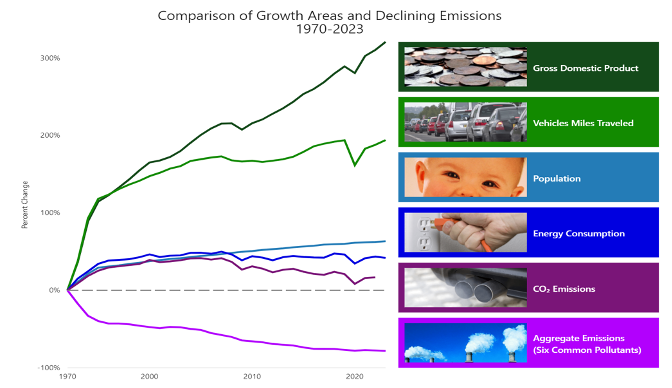
Although environmental regulation has improved the quality of air and water overall since before enacting the regulations under the EPA, the results have not kept up with the challenges of modern industrial chemical contamination, nor have they prevented the effects of accumulation of man-made chemicals in the environment. The expectation and complaints from industry that environmental regulation hurts the economy has not been documented. In fact, economic growth has continued even as environmental controls have been enacted and enforced.
De-construction of environmental protections. Today we see the unravelling of the complex tapestry of regulatory controls on pollution, from Executive Orders granting absolution to 41 industries from emission constraints to laws rescinding critical portions of the Clean Air Act.[ii] The EPA under the Trump Administration has rescinded 31 regulations that protect water, air and land from industrial pollution and chemical contamination, challenging Safe Drinking Water and Clean Water Act requirements, and curtailing enforcement actions. Rulemaking to control forever chemicals (PFAS) has been delayed or abandoned. The Supreme Court has removed the science-based expert authority of regulatory agencies requiring a strict and narrow interpretation of authorizations stated in the enabling legislation. The EPA revoked the Endangerment Finding of 2009 which put greenhouse gas emissions control under the Clean Air Act, effectively eliminating climate action controls. The EPA has also declared that costs of health harms and deaths from pollution will no longer be calculated in the analysis of regulatory action on air emissions. Challenges to these actions have had some success in federal courts, including the declaration that rescinding congressionally approved grants for renewable energy are illegal.
RebuildEnvironmental Protection with Regenerative Thinking. The long-term implications of these policy changes alarm environmental organizations and people concerned with the health of communities who are looking toward a change of administration to correct the harms. But, at this point, simply reversing the actions taken so far will not address the underlying issues. Of all the environmental regulations adopted to date, only the Pollution Prevention Act of 1990 addresses the concept of designing to prevent pollution and encouraging recycling. We can take lessons from the regulatory approach of the last 56 years and improve the outcome going forward. This is the opportunity to move our system of laws and regulations through a transformation from an extractive fossil-based economy to a regenerative renewable resourced economy. There are at least five elements to this process.
1. REACH: The first lesson would be to adopt the precautionary principle as the basis for evaluating the introduction of new man-made materials into large scale production.
2. Green Chemistry: Second, adopt a regulatory framework that emphasizes reduction or elimination of the inherent hazard, rather than computing the “safe” amount of toxicity for individual contaminants.
3. Empower Renewable Resources. Third, adopt the regulatory infrastructure to empower distributed renewable energy systems.
4. Heal damaged lands. Beyond preventing future pollution and damage, lies the responsibility to repair the scars and harms of legacy industries.
5. Remove fossil industry subsidies. The federal subsidies currently lavished on the fossil extractive industries can be shifted directly to fund the sustainable energy system.
A shared prosperity. It is time for bold action. It is time to recognize that the laws of nature are not negotiable, nor can they be rescinded by executive order or wishful thinking. The condition of our life support system requires both reduction in the levels and types of pollution as well as strong support for the known and available technical solutions. Burning fossil resources as the base for the economy drives the global warming that will make the planet uninhabitable to life as we know it.[i] By creating a new regulatory framework based on regenerative thinking and protection for our life support system, we can establish the conditions for a shared prosperity and sustainable growth within the constraints of our living earth.Those who contemplate the beauty of the earth shall find reserves of strength that will endure as long as life lasts. Rachel Carson.
In this essay, I reflect on the 2024 election results, give some analysis of the situation we face, and some actions forward to create a better outcome. We need a better narrative of how we see the future as a nation of shared prosperity in a healthy, peaceful world. And we need to use the tools of the 21st century to communicate ideas and programs. We need to tell the success stories of taking paths of true and tested policies that support a return to an American Dream that includes everybody, not just the top 10 % of wealthy people.
For me, the solutions are at the community level, because communities- Mayors, Church leaders, civic leaders – we are on the front lines, regardless of what mayhem is cast out from federal policies. Basic institutions have failed everyday people. But tearing down the government does not solve the problems. Returning to the policies of the “Guilded Age” will assure a greater divide in the wealth gap, and leave even more people falling into poverty and despair. We need to build a narrative of inclusion, hope for a better future, and justice for people exploited by this devolution of our society. We must stand together and rethink our way forward from the bottom up. In the United States of America it is not OK for children to go to school hungry, for the maternal and infant mortality rates to fall among the level of underdeveloped countries, for people to work three jobs and still not make ends meet. We need to revive the sense of caring for each other, creating a culture of celebrating the dignity of each person and giving true opportunities for all to thrive together.
Going forward we must hold those in power accountable. If our goal is to build an America where shared prosperity in a healthy world is a reality, not a pipe dream subject to derision and mockery, we must build solidarity. We must re-learn the lessons of the unions that brought safe working conditions and living wages to millions of workers. We need to prepare for meaningful resistance and constructive redirection. We need to study the history of our country and avoid the descent into chaos.
Freedom is not free; democracy comes at the price of citizen responsibility and respect for the rule of law. Freedom without accountability yields chaos. We need to sharpen the tools of resistance to tyranny. We need to sharpen the tools of organizing collective action. Could we mount a general strike or a rolling series of strikes these days? Do consumers have the knowledge and tools to harness boycotts to bring polluters to heel? Do we have a communication system to support organized resistance to discrimination, racism and suppression of rights? We need to step onto our power and build a New American Dream that makes liberty and justice for all a reality.
I wish all of you my readers, colleagues and friends all the Blessings of this Christmas and Holiday Season. May we build a New Year for Peace in the world, with love in our lives, and Joy in our hearts.
This is a pivotal year in many ways, especially in the urgent need to make the policy U-turn from an extractive to a regenerative economy. Without the restructuring of our economy, and indeed our civilization, away from fossil fuel combustion within the next five or six years, the climate tipping point may be irreversibly crossed. 2023 was the hottest year in recorded history, with many regions experiencing unlivable conditions for at least part of this year. https://climate.copernicus.eu/copernicus-2023-hottest-year-record Conditions will only worsen if we continue the slow walk on climate action.
Engaged and informed citizen action has never been more important.
Growing from the Petrochemical Lunch and Learn Series of 2023, we saw great interest in further exploration of environmental-related health harms and how to address and prevent them. I am partnered with the Black Appalachian Coalition (BLAC) and with the Ohio River Valley Institute to dive deeper into the connection between environmental pollution and our health. https://blackappalachiancoalition.org/ Our first sessions of the series are:
February 15 – Health Is a Human Right
March 21 – Air Pollution: Sources, Health Harms, and Mitigation
April 18 – Water is Life
May 16 – The Land Beneath Our Feet
This series of workshops empowers people with information and guidance for action, especially in communities affected by petrochemical and extractive industries. A healthy environment is necessary for healthy people; it is a human right for people to have clean air, water, and access to health care.
I have ended my term as an elected official on December 31st 2023., and I have been appointed to the Forest Hills Community Alliance, the community development corporation for Forest HIlls. To structure and organize my consulting activities, I have joined The Main Street Associates in Braddock as a Principal Associate.https://www.themainst.org Work here includes developing Community Benefit Plans and Agreements required by grant recipients under the Inflation Reduction Act and the Bipartisan Infrastructure Law. I have a focus on the regulatory infrastructure necessary to promote and enable renewable energy systems to thrive in PA. Shifting from a central fossil fueled power station with distant customers must give way to a Distributed Energy System. We are working to build a shared prosperity for our communities.
I continue writing as a Pittsburgh centered author. ReImagine Appalachia- Healing the Land and Empowering the People is In Press now. I have two new writing projects. I am collecting stories and resources to develop the story of the Mon Valley- its past and its future as a journey from the industrial extractive era to the clean manufacturing era. With the passing of my Aunt Rosa, I received the mantle of Matriarch of our Family. With this honor, I will be collecting the multi-generational story of our family from the mountains of Campolieto Campobasso in the Abruzzi region of Italy to the interwoven branches across America.
This will be a year of challenges and trials. Our country seems painfully divided and polarized. But we can come together as a people affirming what is good and true in our culture; learning and sharing with those who bring tradition and wisdom to bear on our common problems, and restore the attribute of treating each person politely with dignity and respect. Without justice, there is no peace. Without compassion, there is no healing. We can build a shared prosperity, a better future, if we work together and respect the laws of Nature as a guide to our way forward.
On this Winter Solstice, I reflect on a time of closure, and a time for planning new beginnings. I have shared my life for the last 15 years with my partner, Tom Jensen as we had adventures to other countries, explored the places of his ancestors, and significant historical places. We found spontaneous dancing happened at any time, especially when we were both working at home. We took on several construction and reconstruction projects – and we laughed a lot…until he fell to a long and valiant battle with cancer. Chronic terminal illness challenges the character and erodes at the very soul of a relationship, but in lucid moments between bouts of delirium and rage, we were as close as ever. I will treasure those few precious times and remember the wonderful experiences we shared, and let the pain and sadness recede slowly into the past. I know I will miss Tom every day of the rest of my own life.
He was always there to cheer me on and encourage my work. It is ironic that my second book came to print the week of his passing. Writing “In the Footsteps of Rachel Carson- Harnessing Earth’s Healing Power” captured my own struggle to recognize my mortality. I am acutely aware that as a four times cancer survivor I am living on borrowed time. So, I make the most of every day.
All of the crises of the world have continued swirling around me as I have been in a cocoon of slow grieving and caregiving as Tom receded into the clutches of the tumors that consumed him over 18 months. I have swatted at them like irritating flies, keeping focus only on the most immediate and pressing needs. Now, I reflect on what is ahead, and set my priorities for this coming year.
Recognizing the amazing accomplishments of our collective action over the last year sets the stage for what comes next. Much of the ReImagine Appalachia Blueprint is now incorporated into law! (See https://reimagineappalachia.org ) Climate action policy, recovery of abandoned mine lands, broadband expansion, assistance for neglected communities, support for regenerative agriculture, requirements for community benefit agreements attached to federal grants, and many more actions now have the force of law. The tools for creating a more just, equitable and sustainable future are at hand. Now comes the challenge of implementing with intent and keeping the goals in the forefront.
The success story of ReImagine Appalachia needs to be celebrated, and documented. This is the subject of my next book, to be published through the Association of Environmental Studies and Sciences. ReImagine Appalachia is quite a testament to the power of the people. It began with 45 listening sessions in which 1,500 people contributed ideas, concerns, life experiences, hopes and dreams – all on zoom because of COVID-19. With only a few paid staff and with amazing leadership from Amanda Woodrum, Stephen Herzenburg, Ted Boetner and Dana Kuhlein, and Natalia Rudiak, teams of working groups sorted the issues and ideas into issue papers, documented policy proposals and case studies illustrating the need for new laws. Visionary leaders like Rev. Marcia Dinkins inspired us to act. Fifty collaborating organizations across four states- Ohio, Pennsylvania, Kentucky and West Virginia – worked together to brief critical members of Congress, and their key staff. We were at the table when the laws were being crafted, when the budgets were being set, and we turned out hundreds of engaged citizens at all stages for comments, support, and intervention when things got sticky. Faith communities, people of color, local government officials came together to press for changes that would heal the land and empower the people.
As I sit in my 76th year of life, I recognize the need to mentor and coach successors in my path as a compelling drive. All of my activities and engagements align to build a better future for the coming generations. The legacy of the Baby Boomers has been a mixed bag, and I feel a responsibility to show a vision forward that corrects some of the mis-steps. I think our civilization is ready for a renaissance of attention to cultural and spiritual values reflected in care for the natural capital of the Earth – fresh air, clean water, fertile ground and the vast diversity of species that constitute the great Web of Life. Restoring our life support system ties so many conflicting factions together. Seeking common ground and shared purpose in building a better future for our children and for their grandchildren allows us to rise above the petty conflicts that impede progress.
I am honored to be drawn in to the efforts of my colleagues and friends in the Mon Valley- Tina Doose, Lisa Franklin-Robinson, Chad FitzGerald, Lori Rue, and Derrick Tillman. Rather than moaning with horrors hidden behind a veil of nostalgia for the “heyday of Steel,” we are working for a new vision for the Mon Valley. Rising from the ashes of the extractive industries of the past, we are creating a future built around renewable resources, non-toxic production systems that are compatible with healthy neighborhoods, and circular supply chains that conserve resources and build local and regional resilience. We are developing major projects with community benefit agreements, and including workforce development pathways to careers that include returning citizens, high school students, and recovered addicts. People will not move to a vacuum. But they will embrace a movement that meets community needs and builds on the endurance, resilience and determination of people long ignored and suppressed. The Mon Valley will rise like a phoenix from the ashes of the past and soar to a finer future.
For this New Year of 2023, we step out of the dark shadows and into the light.
Land Acknowledgment: I write from Pittsburgh, which occupies ancestral lands of the Haudenosaunee, Lenape, Osage, and Shawnee peoples.
For most of human history, people struggled to survive and thrive against the forces of nature, as is the case with most other species on the planet. Discovering and harnessing fossil resources to use as fuel released human civilization from the constraints of nature. The Industrial Revolution rested on coal, then petroleum to allow people to conquer seasonal weather challenges, nighttime darkness, travel and industrial operations beyond the scope of human or animal power and bio-based fuels such as wood and whale oil. Burning fossil fuels to support almost all human enterprises has now breached the limits of the natural ecosystems in which we live and upon which we depend for survival.[1]
Humans have surpassed the Earth’s capacity to support us:
However, even as the calls of alarm for the rapid pace of global warming become more urgent, the Russian invasion of Ukraine has become the latest excuse to defer the energy system transformation to a renewable base. As noted by the Council on Foreign Relations:
The United States’ dependence on oil has long influenced its foreign policy. U.S. oil development spans three major periods: the rise of oil as a commodity, beginning in 1850; the post–World War II age of geopolitical competition; and the post–Cold War era of deregulation and diversification. Most recently, Russia’s war with Ukraine has aggravated geopolitical tensions and revived the debate about U.S. energy independence.[2]
Calls for relaxing restrictions on drilling and increasing production for export set back policy momentum for reaching the necessary reductions in greenhouse gas emissions. The increases in gasoline prices illustrate how interdependent the U.S. is on the global market which sets the price of petroleum. U.S. energy policy has long been driven by the concept of cheap gas at the pump. People have become accustomed to using the gas price as a barometer of our energy security. In fact, this is just another signal of our vulnerability.
Energy independence is a term of political manipulation with several definitions, all contested by economists and energy analysts. Those who define energy independence as exporting more than we import fail to acknowledge that even when exporting oil, the U.S. still imports oil.[3] In 2021, the United States exported about 8.63 million barrels per day (b/d) and imported about 8.47 million b/d of petroleum, making the United States an annual total petroleum net exporter for the second year in a row since at least 1949.[4]
As long as the U.S. participates in an international marketplace where the price of the commodity is determined by global geo-political forces, the concept of energy independence has no real meaning. Even renewable energy systems are interdependent in the global marketplace, as is evident in the arguments over tariffs on imports of solar panels from China[5], and the sourcing and trade of rare earth materials such as lithium.[6]
Rather than seek an unachievable goal of “energy independence,” we can seek to reduce our vulnerability. It is critical to recognize that failing to reduce greenhouse gas emissions from burning fossil fuels to zero, at least by 2050, will be catastrophic for our economy and for the viability of the planet.[7] The laws of Nature are NOT negotiable – the laws that support continued use of fossil fuels must change immediately.
Technology is not a barrier to achieving 100% renewable energy system in the U.S. by 2050. A 2015 analysis conducted by researchers at Stanford University and the University of California at Berkeley found that 100% wind and solar power — in conjunction with energy efficiency, energy storage and other advances to complement renewables — could provide electricity to the continental U.S. more reliably than the current system by 2050, and at lower projected costs.[9]
The political will to move the legal and regulatory infrastructure to support this goal has not been mobilized, even though most Americans see climate change as an important issue. Three-quarters of Americans say that human activity, such as the burning of fossil fuels, contributes to climate change at least some, with 46% saying it contributes a great deal.[10]However, opinions are sharply divided on partisan lines. Democrats say human activity contributes a great deal to climate change (71%), while just 17% of Republicans say the same.[11] Major policy changes will be needed to achieve the necessary transformation of. Our energy system, but as the last session of Congress has illustrated, political conditions are unlikely to achieve the necessary level of action.
The complexity of climate change issues and the diversity of impact even within the U.S. complicates mobilization around climate action. A recent study by the Allegheny Conference Energy Task Force in Pittsburgh has chosen a middle of the road path, even though it recognizes that this approach will not meet the climate goal of limiting global warming to 1.5°C by 2050.[12] The principal focus area for funding identified in this report relies on continued production of natural gas from hydraulic fracturing to produce “blue hydrogen” as an industrial fuel source, and applying carbon capture and sequestration technologies to control emissions.[13] This approach locks in dependence on fossil fuels for another two or three decades.
People fear the loss of jobs in the energy sector, without recognizing that the skills and capabilities of workers in this sector are readily transferable to the clean energy economy. A federal investment package with annual average allocations of $11.3 billion to Pennsylvania, from 2021 to 2030, along with an additional $19.7 billion in private investments would generate approximately 243,000 jobs in Pennsylvania— enough to bring Pennsylvania’s high unemployment rate back down towards 4 percent.[14]
The burden of immediate action has fallen to local governments to act. At the local level, people see the immediate effects of climate change vulnerability. In coastal areas, local governments have to address higher tides and more severe storm surges which have been highly dramatized in the media coverage of hurricane damage. Usually there is little or no discussion of the connection of larger, more severe and longer lasting storm systems to global warming and its effects on storm formation. Inland areas see drought and flood damage as well as landslides and stormwater damage. Federal assistance only comes when disastrous levels of infrastructure damage occur, such as in Hurricane Katrina or Hurricane Sandy.
For the gradual increase of climate effects, local governments have been adopting climate action plans individually[15]and as regions.[16] In all cases, local climate action plans will require federal and state policy support by at least 2030 to support the goals established. For example, in the Forest Hills Climate Action Plan, the predominant sector is Residential. Shifting the heating systems of most houses from natural gas to high efficiency heat pumps will require policy support as well as financial assistance in the form of tax incentives or grants. Local governments have not organized well to pressure state and federal levels of government to respond to these needs.
Forest Hills Borough net zero energy -Volpatt photo
The assumption that reducing energy consumption cuts economic productivity was reinforced by the COVID-19 pandemic. Energy consumption did fall as pandemic restrictions limited travel and other activities.[17] However, decoupling energy use from the economic productivity has occurred in many countries already. It is certainly plausible to decouple primary energy consumption growth from meeting the planet’s energy needs. For example, Denmark has 30 years of proven history in reducing the energy intensity of its economy.[18]
It is important to recognize that we need to make a transformation of the energy system, not simply substitute renewable fuels for fossil fuels. The entire approach changes when we focus on supplying the work necessary to meet the needs for people, agriculture, and industry in a different way. There are at least three points here:
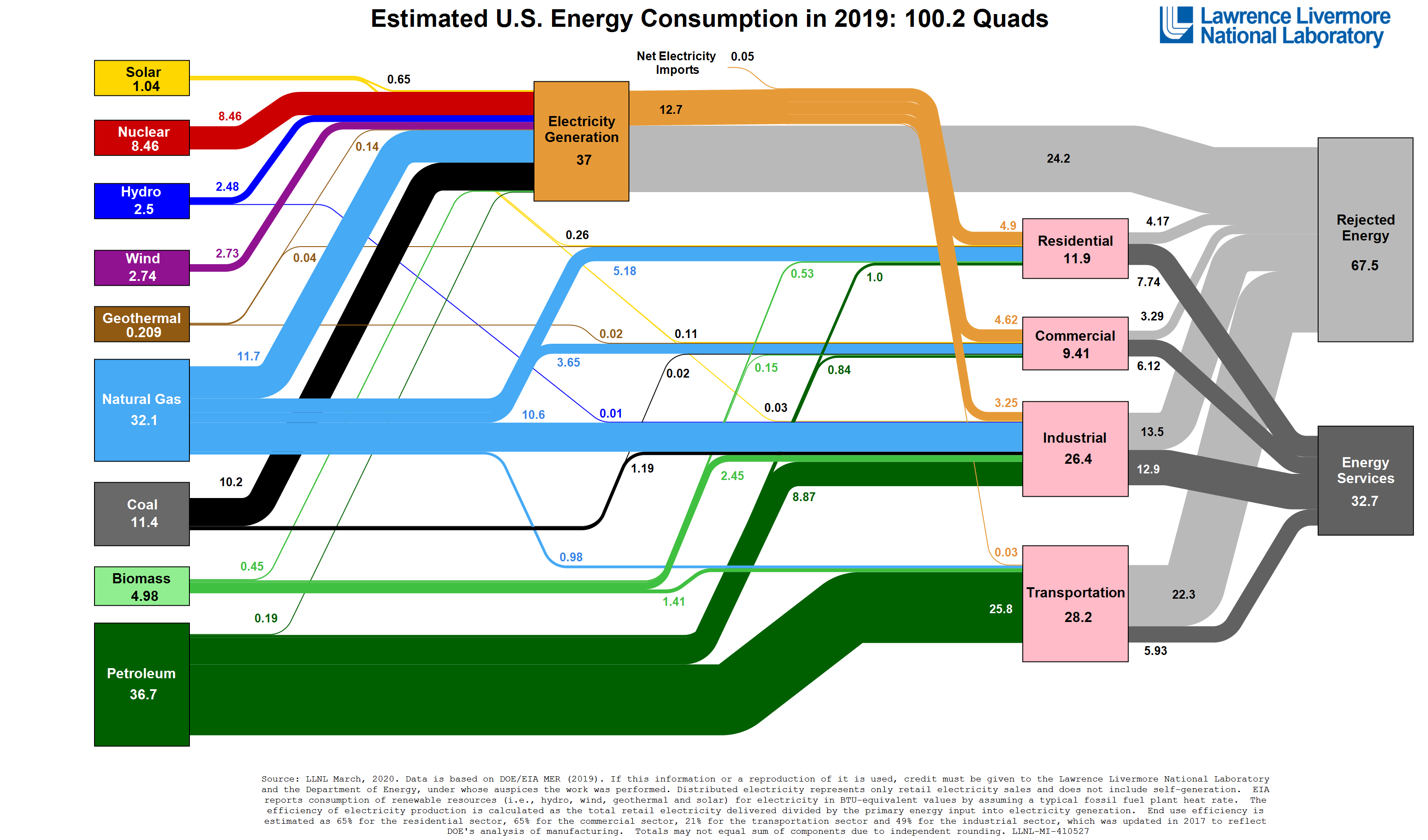
primary energy consumption automatically goes down when switching from fossil fuels to wind, solar and hydroelectricity, because they have no conversion losses according to the usual definition of primary energy;
living standards can be maintained while increasing energy efficiency;
renewables-based systems avoid the significant energy usage of mining, transporting and refining fossil fuels and uranium.[19]
Ultimately, reducing our vulnerability to energy disruptions comes down to building energy systems that are in harmony with the laws of nature. We must change the dynamic of the conversation about climate change. It is critical for the survival of our planet and for the immediate well-being of every person to move rapidly to a sustainable energy system.
It is time to recognize the reality of our interdependence as human species to preserve the biodiversity of the planet and to restore the health of the ecosystems we depend on for our survival. Fresh water, clean air, and fertile ground support life on Earth as we know it. If we continue on this path, driven by greed and adherence to a fossil fueled economy, we will destroy ourselves, and all of the living Earth. I close with this reflection from Rachel Carson:
Mankind has gone very far into an artificial world of his own creation. He has sought to insulate himself, with steel and concrete, from the realities of earth and water. Perhaps he is intoxicated with his own power, as he goes farther and farther into experiments for the destruction of himself and his world. For this unhappy trend there is no single remedy – no panacea. But I believe that the more clearly we can focus our attention on the wonders and realities of the universe about us, the less taste we shall have for destruction.[20]
Citations
[1] IPCC, 2021: Summary for Policymakers. In: Climate Change 2021: The Physical Science Basis. Contribution of Working Group I to the Sixth Assessment Report of the Intergovernmental Panel on Climate Change [Masson- Delmotte, V., P. Zhai, A. Pirani, S.L. Connors, C. Péan, S. Berger, N. Caud, Y. Chen, L. Goldfarb, M.I. Gomis, M. Huang, K. Leitzell, E. Lonnoy, J.B.R. Matthews, T.K. Maycock, T. Waterfield, O. Yelekçi, R. Yu, and B. Zhou (eds.)]. Cambridge University Press.
[7] IPCC, 2022: Summary for Policymakers [H.-O. Pörtner, D.C. Roberts, E.S. Poloczanska, K. Mintenbeck, M. Tignor, A. Alegría, M. Craig, S. Langsdorf, S. Löschke, V. Möller, A. Okem (eds.)]. In: Climate Change 2022: Impacts, Adaptation, and Vulnerability. Contribution of Working Group II to the Sixth Assessment Report of the Intergovernmental Panel on Climate Change [H.-O. Pörtner, D.C. Roberts, M. Tignor, E.S. Poloczanska, K. Mintenbeck, A. Alegría, M. Craig, S. Langsdorf, S. Löschke, V. Möller, A. Okem, B. Rama (eds.)]. Cambridge University Press. In Press. https://www.ipcc.ch/report/ar6/wg2/
[9] Mark Z. Jacobson, Mark A. Delucchi, Mary A. Camerona and Bethany A. Frew. “Low-cost solution to the grid reliability problem with 100% penetration of intermittent wind, water, and solar for all purposes.” PNAS. December 8, 2015. vol. 112 no. 49 www.pnas.org/cgi/doi/10.1073/pnas.1510028112
[14] Robert Pollin, Jeannette Wicks-Lin, Shouvik Chakraborty and Gregor Semieniuk. Impacts of the ReImagine Appalachia & Clean Energy Transition Programs for Pennsylvania – Job Creation, Economic Recovery, and Long-term Sustainability. University of Massachusetts Amherst, Political Economy Research Institute. January 2021. https://reimagineappalachia.org/wp-content/uploads/2021/01/Pollin-et-al-PA-Final-Report-1-22-21.pdf
[20] Rachel L. Carson. “The Real World Around Us.” In Linda J. Lear (Ed.) Lost Woods – The Discovered Writing of Rachel Carson. Beacon Press. Boston 1998. Page 163.
PATRICIA DEMARCO | Wednesday, March 16, 2022 11:00 a.m.
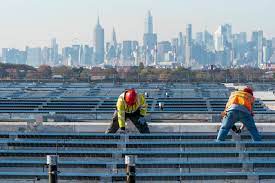
AP Framed by the Manhattan skyline, electricians install solar panels on top of a garage at LaGuardia Airport in New York Nov. 9.
The Russian invasion of Ukraine has renewed calls for energy independence and increased domestic production of oil and gas. However, the call for “energy independence” is nothing more than a distraction, a disinformation campaign propagated by the fossil-fuel industry with the intentions of profiting off this crisis. Despite what they say, the answer isn’t at the bottom of a well. Drilling more oil and gas will only put more money in their pockets. Rather, the surest path to security is to fully ramp up our transition to clean energy.
Here in the U.S., domestic oil and gas production is already at record levels. Meanwhile, clean energy, like wind, solar and other renewable sources, creates good-paying jobs here in the U.S. and is homegrown — so we don’t need to import it and it’s not subject to the wild fluctuations of the global fossil-fuel markets and supply-chain disruptions. Clean energy is how we can achieve greater security, economic stability and a healthier future.
Of course, moving toward clean energy not only creates jobs and decouples the U.S. from its reliance on foreign oil, but also helps solve the climate crisis. There is no time to waste here. Just last month, another dire warning; the United Nations Intergovernmental Panel on Climate Change (IPCC) released a report that confirms that climate change is wreaking havoc on our communities and causing dangerous, widespread disruptions to life as we know it. Many ecosystems have already been irreversibly damaged.
Here in Pennsylvania, we have seen more frequent and severe extreme weather events. Just last month, floods in Western Pennsylvania forced many to evacuate their homes as others needed to be rescued. As flooding continues to worsen, the more damage there will be to our homes and businesses, and more lives will be put at risk.
As the IPCC report makes clear, delaying action will only make things worse. By 2050, the number of dangerous heat days Pennsylvanians experience per year is expected to triple. This is a major concern for all Pennsylvanians, but especially for the more than 310,000 people here who are especially vulnerable to extreme heat. To make matters worse, summer droughts are projected to increase in severity by 50% by 2050.
Tackling climate change in Pennsylvania must start with working to reduce our pollution. Pennsylvania is the 12th most polluted state in the nation. A study conducted in Allegheny County found that children who live near steel mills, power plants and other sources of pollution have three times the risk of developing asthma. In communities of color and low-wealth communities, which disproportionately live near these sources of pollution, over 22% of children suffer from asthma. To put that in perspective, the national average is 8%.
In 2021, the U.S. House of Representatives took bold action by passing $555 billion in investments in climate action, clean energy, justice and jobs. In his State of the Union address earlier this month, President Biden called for the Senate to push these investments through as well. If passed, these investments will be of great benefit to Pennsylvania. We can be a leader in driving the transformation to a low-carbon energy economy. With a strong manufacturing tradition, skilled workforce, and existing infrastructure, Pennsylvania is primed to lead in replacing fossil fuels with solar energy and wind systems made here as well as advanced battery technology, fuel cells and electric grid upgrades for load management through artificial intelligence technology.
The window for making the transformation to a low-carbon future is closing rapidly. This is the time for people of vision and courage to stand together and demand our leaders act on behalf of our children and their grandchildren to assure a sustainable future for our nation and our world. Congress and Biden must immediately work together to get these climate investments over the finish line so that Pennsylvania can thrive like never before.
Patricia DeMarco is a senior scholar at Chatham University and is vice president of Forest Hills Borough Council.
The title of this piece comes from remarks my friend Rev. Marcia Dinkins made at the PA Interfaith Power and Light Annual Meeting. I share this sentiment as a commitment to unrelenting action and advocacy for the essential transformation that must occur if our children are to have a safe and healthy future. There is no prospect for survival beyond this century unless we all take action to shift from a society based on extractive fossil resources to one based on regenerative and sustainable resources.
The transformation a sustainable future is in progress, but moving far too slowly. Every person can act. Every person matters. We can build a sustainable future with equity, resilience and shared prosperity for all of us.
2021 marked a threshold in the global perception of climate change action. Sixty-four percent of people worldwide believe climate change is a global emergency, despite the ongoing COVID-19 pandemic. https://www.undp.org/publications/peoples-climate-vote The “People’s Climate Vote” survey, conducted by the University of Oxford in conjunction with United Nations Development Program, asked respondents if climate change was a global emergency and whether they supported eighteen key climate policies across six action areas: economy, energy, transport, food & farms, nature and protecting people.
UNDP Administrator Achim Steiner said:
“The results of the survey clearly illustrate that urgent climate action has broad support amongst people around the globe, across nationalities, age, gender and education level. But more than that, the poll reveals how people want their policymakers to tackle the crisis. From climate-friendly farming to protecting nature and investing in a green recovery from COVID-19, the survey brings the voice of the people to the forefront of the climate debate. It signals ways in which countries can move forward with public support as we work together to tackle this enormous challenge.”
In America, the picture is much more complicated. In October 2019, a Pew Research Survey found that about six-in-ten Americans (62%) said that global climate change was affecting their local community a great deal or some. And two-thirds of Americans (67%) said the federal government wasn’t doing enough to reduce the effects of global climate change. But there were wide political divides over the effects of climate policy. Partisanship is a stronger factor in people’s beliefs about climate change than is their level of knowledge and understanding about science. Democrats with a high level of knowledge about science (89%) said human activity contributes a great deal to climate change, compared with 41% of Democrats with low science knowledge, based on an 11-item knowledge index. Republicans with a high level of science knowledge (17%) were no more likely than those with a low level of knowledge (25%) to say human activity plays a strong role in climate change. https://www.pewresearch.org/fact-tank/2020/04/21/how-americans-see-climate-change-and-the-environment-in-7-charts/
Each of us can commit to taking action on climate in the New Year- it is the most important gift we can give our children. Here are Five things we can all do to reduce climate causing carbon emissions every day:
1. Speak out and vote. Regardless of our means or station in life, every citizen has the obligation to participate actively in the process of government. We must hold our elected representatives accountable to act in the best interest of our future, not for vested interests mired in the fossil industries. Contact your state and federal Representatives and Senators at least once a month to urge action on climate and protecting our air, water and lands. It is time to restore government actions in support of people and communities instead of enhancing corporate wealth. Trickle down economics does not work. Never has, never will. Strong unions, strong communities, fair wages and good education and medical care for all citizens build the middle class and create a shared prosperity. You can find your federal, state and local elected officials here. https://www.usa.gov/elected-officials See the Reimagine Appalachia Blueprint for good information about policies that will help our region move away from fossil extractive industries , restore the land and build good jobs that support a shared prosperity for all of us. https://reimagineappalachia.org
2. Take responsibility for your own climate footprint. Energy use is the most significant contributor to the greenhouse gases that cause climate warming. Each of us can move our energy use toward zero carbon emissions with deliberate choices.
Implement low-cost and no-cost efficiency measures like setting thermostats higher in summer and lower in winter, sealing up leaks in heating ducts, windows, doors and vents; have an energy audit of your house and make the efficiency improvements that may include adding insulation to attic and walls, replacing windows and doors or upgrading the heating and cooling system. https://www.energy.gov/energysaver/do-it-yourself-home-energy-assessments
Examine your appliances for efficiency and choose efficient options when replacing them. remember to unplug appliances when not in use- anything that has a clock on it, or that runs constantly whether in use or not, turn off computers and electronics when not in active use. “Vampire power” use can be a big drain on your electricity bill. Choose a 100% local renewable energy electricity provider. Here is a resource to guide how to switch. https://electricityrates.com/how-to-compare/switch-electricity-providers/renewable-energy/
3. Eat for Health and a Healthy Planet. Food choices matter for the health of our families and for the. health of the planet. Agriculture contributes to climate change in many ways, not only by carbon emissions from farm machinery and animal wastes, but also by the degradation of soil fertility from over-use of agricultural chemicals such as herbicides, pesticides and fertilizers derived from petrochemicals. Advocate for federal, state and local agricultural land practices that regenerate fertility of the soils a top priority. Agricultural lands in America were once blessed with 12 to 24 inches of topsoil; now more often one to four inches. Building up organic material in the soil through regenerative agricultural practices can sequester carbonated improve fertility of the land. https://rodaleinstitute.org/education/resources/regenerative-agriculture-and-the-soil-carbon-solution/
Convert as much of your energy use to electricity as possible, especially large appliances like hot water heaters, clothes dryers (really consider hanging clothes to dry!) stoves, and heating systems. Modern high efficiency heat pumps can replace gas furnaces for heating.Here are some good resources to guide this effort https://www.rewiringamerica.org
Eat lower on the food chain. You can eat much less meat, or eliminate it from your diet completely. Look for locally produced food and support local farmers, farmers markets and local produce in grocery stores. https://ourworldindata.org/food-choice-vs-eating-local
Avoid food waste. In America, 40% of produced food goes to waste land food scraps and yard waste together currently make up more than 28 percent of what we throw away. Plan menus to use all of the food you buy. Compost food waste and additive to your gardens or to a community composting service. https://www.epa.gov/recycle/composting-home
4. Decarbonize your transportation. Transportation based on internal combustion engines replaced horses within the decade of 1903 to 1913 because cost, convenience and prestige drove a rapid innovation. Similar change can happen if we organize our transportation system to replace the internal combustion engine with electric engines and other transportation technologies. The first personal choice for reducing the transportation energy use is to drive less. Walk when possible, take public transit when possible, and drive conscientiously. Consolidate trips, avoid idling, and keep your vehicle properly tuned up. As you seek to replace your vehicle, shift to an electric hybrid model or to an all-electric model. Economic incentives are emerging for electric vehicles and for the infrastructure such as charging stations and service stations as well as advances in battery and storage systems. https://www.fueleconomy.gov/feg/taxevb.shtml This is a rapidly chancing arena, so watch for updates as the legislation emerges.
Carry re-usable bags for purchases. Some communities are adopting bans on plastic bags.
Look at labels and choose non-plasttic options. There are hundreds of ways to eliminate plastics and I have written about this subject often on tis site. Se this resource for a step by step guide to eliminating plastic. https://myplasticfreelife.com/plasticfreeguide/
As we close this year, the climate battle rages on multiple fronts with the added punctuation of loss from the pandemic casualties. I find hope and confidence in the future in the eyes of so many colleagues fighting every day to improve our situation. I see it in the many hands of people turning to help each other through hard times. I feel it in the love and affection poured out in families and communities as we support each other through grief and sadness. I know it in experiencing the embrace of the living earth as each day dawns anew.May we celebrate the Gifts of the Living Earth in the coming year and for always.
Re-invest in the communities of Appalachia -restore the land, heal the people
Earth Day 2021
In this second decade of the 21st century, we see the beginning of the transformation of our society and our economy away from the extractive fossil fuel base that is driving the climate emergency toward a more resilient, equitable and sustainable, shared prosperity based on renewable resources. The Spring comes as a welcome burst of hope after a long winter of COVID isolation, illness and fear. The living earth emerges once again with flowering trees, verdant woodlands and grasslands, and the manifestations of the cycles of life. These assurances of the resilience and certainty of the natural world offer hope, but also a caution. The laws of Nature are not negotiable. Preserving our life support system of oxygen-rich air, fresh water, fertile ground and the biodiversity of species depends on shifting from extractive fossil fuel industries to regenerative systems for energy, food and materials.
We must focus on the needs of society and the work needed to sustain it rather than on replacing fuels. Technologies from the 1800s – the Rankine steam cycle for electricity generation and the internal combustion engine for transportation – need to be updated with modern, cleaner and more efficient technologies appropriate to the needs of the 21st century.[1]
We have heard President Biden call for an Infrastructure and Jobs Plan which strongly mirrors the ReImagine Appalachia Blueprint for a new economy that works for all of us.[2] Similar to the THRIVE Agenda of Southeastern PA and neighboring states and the Mayors Marshall Plan for Middle America, the ReImagine Appalachia Blueprint has a focus on good-paying union jobs and offers tangible and realistic steps to reach a sustainable future for our state and region.
The ReImagine Appalachia Blueprint expands opportunity through public investments in local communities; builds a 21stcentury sustainable economy; and rebuilds the middle class.[3]
First the plan maximizes good union jobs and provides fossil industry workers with genuine opportunities for doing this work. It ensures access to union jobs for Black, Indigenous, female and low-wage workers. And it ensures community benefits from federal investments through public input and oversight.
Second, the plan restores our damaged lands and waters, modernizes the electric grid, grows manufacturing by making it more efficient and cleaner, builds a sustainable transportation system and revives the Civilian Conservation Corps.
Third the Blueprint promotes union rights, better pay, benefits and local ownership models for working people across all industries in the region.
The jobs impact of this Blueprint is significant for Pennsylvania. A federal investment package with annual average allocations of $11.3 billion to Pennsylvania, from 2021 to 2030, along with an additional $19.7 billion in private investments, would generate approximately 243,000 jobs in Pennsylvania— enough to bring Pennsylvania’s high unemployment rate back down towards 4 percent.[4]
Repair the damage done over the last century– $1.2 Billion federal investment and 9,283 jobs per year from plugging orphaned oil and gas wells, repairing leaks in gas distribution pipelines, and repairing dams and levees.
Modernize the electric grid with a $3.2 Billion federal investment, leveraging $18 Billion in private investment to create 142,999 jobs per year through electric grid updates; building retrofits; solar installations; onshore and offshore wind generation; low-emissions bioenergy (anaerobic digestion); geothermal HVAC systems; and broadband expansion.
Expand Manufacturing by making it more Energy Efficient and Clean– requires 1.28 Billion in federal investment, leveraging $1.08 Billion in private investment and will create 18,016 jobs per year through industrial efficiency upgrades, including combined heat and power; manufacturing research and development; and bioplastics research and development
Build a more sustainable transportation system with a federal investment of $928 million leveraged with $522 million in private investment will create 16,182 jobs per year through public transportation expansion and upgrades including rail; and expanding a high efficiency automobile fleet.
Absorb carbon and Re-launch the Civilian Conservation Corps with a federal investment of $4.7 billion to create 56,700 jobs per year through regenerative agriculture; farmland preservation; land restoration, especially for abandoned mined lands; and restoration of watersheds, waterways and wastewater systems.
The ReImagine Appalachia initiative aims to consolidate our regional Congressional delegation to argue for federal resources directed toward our region because we have built the wealth of the industrial age through industries now in decline, and we need to move to a clean and efficient future. The jobs program presented here relies on the skills and capability of our union workers in electrical system upgrades and new generation integration into a smart micro-grid system. We see good union carpenters, pipefitters, boilermakers and steamfitters employed in anaerobic digestion and fuel cell operations as well as in constructing solar powered buildings that make more energy than they use. The possibilities are real, and only beginning.
No technological breakthroughs are necessary for this new economy to operate building a prosperity that can last without the boom/bust cycles of depleting extractive industries. We can muster the political will to make the necessary changes in policy and practice to support a new economy for the 21st century. Pennsylvania can assume a leadership role in building the new economy in three primary ways:
Adjust the regulatory infrastructure to enable rather than inhibit expansion of renewable energy systems and practices. Adopting practices such as uniform building standards for solar and wind installations, enabling a utility tariff system for virtual net metering and community shared power, joining the Regional Greenhouse Gas Initiative, and adopting a universal passive solar design building code for all new commercial and residential buildings are part of this process. Conduct a comprehensive review of regulations to enable sustainable practices and empower workers.
Shift Pennsylvania state subsidies toward private investment in the newer clean technologies addressed in the jobs scenarios above. Pennsylvania provided $3.8 billion in fossil fuel subsidies in Fiscal Year 2019 by systematically disabling many of its standard tools for collecting tax revenues, allowing the industry to extract public resources at little to no charge, and awarding the industry grants and tax credits. Meanwhile, in the same time period, the industry imposed $11.1 billion worth of external costs to the state and its residents.[5] Pennsylvania can use these subsidies to entice private investment into the green jobs arena instead.
Empower local communities to attract investment in innovation. Establishing enterprise zones around re-purposed industrial or marginal commercial spaces before the tax base erodes to the point of bankruptcy will enable communities to offer resources for reinvigorating their economy before they fall into despair. Provide support for planning together around regional efforts to coordinate resource allocation and opportunities.
I would like to speak to the role of the gas industries in the sustainable future. The gas industries, especially in the Marcellus Shale region and the sectors pressing for plastics production, pose mighty and well-funded opposition to any perceived competition from renewable resources. Preserving the historic business model of extraction, combustion, or using fossil-based raw materials for single use commodities is not compatible with a sustainable future. The expertise and infrastructure of the gas industry is uniquely suited to developing methane from anaerobic digestion of municipal waste and sewage. Methane produced from these sources, as well as from manure pools of farm animals, stays in the contemporary carbon cycle and does not draw from carbonized remains of living plants that created the 20% oxygen in our atmosphere millions of years ago. Using anaerobic digestion creates methane biogas that can be sent into the existing gas distribution system for home heating. This would shift home heating from a fossil base to a sustainable base. In addition, biogas can be used to create hydrogen for fuel cells to generate electricity through a chemical reaction similar to a battery, without combustion. This technology is mature and operating efficiently in Germany, Japan, Korea and France based on American technology developed through space exploration research and commercialized in the 1990s.(6) The gas industry would rightly enjoy a leadership position in building a truly sustainable economy by making this kind of a shift in focus.
The true wealth of Pennsylvania lies in the land that supports us. Not the fossil resources buried deep within the crust of the Earth, but the living earth, the fertile ground that gives life to our planet through binding essential elements to create food, fiber, fuel, and oxygen. When we restore the land and empower the people, we set the foundation for a long-lasting prosperity for all of our citizens.
Citations and Resources:
[1] Patricia M. DeMarco. Pathways to Our Sustainable Future- A Global Perspective from Pittsburgh. University of Pittsburgh Press. 2017.
As I sit in my study watching fat snowflakes drift past the window, my mind wanders to the warmer times of summer walking through the protected lands of the Allegheny Land Trust. From the depths of the woods, it is easier to feel part of the web of life that holds all of us. The forest ecosystem moves in a succession of interconnected living things toward a climax community, the equilibrium point where the annual production and import of resources exactly matches the annual consumption and export of resources. It is a self-perpetuating condition where the living systems are in perfect harmony with the supporting physical environment. The ant and the snail are no less partners than the mighty maples or the bear that occupy the climax community, all are interconnected and essential for sustained balance. Natural ecosystems progress through a succession unique to each place toward a climax equilibrium. I wonder how much of the Earth would reach this ideal state absent the perturbations of human activity?
Human civilization has not grown with a balanced advance toward a climax equilibrium that natural systems follow. Rather, we have withdrawn massive amounts of raw material from fossil reserves deep in the Earth and converted that material to trash as rapidly as possible to generate economic advantage. Worse, the way we compute value and economic benefit excludes the intrinsic flow of value vested in ecosystems. The global pollution from plastics discarded after a single use epitomizes the mark of modern society. Wasted material, vested with massive amounts of resources, pile up on the shores, in landfills, in the ocean, and blows around in neighborhoods littered with discarded stuff.
II. Rethinking Plastic in a Circular System – a discussion of alternative materials that can replace plastics, especially for single-use products, and definitions of the different kinds of bio-plastics.
There is much discussion about “Bio-Plastic,” but the term can be confusing. Generally, there are two major classes of plastics: (2)
– Thermoplastics are a family of plastics that becomes mold- able when heated and hardened upon cooling. They account for over 90% of the mass of plastics produced.27 The most commonly encountered thermoplastics are PE, PP, polystyrene (PS), polyvinyl chloride (PVC), acrylic, nylon, and PET;
– Thermosetting polymers are plastics that have been irreversibly hardened in a way that prevents melting. Most popular thermosets are used as the matrix in fiberglass, polyurethanes (PUR), vulcanized rubber, and urea-formaldehyde foam.
– Bio-based plastic polymers are produced from biomass or by living organisms, and they may or may not be biodegradable.
– It is also possible, but more expensive, to produce biodegradable plastics of petrochemical or mixed origin.
However, plastic products usually consist not only of the basic polymer but also different often environmentally damaging additives incorporated into a plastic compound, such as plasticizers, flame retardants, antioxidants, acid scavengers, light and heat stabilizers, fillers, lubricants, pigments, antistatic agents, slip compounds, and thermal stabilizers. Depending on the product, these additives can sometimes account for more than 50% of the mass of the final plastic product. (3)
III. Build the Regulatory Infrastructure for a Circular Materials System -ways to move toward a circular materials management system and policy recommendations to address the market failures that have caused the inundation of plastic waste. The invisible hand of the market will not solve the failures of the current system of materials management. We must move from a linear value chain to a circular one, modeling our supply sources, production, use and re-use of materials after natural systems.
IV. Resources and Citations for further study.
You can read the entire paper with illustrations and references here:
As 2020 closes, I am weary from struggling against the challenges that confront us. With the approval of a vaccine, people see an end to the stress and fear of this pandemic that has taken the lives of 316,844 Americans with 1.8 million infected by the coronavirus. (1) We long for a return to “normal.” But as we wait for the pandemic to recede, it is critical to recognize the important lessons that emerge from this crisis. COVID-19 amplified difficulties that have always been present and forced a reckoning. The Presidential election in this year of pandemic restrictions gave a stress test to our institutions, and we passed, but with huge red flags waving. We have taken one step back from the edge of an abyss, but we have yet to make a turn in the direction of resilience, inclusion and prosperity for all, in America and around the world. As we execute a recovery from COVID, we must take the opportunity to address the complex problems revealed and build a New Normal.
The interconnected
web of life
Lessons to shape a “New Normal”
Take responsibility to preserve the interconnected web of life. The pandemic of COVID-19 is a predicted symptom to the destruction of the ecosystems that support life on Earth. Human infrastructure, industrial agriculture and extractive resource industries have altered the Earth significantly. According to the Fifth Global Biodiversity Assessment, 75 per cent of the land surface is significantly altered, 66 per cent of the ocean area is experiencing increasing cumulative impacts, and over 85 per cent of wetlands area has been lost. While the rate of forest loss has slowed globally since 2000, this is distributed unequally. Across much of the highly biodiverse tropics, 32 million hectares of primary or recovering forest were lost between 2010 and 2015. Over one million species face extinction within a decade. (2) Transformative changes in the way we produce food, obtain and use energy, and manage materials can protect and restore biodiversity, habitats and ecosystems. Preserving biodiversity is our best defense against further pandemic outbreaks from viruses and diseases that cross from animals to humans either from contact or from food chains. Using agricultural land to capture carbon, protect watersheds and pollinators and provide food primarily for people rather than for animals can limit the wasteful depletion of soil from industrial agriculture practices.(3) We must adjust all of our policies and practices to protect our life support system, the gifts of the living earth. (4) It must be our mission to protect and restore natural ecosystems and integrate human activities into their functions without destroying them. The technology and policy pathways to do this are known and operate well. We must make the moral and ethical choice to live in harmony with Nature.
3. The mainstream economy is not working for millions of Americans. Household incomes have grown only modestly in this century. Economic inequality, whether measured through the gaps in income or wealth between richer and poorer households, continues to widen. Households near the top of the economic ladder had incomes that were 12.6 times higher than those at the bottom in 2018. (5) Income inequality has increased by about 20% from 1980 to 2016 according to Congressional Budget Office reports. (6) Moreover, one-third of US adults either can’t pay all their bills or are one small problem away from it. Forty three percent of rural households report adult household members have lost their jobs, been furloughed, or had wages or hours reduced since the start of the COVID outbreak, with two-thirds of these households (66%) reporting serious financial problems. (7) The pandemic crisis has made evident the stark reality that faces nearly half of Americans- we are one paycheck away from disaster. Savings are insufficient to the need, and loss of a job to illness or business closure leaves millions with no recourse but bankruptcy and despair. Millions see no path to upward mobility or wealth accumulation, and most believe they are powerless to change the situation. One way to address this issue is to strengthen unions and establish a higher minimum wage, with adjustments to the cost of living regularly incorporated into the minimum wage index. As union membership declines, more of the income share has gone to the top 10% of wage earners. The weakened bargaining power of workers since 1979 has continuously decreased the earning power of workers (11.1% growth) compared to productivity increases (70.3% growth) from 1979 to 2017. At the same time, a greater share of corporate earnings has gone to the capital owners, expanding the earnings gap significantly over this period. (8)
2. Acknowledge and address systemic racism. This year, America was confronted again with the painful reality that our country was founded on the genocide of Indigenous Peoples of this continent and was built on a culture of slavery and indentured servitude. The statistics on COVID impact on people of color made the inequities of systemic racist practices impossible to ignore. It is clear that without acknowledging that the Health Gap, the Wealth Gap and the Power Gap stem from long-sustained practices and deliberate policies of oppression, we will be unable to heal this nation and find our common ground. (9) We are none of us free until we take responsibility for the rights of the downtrodden. None of us are free as long as our fellow citizens are abused before the law. We are all guilty if we stand by in silence while our fellow citizens suffer injustice, abuse and despair. Public demonstrations for Black Lives Matter in the face of police killings of black people in multiple locations around the country raised this issue again. More police, training for police or defunding police were proposed in various locations to keep peace. Freedom is not free- it comes with a responsibility to fight for justice, to act for fairness, and to demand accountability from those in power. (10) Redressing the legacy of redlining districts, of limiting credit for business and personal loans, and failing to provide the social infrastructure to support people and communities of color must take a higher priority in public policy. Those of us who do not bear the daily burden of hatred must stand up and lift that yoke of racist hatred from the backs of our Brothers and Sisters.
4. Govern for The People, not corporations. The pendulum of politics swings over decades from right to left and back, driven by circumstances and the struggle for power. Two forces have shaped our governance culture since the 1980’s. The Regan Administration introduced a governing principle of economic determination for all federal programs, and argued for a trickle down effect for government spending. Thus, federal programs that did not meet the economic productivity test were defunded and gradually eroded. These included education programs, grants to the arts and to basic research, social services, health care services and public parks. Even under the Democratic administrations in the period 1979 to 2020, there was little push back to these policies in principle. At the same time, the influence of corporate interests expanded considerably through Citizen United granting corporations the rights of “persons” under the law. And finally the heavily gerrymandered voting districts where districts are aligned for political advantage rather than for logical and fair distribution of representation for voters. While productivity of American businesses grew 70.3% between 1979 and 2017, hourly compensation of workers grew by only 11.1% in the same period. ( 11) These disparities are not accidental, but rather flow from specific subsidies and tax policies. The social inequities in wealth, health care, education and access to capital have grown from these practices which give advantage to the top 10% and corporations, even multinational corporations not headquartered in America, to the disadvantage of working people. (11 ) Environmental protections, climate mitigation and protection of public lands and parks have likewise fallen in priority to the advantage of specific corporate interests. It is time to return the priorities of government to protecting the interests of The People, to govern for the public interest, not private benefit. For this year and the next three decades, we must sustain a divestment from subsidies to fossil extractive industries at all levels from research, exploration, production and development of infrastructure. We must invest in communities to build the infrastructure for the green economy, creating manufacturing and restorative jobs in areas abandoned and left waste by prior decades of extraction. We must restore the environmental protections and the social safety net that sustain the well being, productivity and quality of life for all Americans, placing priority on those most affected by sacrifice zones and abandoned extractive practices such as the people of Appalachia. (12 )
Decide to preserve a living planet with a just, inclusive, caring society for our children and theirs to seven generations forward.
The Awesome Woodland Hills High School Climate Action Team of 2020
As we close this year of challenge and such sadness, we can look ahead to a better time. The solutions to the inter-related problems of environmental degradation, racial and social injustice and wealth disparity can be solved like a set of simultaneous equations. Only by integrating environmental health with a social safety net based on respect for the dignity of every person can we reach a sustainable prosperity. We must restore the value that to achieve prosperity that can be sustained, we must create an inclusive structure where all can thrive. The bloated enrichment of the top few has distorted our sense of what is right and just. Without justice there is no peace. Without accountability there is no freedom. Without love, there is no life.
2. IPBES (2019): Summary for policymakers of the global assessment report on biodiversity and ecosystem services of the Intergovernmental Science-Policy Platform on Biodiversity and Ecosystem Services. S. Díaz, J. Settele, E. S. Brondízio E.S., H. T. Ngo, M. Guèze, J. Agard, A. Arneth, P. Balvanera, K. A. Brauman, S. H. M. Butchart, K. M. A. Chan, L. A. Garibaldi, K. Ichii, J. Liu, S. M. Subramanian, G.F.Midgley, P. Miloslavich, Z. Molnár, D. Obura, A. Pfaff, S. Polasky, A. Purvis, J. Razzaque, B. Reyers, R. Roy Chowdhury, Y. J. Shin, I. J. Visseren-Hamakers, K. J. Willis, and C. N. Zayas (eds.). IPBES secretariat, Bonn, Germany. 56 pages. (https://www.ipbes.net/sites/default/files/2020-02/ipbes_global_assessment_report_summary_for_policymakers_en.pdf )













 Patricia DeMarco Ph.D.