Patricia DeMarco Ph.D.

"Live in harmony with nature."


Leave a comment

The Voice of the Earth Rising

As 2015 comes to a close, we mark a rare congruence of awareness and a call to action on climate change. In advance of the COP-21 talks in Paris, the leaders of all of the world’s major religions have called for true stewardship of the Earth.  The Encyclical of Pope Francis, Laudato Si

 http://w2.vatican.va/content/francesco/en/encyclicals/documents/papa-francesco_20150524_enciclica-laudato-si.html,

the Islamic Declaration on Global Climate Change http://islamicclimatedeclaration.org/islamic-declaration-on-global-climate-change/

and the Universal Declaration of the Rights of Mother Earth from the People’s Climate Conference in Cochabamba,  https://pwccc.wordpress.com/programa/

calls to action resound with increased urgency. The COP-21 Accord, though non-binding, united the voices of 195 nations to strive for a 2 degree ceiling, with many advocating a goal of a 1.5 degree limit, in temperature rise by mid-century.

imagesIt is my hope for the new year that we can recognize the critical importance of the living Earth. We hear the voice of the Earth not in words but in the songs of birds and of whales; in the intricate ballet between flowers and pollinators; in the exhalation of forests and phytoplankton; and the sweep of landscapes. Earth speaks also in pain as forests are felled; oceans become acidic; mountaintops are scraped off; and the carbon dioxide of human energy production and agriculture pollute the air and water.

As we celebrate our Holidays and make plans for the New Year, may we remember that we are more alike in our humanity than different in cultures, religions or customs. May we reach out to work together to preserve and restore the life support systems of the living Earth- fresh water, clean air, fertile ground and the biodiversity of species that constitute the global web of life. May we work together for justice and equity as we face the necessary transitions from despoiling to preserving the resources of the Earth.

To my Colleagues who have helped me in so many ways this year as my manuscript has come together, I offer thanks for gifts beyond measure. Thank you for all you are doing to build a Pathway to Our Sustainable Future. May we all hear and embody the great power of the voice of the Earth. The children of the 21st century deserve our fullest effort to preserve our beautiful living Earth. To my grandchildren, and the nieces and nephews of my family, I solemnly promise my whole life to protecting your future.

Buon Natale!


1 Comment

The Critical Agenda for COP-21 in Paris

In addressing the opening session of the COP-21 session in Paris, President Obama has called for “A world that is worthy of our children.  A world that is marked not by conflict, but by cooperation; and not by human suffering, but by human progress.  A world that’s safer, and more prosperous, and more secure, and more free than the one that we inherited.”

Lofty aspirations designed to engender a spirit of cooperation make excellent rhetoric. The reality is quite different.  America retains an “All of the above” energy strategy, as reported in the 2015 Energy Outlook by the EIA: “While the overall energy history of the United States is one of significant change as new forms of energy were developed, the three major fossil fuels—petroleum, natural gas, and coal, which together provided 87% of total U.S. primary energy over the past decade—have dominated the U.S. fuel mix for well over 100 years. Recent increases in the domestic production of petroleum liquids and natural gas have prompted shifts between the uses of fossil fuels (largely from coal-fired to natural gas-fired power generation), but the predominance of these three energy sources is likely to continue into the future.” The effects of the Clean Power Plan noted by President Obama in his remarks in Paris are not included in the 2015 Energy Outlook, and in fact the CPP was rejected by the U.S. Senate on Tuesday. Our country is a house divided, conflicted and distracted in its focus. Climate change remains a partisan, divisive issue, with no consensus on action in sight.

Changing the frame of reference of the discussion may be helpful. While the political forces vie over the pace of continued exploitation of fossil resources for fuels, the systems of the living planet earth show signs of breaking down.  If the Milankovich cycle estimates are accurate,  our planet is in the period of its orbital cycle most closely spherical, a period between ice ages when life flourishes. But, this period of stability has been compromised by the combustion of fossil reserves for fuel, and the simultaneous destruction of oxygen producing forests and phytoplankton. The components of the planet that provide the life support system of oxygen-rich air, fresh water, fertile ground and the complex biodiversity that connects all living things are being compromised by human actions. The negotiations at COP-21 in Paris focus on sharing rights and responsibilities among nations, and seeking compensation and balance for development in differing economies.  There is no discussion about the rights of the living earth on which all of humanity depends.

The People’s Movement for the Rights of Mother Earth are bringing the following Universal Declaration to the negotiations at COP-21 with a tribunal on December 7th.  Here is the preamble to that declaration:

We, the peoples and nations of Earth: 

Considering that we are all part of Mother Earth, an indivisible, living community of interrelated and interdependent beings with a common destiny;

Gratefully acknowledging that Mother Earth is the source of life, nourishment and learning and provides everything we need to live well;

Recognizing that the capitalist system and all forms of depredation, exploitation, abuse and contamination have caused great destruction, degradation and disruption of Mother Earth, putting life as we know it today at risk through phenomena such as climate change;

Convinced that in an interdependent living community it is not possible to recognize the rights of only human beings without causing an imbalance within Mother Earth;

Affirming that to guarantee human rights it is necessary to recognize and defend the rights of Mother Earth and all beings in her and that there are existing cultures, practices and laws that do so;

Conscious of the urgency of taking decisive, collective action to transform structures and systems that cause climate change and other threats to Mother Earth;

Proclaim this Universal Declaration of the Rights of Mother Earth, and call on the General Assembly of the United Nation to adopt it, as a common standard of achievement for all peoples and all nations of the world, and to the end that every individual and institution takes responsibility for promoting through teaching, education, and consciousness raising, respect for the rights recognized in this Declaration and ensure through prompt and progressive measures and mechanisms, national and international, their universal and effective recognition and observance among all peoples and States in the world. ( See full text here of the Articles of the Universal Declaration for the Rights of Mother Earth)

https://pwccc.wordpress.com/2010/08/16/the-proposals-of-%E2%80%9Cpeoples-agreement%E2%80%9D-in-the-texts-for/

This declaration was created at the People’s Climate Conference in Cochabamba, Bolivia in April 2010, signed by 288 organizations from around the world, and carried to the COP-21 talks with even greater support of nations, individuals and more organizations.

We must recognize that only by preserving and protecting the ability of the living earth to serve the vital ecosystem functions will we survive and thrive on this planet. The services that generate oxygen-rich air, filter and purify water, create food and fiber from photosynthesis, and many others, come from the interconnected operations of the living systems of the planet.  Humans are one part of that interconnected web of life. Extracting resources without any thought to replacement, restitution of disruptions, or protection to vital components has brought our civilization to the bring of extinction.  From billions to none can happen within a generation, as is evident from the loss of creatures such as the passenger pigeon. We are witnessing the extinction of nearly 25,000 species this year alone.

Recognize this challenge to control the excesses of consumption and waste. Seek to unleash the imagination and aspirations of the most wise among us in the ways of living within the constraints of the resources of the living earth, without continuing to exploit non-renewable components of the earth’s crust. Apply technology with the goal of regenerating and renewing the life support systems of the living earth, not subduing and suppressing them. If we in America can apply our ingenuity and expertise to solve the issue of controlling greenhouse gas emissions, stability and prosperity will follow.  Greed is the enemy.  It is time for a just transition to a renewable and sustainable way of living.


Leave a comment

Support for the Federal Clean Power Plan

The following testimony was filed in the EPA Hearings in Pittsburgh on the Final Rule for the Federal Clean Power Plan.  There is a move in progress in the U.S. Senate to block this initiative.  If anything, this effort must be strengthened and accelerated, not stopped. Call you Senator TODAY!

RE: Docket ID: EPA-HQ-OAR-2015-0199

Federal Plan Requirements for Greenhouse Gas Emissions from Electric Utility Generating Units Constructed on or before January 8, 2014; Model Trading Rules; Amendments to Framework Regulations.

My name is Patricia M. DeMarco.[i] I reside at 616 Woodside Road in Pittsburgh Pennsylvania. I am speaking in trust for my grandchildren, and all the unborn children of the 21st century whose fate is set by the actions we take to address climate change.

The Federal Clean Power Plan presented in this regulation sets out a framework in which to begin curtailing emissions from existing power plants. I recognize the difficult political environment surrounding this effort. It is important to begin the process of curtailing fossil fuel combustion, but the cautious approach offered in the Federal Clean Power Plan will not meet the urgent need we face. There are three areas where more attention must focus going forward to control greenhouse gas emissions from existing electric generating units:

  1. The final target for acceptable emissions by 2030 is too low.
  2. Environmental and social justice issues are not adequately addressed.
  3. The plan does not encourage creative approaches that set the elimination of fossil fuel combustion as a firm goal.
  1. Target is too low.

If the Federal Clean Power Plan for Existing Electric Utility Generation is fully successful, by 2030 emissions from the electricity- generating sector will only be reduced by 32% below the levels in 2005. That will maintain 1.2 billion metric tons per year of carbon dioxide emissions from fossil electricity production.[ii] The World Meteorological Organization reports levels of carbon dioxide, the main greenhouse gas, climbing steadily towards the 400-parts-per-million (ppm) level, having hit a new record every year since reliable records began in 1984. Carbon dioxide levels averaged 397.7 ppm in 2014 but briefly breached the 400-ppm threshold in the northern hemisphere in early 2014, and again globally in early 2015.[iii] As carbon dioxide and other greenhouse gases continue to accumulate, the production of water vapor in the air accelerates due to warmer conditions, which magnifies the warming effect even more. Warmer temperatures are melting the permafrost releasing tons of trapped methane from the tundra in the Arctic.[iv] The goal of limiting atmospheric carbon dioxide to 350 parts per million no longer appears achievable. The actions contemplated in this regulation are insufficient to the urgency of the situation our children will face.

As a practical matter, the EPA is attempting to retain a minimum disruption of business as usual for the electric utility industry. The final rule states: “Fossil fuels will continue to be a critical component of America’s energy future.”[v] This rule alone will not meet the need to maintain viable climate conditions for the future. A more comprehensive climate policy is required.

  1. Environmental and Social Justice Issues

There are three levels of environmental and social justice issues inherent in the Federal Clean Power Plan. First, the Community Impact Assessment in the Plan shows the burden of pollution continues to fall disproportionately on disadvantaged people within three miles of the target power plants. In Pennsylvania, fifty-one existing electric generation units are targeted in the Clean Power Plan. Within a three mile radius of these plants, 1,853,694 people are exposed to particulates, sulfur dioxide, nitrogen oxides, hazardous air pollutants, and heavy metals like mercury, cadmium and lead emitted from coal combustion. One single plant in Pennsylvania affects 447,057 people of whom 61% are minorities, 49% are low income, 18% are below high school education, 6% are children and 12% are elderly. This plant emits pollution levels in the 89th percentile – it has pollutants above the recommended safe levels. The ethical and appropriate decision for this kind of plant is to take it off line, and seek replacements for this power from renewable and non-combustion power sources.

The second social justice issue pertains to the workers in the fossil fuels industries. 80,000 coal miners, 147,000 oil and gas field workers face declining employment opportunities as part of the transition to a non-fossil future. It is essential to proactively protect the future of these workers.[vi] The corporate behavior towards workers has not been encouraging to date, as companies such as Peabody Coal have off-loaded retirees and laid off workers with their pension and health benefit obligations, to shell corporations like Patriot Coal, which soon declares bankruptcy, leaving the workers to an uncertain fate.[vii] This behavior may be legal within the laws of corporate finance, but it is wrong. Federal subsidies of $18 to $35 billion per year flow to large multinational corporations for oil, gas and coal exploration, development and production.[viii] These funds could be used to address the social justice needs of displaced fossil fuel workers.

The third environmental justice issue is the unattended remediation and restoration of the land. When the continued production of fossil fuels is no longer a priority, companies will have even less incentive to restore land, watersheds or ecosystem services disrupted by extraction and production activities. As they have done for years, they will walk away taking their profits and investing in the next big thing, leaving the remains of their resource extraction to be addressed as public obligations. In Pennsylvania alone over 3,000 miles of streams have been permanently degraded from mining.[ix] More watersheds and lands are becoming affected by Marcellus and Utica shale drilling and production activities. The profits come in short term bursts to private companies, but the environmental impact may lag by years, even decades, and the cost of remediation falls to the public. Withdrawing from fossil fuel extraction must include remediation and restoration to the extent possible. Mountain tops removed for coal extraction remain as scars on the land, looking more like moonscapes than forested, rolling hills formerly sheltering homes and towns. We must build a future that respects and restores the land. On April 22, 2010, the world’s Peoples Conference on Climate Change adopted a Universal Declaration for the Rights of Mother Earth. It declares in part: “Article 3. respect, protect, conserve and where necessary, restore the integrity, of the vital ecological cycles, processes and balances of Mother Earth”[x] The United States should join the 126 nation signatories to this declaration. The time of brute resource extraction without restoration and protection of the living systems of the earth is overdue to end.

  1. The lost opportunity to challenge innovation.

The Federal Clean Power Plan appears to displace fossil fuels as slowly as possible, rather than as rapidly as possible. There is no aspirational goal of eliminating fossil fuel combustion by 2030 or even by 2050. There is no commitment to enable the maximum possible contributions from renewable resources and energy demand reduction by efficiency improvements. In fact, major impediments to using non-combustion technologies remain embedded in the energy system. For example, constructing a passive solar, zero net energy house in Pittsburgh requires 22 variances from existing zoning regulations.[xi] Subsidies to fossil fuel development and exploitation remain, while investment mechanisms for either renewable resource development or abatement of fossil fuel environmental effects are variable, and relatively limited. In 2014, US taxpayers were subsidizing fossil fuel exploration and production alone by $18.5 billion a year, an increase of 45% from 2009.[xii] An “All of the above” energy policy will not achieve the goal of eliminating fossil fuel combustion by 2050 to control life-threatening changes in the climate.

Using existing commercial technologies, it is possible for the United States to reach an electricity generation carbon dioxide emissions target of 750 million metric tons per year by 2050 at a cost of less than 1% of the annual Gross Domestic Product. According to a study completed in November 2014 for two national laboratories, deep de-carbonization requires three fundamental changes in the U.S. energy system: (1) highly efficient end use of energy in buildings, transportation, and industry; (2) de-carbonization of electricity and other fuels; and (3) fuel switching of end uses to electricity and other low-carbon supplies.[xiii] “All of these changes are needed, across all sectors of the economy, to meet the target of an 80% GHG reduction below 1990 levels by 2050. Energy system changes on the scale described in this analysis imply significant opportunities for technology innovation and investment in all areas of the U.S. energy economy. Establishing regulatory and market institutions that can support this innovation and investment is critical. Both areas— technology innovation and institutional development—are U.S. strengths, and place the U.S. in a strong leadership and competitive position in a low carbon world.”[xiv]

Investing in clean energy and reducing greenhouse gas emissions, the United States would add more than one million jobs by 2030 and nearly two million by 2050. By reducing emissions 80% below 1990 levels by 2050, the United States would also increase GDP by up to $290 billion and raise household incomes.[xv] Gains in construction, manufacturing, and other sectors outweigh losses in fossil-fuel industries resulting in a net-gain of employment across the nation.[xvi] A strong commitment to eliminating fossil fuel combustion, with a just transition for workers, rather than slowly ramping down by “market forces” will be more likely to reach a meaningful goal for controlling climate change and will enhance economic viability during the transition.

Americans have demonstrated time and time again the ability to rise to meet a challenge. What is totally lacking in this Federal Clean Power Plan is the inspiration to reach for a new solution. This plan tinkers and tweaks the existing flawed and inefficient electricity generation system, retaining as much of the historic infrastructure and equipment as possible, with no intention to eliminate fossil fuel combustion as the end point. Our children deserve better! Think of the conditions we are imposing on the next generation, conditions we cannot even imagine because the earth has not experienced them for millions of years, if ever. Preventing the worst of the effects of climate change is our obligation to the children of the 21st century. We should set a challenge goal of zero fossil fuel combustion by 2050, and align all systems, the creativity of the American people, and the full might and weight of government resources to achieve that goal.

When President Kennedy challenged us to set foot on the moon, the goal seemed impossible. But the challenge inspired a generation. The technologies spun from that effort yielded results that transformed the world. Our survival as a species is no less of a challenge. There is no supply line to planet Earth but the stream of energy from our sun. It falls on us in a super-abundance to our daily needs. We have only to meet the challenge of organizing our energy systems to use it. Call on the ingenuity and entrepreneurship of our nation rather than stall, suppress and regiment innovation to preserve the systems of the past.

Sources and Citations

[i] Patricia M. DeMarco, Ph. D. full Curriculum Vitae is at www.patriciademarco.com

[ii] Carbon Dioxide Emissions from Energy Industry in 2005 Report #:DOE/EIA-0573 (2009)Release Date: February, 2011 http://www.eia.gov/environment/emissions/ghg_report/pdf/tbl6.pdf

(5,996.4 million metric tons in 2005 reduced by 32% = 1,918.8 million metric tons)

[iii] World Meteorological Organization of the United Nations. Bulletin November 6, 2015. “Greenhouse Gas Concentrations Hit Yet Another Record.” https://www.wmo.int/media/content/greenhouse-gas-concentrations-hit-yet-another-record Accessed November 9, 2015.

[iv] Kevin Schaefer. Methane and Frozen Ground. National Snow and Ice Data Center. https://nsidc.org/cryosphere/frozenground/methane.html Accessed November 10, 2015.

[v] Federal Clean Power Plan Fact Sheet. http://www2.epa.gov/cleanpowerplan/fact-sheet-overview-clean-power-plan

[vi] Jeremy Brecher. “How to Promote a Just Transition and Break Out of the Jobs vs. Environment Trap.” Dollars & Sense. November/December 2015. Pages 20-24.

[vii] Matt Jarmesky and Peg Brickley. “Patriot Coal Again Files for Chapter 11 Bankruptcy.” Wall Street Journal. May 12, 2015. http://www.wsj.com/articles/patriot-coal-files-for-chapter-11-bankruptcyagain-1431435830 Accessed November 10, 2015.

[viii] ICF International. Economic Analysis of U.S. Decarbonization Pathways. November 5, 2015. http://nextgenamerica.org/news-reports/new-report-transition-to-clean-energy-will-create-millions-of-jobs-increase-gdp-and-raise-household-incomes/ Accessed November 10, 2015.

[ix] U.S. Geological Survey. Pennsylvania Water Science Center. “Restoration of Stream Water Degraded by Acid Mine Drainage.” http://pa.water.usgs.gov/projects/energy/amd/restoration.php Accessed November 10 2015.

[x] World People’s Conference on Climate Change. “Universal Declaration of the Rights of Mother Earth” Cochabamba, Bolivia. April 22, 2010. http://therightsofnature.org/universal-declaration/ Accessed November 10, 2015.

[xi] Lucyerna DeBabaro personal communication. Cite Solarize Allegheny

[xii] Oil Change International. July 2014. “Cashing In on an All –of –the Above: U. S. Fossil Fuel Production Subsidies under Obama 2009 to 2014. Page 7.   http://priceofoil.org/2014/07/09/cashing-in-on-all-of-the-above-u-s-fossil-fuel-production-subsidies-under-obama/

[xiii] Energy and Environmental Economics, Lawrence Berkley National Laboratory, Pacific Northwest National Laboratory. U.S. 2050 Report: Pathways to Deep Decarbonization in the United States. November 2014. Page xv. http://deepdecarbonization.org/wp-content/uploads/2015/09/US_DDPP_Report_Final.pdf Accessed November 10, 2015.

[xiv] Energy and Environmental Economics, Lawrence Berkley National Laboratory, Pacific Northwest National Laboratory. U.S. 2050 Report: Pathways to Deep Decarbonization in the United States. November 2014. http://deepdecarbonization.org/wp-content/uploads/2015/09/US_DDPP_Report_Final.pdf Accessed November 10, 2015.

[xv] ICF International. Economic Analysis of U.S. Decarbonization Pathways. November 5, 2015. http://nextgenamerica.org/news-reports/new-report-transition-to-clean-energy-will-create-millions-of-jobs-increase-gdp-and-raise-household-incomes/ Accessed November 10, 2015.

[xvi] ICF International. Economic Analysis of U.S. Decarbonization Pathways. November 5, 2015. http://nextgenamerica.org/news-reports/new-report-transition-to-clean-energy-will-create-millions-of-jobs-increase-gdp-and-raise-household-incomes/ Accessed November 10, 2015.


Leave a comment

Looking Beyond Green Jobs

I recently attended the Canadian and United States Societies of Ecological Economics meeting in Vancouver, British Columbia in Canada. Hearing economists debate how to include ecological and biophysical values into the metrics for assessing progress raised my sense of exasperation, and kindled a small flame of hope. David Suzuki provided the overall thematic direction for the gathering in his plea for balance and the importance of preserving natural systems.  I share his basic ethic, quite congruent with Rachel Carson’s, that we are all interconnected, interdependent and inextricably bound to the complex living systems of the planet.  The laws of Nature are not negotiable – we must recognize the limits and live within them.

The entire economic development of our modern civilization follows the narrative of human domination over the Earth.  Extracting resources to create wealth through commerce has dominated our trajectory for over 200 years. Now, the resources of the planet reflect the consequences of such unrestrained plunder: acidifying oceans, collapse of ecosystems; expanding deserts; and increasing concentrations of carbon dioxide in the atmosphere.  We have been using resources without a thought to replenishing them or preserving the living systems that support life, but are not captured in the metrics that we use to measure wealth- notably the Gross Domestic Product.  A society dependent on indefinite growth in consumption, without replacing or reconstituting resources, is doomed.

Economists are severely limited in their ability to imagine prosperity without growth.  Growth has been so indelibly considered in the context of consumption of material goods, and the energy and mineral resources needed to produce them.  But as Gifford Pinchot pointed out with his wry wit, we can have indefinite growth in the arts, for example, without consuming the resources of the earth.  An opera singer or a violinist uses little in the way of resources. The height of absurdity hit me when I was listening to an esteemed economist presenting a formula for pricing the priceless- monetizing the monarch butterfly!  If you consider a butterfly to be a cultural value, since it has no true commercial use, its value would be determined by the tourism dollars spent in visiting Mexico to see the annual migration….. determined to be about $117 million!  I had a fit over this construct.  Economic value has no way to capture a species about to become extinct, or a landscape, or a garden, or a forest at dawn.

IMG_2152 IMG_2151Our need to see everything in terms of economic value has diminished our spirit, our culture and our ability to think beyond instant gratification.  I was especially disturbed at the discussions of labor and the role of work in a “no growth economy.”  The economy does not need to stop just because we must stop burning fossil deposits for fuel!  Harnessing renewable resources and capturing the efficiencies of a circular economy that recaptures and reuses resources will provide employment.  Sustaining people’s needs without fossil fuels will require adjustments and some resources. Including the dignity of work as well as the critical need to preserve ecosystems and the priceless services they offer may not be possible in the economic models of the past. We will not be able to move forward if we are shackled to a world view that deifies exploitation of natural resources.  I think of the wisdom expressed by Chief Tecumse who said ” The earth was given to all for the use of each.” A shared common good cannot be monetized and owned.  The priceless life of the Earth must be a constant standard- protected, preserved and honored as we fit our human enterprises within Nature’s laws with love and respect.

(Images are totems of the Coastal Salish Nation in Vancouver BC)


1 Comment

Perspectives on Water

Water defines our planet. As seen from space the blue globe is 70% water at the surface, including the ice packs at the north and south poles and the swirling clouds of vapor that course over the surface. The cycle of water from liquid to gaseous to solid states circulates and connects all parts of the globe and interconnects all of the living things on earth.  Our ancient origins in the primordial sea reflect in the salty composition of the blood and intersticial fluids of living organisms from bacteria and single celled organisms to complex plants and animals. We depend on water for life.

Human populations have centered in places where surface waters can provide transportation as well as water for growing food and sustaining living conditions. Technology advances have allowed the spread of human habitation into areas that have been normally dry or desert conditions by pumping from deep aquifers or bringing irrigation from long distances by pipes and channels to divert rivers or capture snow melt.  The advance of long periods of drought have disrupted cultures and settlements frequently over the recorded history of humanity.  New theories about the fall of the Mayan culture are based on a prolonged drought- 200 years or so in duration- based on findings of fossil pollen residues found from that period. Will we see in our time massive realignments of cultural settlement patterns in response to drought and climate changes?

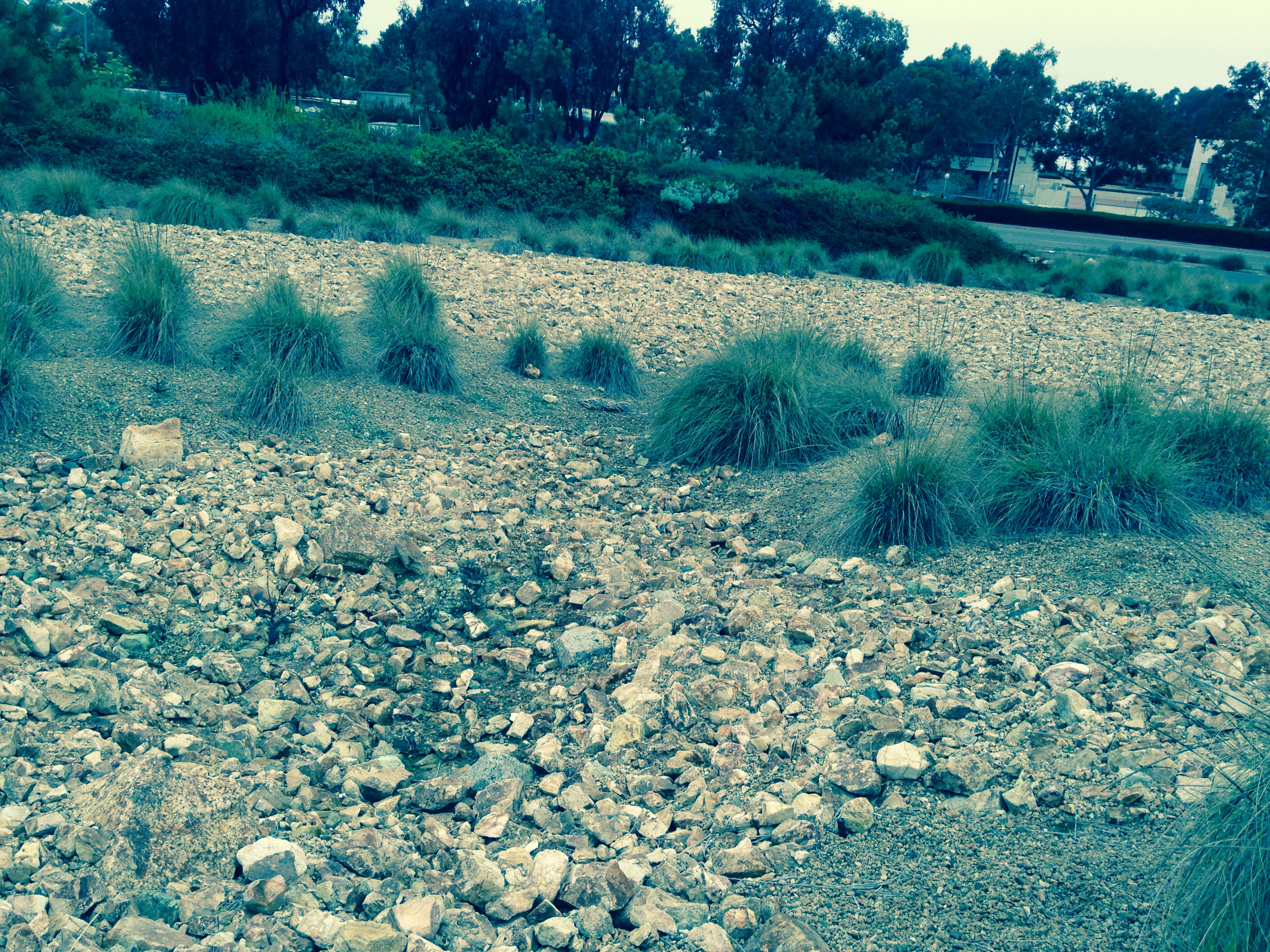
I attended the AESS meetings in San Diego California in the last week of June.  They have been experiencing a drought for four years, with this May a cooler wetter month than usual.  I walked in the Torey Pines City Park, outside the bounds of the watered FullSizeRender-2 FullSizeRender-1 FullSizeRender-3 FullSizeRender-5 FullSizeRender-4central campus of University of California San Diego to see what the landscape looks like.  In place of the deciduous woods of Pennsylvania that I am familiar with,  I found the ancient layered sandstone canyon covered with succulent vegetation- all looking parched and dusty to my eye.  The early morning mist that rose from the pounding surf settled among the growing plants, providing moisture from the air.  The brush was busy with the lively birds flitting in and out.  I saw small lizards sitting on rocky ledges, and footprints of animals in the sand – perhaps raccoons, or mice.  I have not studied the flora and fauna of this area, but notice that the ecosystem here is quite different, shaped by water as a very scarce part of the habitat.

As i sat on the steps, out of breath, I watched the ocean crashing against the cliffs sending a fine spray into the air.  I began to notice that the plants here are designed to absorb moisture from the air, and store it in swollen leaf structures for times when it is lacking.  Even in such moisture constrained places, the fragile flowers attract bees and other pollinators.  I know there is a complex ecosystem thriving here, separate from the human engineered grass and rose bush adorned plantings that survive only from nightly irrigation.

We can take lessons from examining the adaptations to different habitat conditions. How can we prepare for greater resilience in the face of the inevitable changes in our climate?


1 Comment

The Limits to Methane Regulations- Comment to the EPA

Environmental Protection Agency

EPA-HQ-OAR-2010-0505-4776

Oil and Natural Gas Sector: Emission Standards for New and Modified Sources

My name is Patricia DeMarco. I am a biologist by training with a thirty-year career in energy and environmental policy.[1] I speak on behalf of my grandchildren and the unborn children of the 21st century whose fate we determine by our actions today. I support the EPA’s efforts to regulate the oil and gas development industry as part of the 2009 Endangerment Finding, where the EPA Administrator found that the current, elevated concentrations of greenhouse gases in the atmosphere—already at levels unprecedented in human history—may reasonably be anticipated to endanger public health and welfare of current and future generations in the United States. In your background of the regulation you state:

“As Earth continues to warm, it may be approaching a critical climate threshold beyond which rapid and potentially permanent—at least on a human timescale—changes not anticipated by climate models tuned to modern conditions may occur.” http://www.regulations.gov/#!documentDetail;D=EPA-HQ-OAR-2010-0505-4776


In the face of such dramatic findings, the regulations proposed here have the effect of putting a Band-Aid on a hemorrhage. The regulations you are considering come late in the process for an industry shamefully protected by Section 322 of the National Energy Act of 2005 with exemptions from the Clean Air Act, the Safe Drinking Water Act and the Resource Conservation and Recovery Act. These exemptions for high volume hydraulic fracturing and other deep drilling operations assure weak regulatory provisions. Nevertheless, as citizens we must reiterate the plea for regulations that take consideration of the public health and safety for those affected by fugitive methane and volatile organic compounds produced at all stages of the gas and oil production process.


As you consider the reams of technical comments received in this docket, I ask that you recognize that the hydraulic fracturing process for developing natural gas from deep shale formations happens in neighborhoods, next to schools, in and under parks and on farms where our food is grown. The industry has intruded with impunity into the most intimate parts of communities and sets up industrial operations adjacent to sensitive areas and in watersheds. Fugitive emissions from such operations affect people where we live, work and play. The EPA’s mission is to protect human health and the environment, but has lost the confidence of the people because the industry has eviscerated its capacity to act strongly in the public interest. The EPA’s purpose is to ensure that all Americans are protected from significant risks to human health and the environment where they live, learn and work. These regulations restricting the emission of methane and volatile organic compounds from oil and gas industrial operations must draw a clear line of safety for the public.


Hydraulic fracturing now takes place in 39 states, with millions of people living within five miles of a fracking facility. For people in the zone of impact, the national average data used for assessing “significant risk” are not relevant. If your house is within 100 feet of a well, or your school is 200 feet from a compression station, or your business is 300 feet from a processing facility, you are exposed to numerous volatile organic compounds. Theo Colborn and colleagues compiled a list of 632 chemicals (an incomplete list due to trade secrecy exemptions) identified from drilling operations throughout the U.S. Their research found that 75% of the chemicals could affect the skin, eyes, and other sensory organs, and the respiratory and gastrointestinal systems. Approximately 40–50% could affect the brain/nervous system, immune and cardiovascular systems, and the kidneys; 37% could affect the endocrine system; and 25% could cause cancer and mutations.[2]


Fugitive methane mobilized by the fracking process has migrated into water supplies, even wells posing significant health and safety hazards to the persons affected. Inquiries for documentation about the number of people for whom the gas companies are providing trucked drinking water were not obtainable, as proprietary information. Requests for documentation of the composition of emissions were not obtainable because the industry has no requirement to disclose, or even measure what they are. This arrogant attitude of disregard for the concerns of people about their health and safety cannot stand.


These regulations on methane and VOC emissions should apply to existing oil and gas facilities as well as new and major modifications. Strengthen the requirements for documentation and reporting of leaks at all stages of the operations: Pre-production, Production, Processing and Transmission.[3] Establishing required protocols for monitoring and reporting leakages of methane and volatile organic compounds will contribute to the understanding of this entire system.[4] Annual or semi-annual data collection is insufficient to protect the public health.[5] Continuous monitoring stations should be required for every unconventional oil and gas facility that is within five miles of residences, businesses, schools, parks or populated areas. The data from such monitoring stations should be publicly available, and local authorities should be notified when levels exceed established limits of safety. Corporate voluntary compliance protocols are inadequate to protect the public health and safety.


Uncertainty remains over a potential environmental benefit of High Volume Hydraulic Fracturing that has public health implications. Natural gas is more efficient and cleaner burning than coal. When burned, natural gas releases 58% less CO2 than coal and 33% less CO2 than oil. Because of that, it has been promoted as a transitional fuel to begin conversion to greener energy such as wind and solar. Although natural gas burns more cleanly than coal, a recent study argues that replacing all of the world’s coal power plants with natural gas would do little to slow global warming this century. Switching from coal to natural gas would cut the warming effect in 100 years’ time by only about 20%. [6]Although a 20% decrease in warming over 100 years is significant, the consequences of the warming not prevented will have grave implications for public health.[7]


If the objective of this regulation is to reduce the emission of methane and other VOC’s as greenhouse gases affecting climate change, I question the effectiveness of the investment contemplated in this regulation as the best way to do so. As stated in the background of this proposed regulation, the EPA estimates the total capital cost alone of the proposed regulation will be $170 to $180 million in 2020 and $280 to $330 million in 2025. This amount of investment in solar and renewable technology implementation would have a far greater positive effect on greenhouse gas reductions with virtually no public health effects. We require a comprehensive energy policy that moves forward to an economy that is not based on fossil fuels. Continuing to build out the infrastructure, fine-tuning the way we extract oil and gas, is not solving the underlying problem.


Specific Recommendations:[8]

Recognizing that the process is in motion, the following specific recommendations may help to make these regulations more effective.


  1. Require Reduced Emission Completions (REC), also known as “green completion,” to reduce methane and other VOC leaks for all wells, not only gas wells. RECs and green completions refer to technologies that capture methane and other gases at the well head during and after well completion and avoid their release into the atmosphere.
  2. Require Leak detection and repair (LDAR) programs for all stages of oil and gas development.
  3. Require advanced technologies to control fugitive emissions.
  4. Require reduction of diesel particulate matter through the use of cleaner combustion engines and alternative fuel types at oil and gas development operations, especially in the transport of water, wastes and chemicals from High Volume Hydraulic Fracturing operations.
  5. Limit venting and flaring gas associated with oil production and ensure that all gas is captured or used on-site.
  6. Require comprehensive characterization of all pollution sources in unconventional oil and gas development and quantitative assessment of pollutants and emission rates through research and updated federal and state inventories.
  7. Improve air quality monitoring before, during, and after well development and around all sources.
  8. Expand the federal and state ozone monitoring network to better characterize air quality in rural areas highly impacted by pollution from oil and gas development.
  9. Require identification and implementation of adequate and protective setback requirements to reduce the exposure of residents to intermittent and chronic levels of air pollutants and toxins. Such research could draw on findings from analyzing the dispersion of air pollution as a function of the distance from road traffic and consider data from the effects of new or existing setback rules in states with unconventional oil and gas development. See, for example, the study being conducted by the Geisinger Health System in Pennsylvania.[9]


In closing, I call for the closure of regulatory loopholes in federal environmental programs to fill data gaps, increase transparency and oversight of the oil and gas industry and ensure public health protections. As the evidence of significant and ongoing public health effects from unconventional oil and gas drilling accumulate, it is unconscionable to continue expanding and protecting this industry. In the interest of protecting the health of our planet and the health of our people, we must cease developing fossil deposits that are destroying our life support system.


Thank you.


[1] See full Curriculum Vitae at https://patriciademarco.com/wp-content/uploads/2014/09/patricia-m-demarco-2013-cv.pdf


[2] Colborn T, Kwiatkowski C, Schultz K, Bachran M. 2012. Natural Gas Operations from a Public Health Perspective, Human and Ecological Risk Assessment: an International Journal 17(5):1039-1056.

[3] J. Bradbury, M. Obeiter, L. Drucker, A. Stevens, W. Wang. “Clearing the Air – Reducing Upstream Greenhouse Gas Emissions from the U.S. Natural Gas System.” World Resources Institute. April 2013. www.wri.org/publication/clearing-air Accessed September 25, 2015.

[4] Ramon Alvarez, Steven Pacala, James Winebrake, William A. Chaneides and Steven P. Hamburg. “Greater Focus Needed on Methane Leakage from Natural Gas Infrastructure.” PNAS. Vol. 109 no. 17. Pp. 6435-6440. www.pnas.org/109/17/6435 Accessed September 25, 2015.

[5] Bamberger, M., Oswald, R. (2012).Impacts of Gas Drilling on Animal and Human HealthNew Solutions: A Journal of Environmental and Occupational Health, 22(1): 51-77.

[6] Finkel ML, Law A. The rush to drill for natural gas: a public health cautionary tale. Am J Public Health. 2011;101(5):784–785.

[7] Howarth R, Santoro R, Ingraffea A. Methane and the greenhouse-gas footprint of natural gas from shale formations. Clim Change. 2011;106(4):679–690.

[8] Tanja Srebotnjak Miriam Rotkin-Ellman. “Fracking Fumes – Air Pollution from Hydraulic Fracturing Threatens Public Health and Communities.” Natural Resources Defense Council. Issue Paper ip:14-10-a. December 2014. http://www.nrdc.org/health/files/fracking-air-pollution-IB.pdf Accessed September 24, 2015.

[9] Geisinger Research, “Geisinger Leads Marcellus Shale Initiative Coalition Explores the Potential Health Effects of Natural Gas Mining in the Region,” Geisinger Research Connections Winter: 1–3, 2013.


Leave a comment

A Clean Power Plan for Pennsylvania

September 21, 2015

Comment on the Pennsylvania Clean Power Plan

There is no more serious or urgent issue facing us. I speak on behalf of those who have no voice in this matter but who will be affected grievously by the decisions we make -the unborn children of the next generation, and the living earth that supports all life as we know it.

System problem needs system solutions

Our economy is based on extracting resources to be burned for fuel and it operates on a regional basis. Finding solutions would be most productive in a regional setting, collaborating with economic districts established through trading and production patterns over many years, for example the Power of 32 Region, for which a Regional Energy Flow has been established. (enclosed as Attachment A.)

Coal and natural gas production and exports account for 43% of the energy produced in this region; and 41% is wasted as lost energy from electricity generation and internal combustion engines in transportation. Only 15% of the energy produced in the region is used for work: transportation, residential, commercial and industrial energy use. Only 6% of the energy used in the region comes from renewable resources. BUT, this this is about half of the energy we actually use to do work!

The energy system is designed around the production and use of fossil fuels. The majority of what is produced leaves the region for use in other locations. That means that the profits for the sale of extracted resources from Pennsylvania go out of the economy, with little remaining in the commonwealth in the form of tax payments or royalties; the profits go to private companies. They leave behind the acid mine drainage that has ruined over 3,000 streams in Pennsylvania, land subsidence, devastated landscapes that remain barren for generations from longwall and mountaintop removal of coal, the deep deposits of toxic materials lurking for incursion into the groundwater, and the devastation of mined out communities. Even in dense residential areas communities such as Churchill are threatened with industrial gas development with no recourse to protect residences, schools, cultural and historic areas, or sensitive places such as watersheds. The fossil bonanza has enriched a few and left the consequences to be paid on the public ledger, often a generation removed from the profiteers.

Leadership position in energy – innovation

We have the ability to offer leadership and innovation in the approach to modernizing and rebuilding our power system. If we establish a goal to use as much renewable and regenerative energy as possible, and fill in the gaps with natural gas bridging to bio-gas, we can craft a Clean Power Plan for Pennsylvania that empowers new industries, new investments and crafts a way forward that can sustain a diverse and robust economy. First, raise the Renewable Energy Portfolio standard from 9% to 50% as a 2030 goal. Establish a State Investment Tax Credit to supplement the federal incentives, and make the Green Energy Loan Fund available to homeowners as well as to commercial establishments. Allow Virtual Net Metering for community solar installations to promote shared use in suitable locations such as schools, churches, and municipal buildings. Establish model zoning guidelines to help communities set out the rules for maximum use of solar and wind systems. The City of Pittsburgh Zoning Overlay for renewable and energy efficient development may provide a model.

Take note of the innovations adopted at the Center for Sustainable Landscapes at Phipps Conservatory and the guidance available from the Innovation Workplace at Carnegie Mellon University. Buildings can become generators of energy as well as users, with net positive results for the community.

Existing sources of natural gas can act as bridging fuels in the truest sense of the word. Investment in bio-gas from anaerobic digestion of municipal waste and sewer wastes can provide non-fossil based methane as a fuel. This process recognized and broadly used in Germany and Korea can support industrial applications and act as base load support for renewable energy in distributed sources. Investment and linking to technologies that do not burn gas, but use it in chemical power production mode, such as in fuel cells, can provide efficient energy supplies without the burden of carbon dioxide at the levels produced from burning methane for electricity production. (See Fuel Cell Energy, Inc. of Danbury Connecticut, which has many suppliers of parts in Pittsburgh www.fuelcellenergy.com)

Innovations using direct current micro-grid systems can increase energy efficiency at the point of use. Models of how to integrate these more efficient systems into the existing grid are in pilot mode at the Center for Energy Innovation. The regulatory system for allocating costs and resources needs to be re-visited in light of the shifts in technology from centralized large generation operations to resources integrating generation and use into the same locations. The PUC should convene a generic investigation to explore and conduct pilot trials of new utility paradigm structures that optimize the use of renewable and sustainable energy systems.

Simply shifting our electric power supply from coal to natural gas is not a true solution. It just kicks the can down the road to the next generation.

Attention to the just transition: workers, smooth integration of technologies.

Moving our energy system from a fossil base to a renewable base will require transitions. It is instructive to examine some of the issues that emerge from transitions that have been successful in the past. Moving from the horse drawn buggy to the internal combustion driven automobile occurred over a period of 15 to 20 years. In that time, the process was expedited by paving the roads, making rules for licensing vehicles and drivers to generate a revenue stream to pay for the roads, developed a fuel supply and delivery system. We set up a whole supply chain for the manufacture sale and distribution of vehicles.

The renewable energy system has struggled to become established, and now has reached a condition where the technical capability is stable, but the rules are different in each state, the business conditions of tax incentives and investment conditions are variable and uncertain, and the regulatory interface takes place in a hostile environment. Much of this comes from the fears and concerns of those displaced from the fossil industries, especially the workers. Miners, oil field workers, and the suppliers and supporters of the energy system as it is today have a vested interest in keeping the same process in place. An energy plan to move to a system that places a higher priority on environmental impact must address the displacement of workers.

A fair and just transition must recognize the needs of the fossil industry workforce. Transitions here must include re-deployment of the workforce, re-training and redress of the needs of workers for assurance in pensions and benefits earned through long years of service. The unions have played a huge role in establishing the rights and needs of workers, enriching the entire middle class, including non-union workers. It is essential to maintain the standards for working people in transition times. Communities depend on the stability and resilience of the work force. Embracing innovation can allow significant improvements in working conditions and in job opportunities. Jobs in energy efficiency infrastructure and renewable energy systems are not easily shipped offshore.

“Made in Pennsylvania” standards for renewable energy systems should be part of the 2030 goal for the Clean Power Plan. Re-deploying the workforce to do those jobs here should be a priority. We can replace the export of raw fossil fuels with the export of manufactured parts and systems for solar and wind energy systems, grid technology and software, and innovations in building materials and construction practices. The skills of today’s workforce are transferrable. The work ethic and the production system expertise of long tradition in Pittsburgh can be harnessed to expedite and optimize the transition to a renewable energy system. If it is not the job of the EPA or the DEP to “take care of the workers,” then, the Commonwealth should establish a parallel planning process to address these serious issues. Revamping our entire energy system cannot happen in a vacuum.

Intergenerational Justice:

We are experiencing a time of transition driven by the constraints of the natural world. The laws of nature are not negotiable. As we burn fossil fuels, we release sequestered carbon dioxide into the atmosphere. Over the last 50 years, the process has so accelerated that measurable changes to the composition of the atmosphere, and sea water have been documented. The need for change is urgent, and the changes we see are irreversible in our time. The window of opportunity for adapting to the existing situation and securing a measure of stability forward is critical. We resist change, and we resist dramatic changes with arguments, denial, and predictions of dire results. However, if we do not address this process of burning fossil fuels in a despicably wasteful manner, using technology from the 1800’s, we bear the burden of condemning the next generation to a future with fewer options, and a more dire and deprived state of being.

The choices we face are not those of technology alone. They are choices of ethical values. We have the obligation to look forward and take responsibility to preserve the resources of the Earth for the next generation. We owe our children a planet with its life support system intact. Oxygen rich atmosphere, fresh water and fertile ground supporting a broad diversity of living things are the only way forward to assure the survival of life as we know it. We do not have the right to squander the future for the sake of short term profits or instant conveniences.

We can embrace the challenge of living within the laws of the natural world, in harmony with the regenerative bounty of the living Earth. The sun provides 23,000 times more energy than we can use each day. We need only to organize our efforts to capture the flow that falls on us instead of extracting and consuming what is sequestered in the mantle of the Earth.

Presented to the Commonwealth of Pennsylvania Department of Environmental Protection “Listening Session” on the PA Clean Power Plan.


Leave a comment

A Savored Moment Disrupted

My morning walking meditation includes listening acutely for the songs of birds in the garden as I sit and mediate after “seven count stretches.”  The late August morning is filled with the twitter of goldfinches busy in the thick seed pods of the redbud tree, the noisy flock-let of young cardinals plaguing their mother for attention, the noisy calls of the blue jay brothers, and the chatter of chickadees and the tufted titmouse. Suddenly all are still and silent as the Coopers hawk flies overhead and perches in the pin oak above the garden.

I shift my focus to the air, warm and soft with humidity at this early hour, suffused with the aroma of the newly opened gardenia blossom near my seat. The wind shifts, and my senses are instead assaulted with the sharp smell of sulfur and the acrid scent of coal burning from the plant just over the hill.  The smell brings a faint echo of the oppressive smog of my youth when the coal burning furnaces heated the houses, drove the factories and filled the skies with plumes of black smoke, dimming the noontime sun.

IMG_1952Those hot summer days were filled with the chores of harvesting the bounty of the summer gardens and putting up jars for the winter.  Washing the cinders off of the vegetables was the task of young ones of us, and I can remember the black water that we threw back on the ground from the washing buckets.  How much of that particulate matter ended up in our food?  in our lungs? The lace curtains washed every week and thoroughly bleached then set to dry on the pin frame stretcher eventually assumed a gray cast as the coal dust worked its way into the fibers.  I consciously displace that memory with the more important one of feeling the sense of community in the shared work.  My grandmother, mother and Auntie as well as my cousins all had tasks in preparing the tomatoes for the large vats of sauce that would become Sunday spaghetti dinners for the family all year long.  The overabundance of zucchini, peppers, onions and tomatoes became rattatouile packed in quart jars to serve over polenta. The peaches, pears, apricots and plums all were pared and quartered into jars, or turned into jam.  The whole operation was fueled by the big black coal stove in the cellar.

The echo of that time past leaves me with a sense of longing for the dear ones now gone, and those shared experiences of the dignity and satisfaction of shared work. I pack the recollections into my jars and pass them on.


Leave a comment

Ryerson State Park – A Cautionary Tale

Longwall mining from the Bailey Mine Complex has stamped its mark on the land in Greene County.  People here cling with fatalistic resolve to an industry and a way of life that consumes and destroys the land in its wake, leaving a three thousand acre permanent scar on the green hills, “dewatering” streams and lakes, and displacing communities with Coal Refuse Disposal Areas…formerly verdant valley towns now filled or destined to be filled with rock and coal waste slurry from processing facilities.

Ryerson Station State Park has lost its Duke Lake from mine subsidance that destabilized the dam.

IMG_1887

Now the tributary of Dunkard Creek North Fork that offers trout fishing and a high quality stream habitat in the park is threatened by further permitted longwall mining moving into this area under the park, which is likely to “dewater” the creek.


Preserving natural habitat as well as resources that can support a diversified economy and better quality of life is important in restoring a more resilient and sustainable community.

IMG_1896

A valley across the street from the Coal Refuse Disposal Area

My heart aches for the green hills and for the people and other living creatures tied to this coal mining process by tradition and the accident of birth into an area undermined with seams of fossil deposits. Beautiful green valleys are targetted to be filled with Coal Refuse Disposal Areas.

IMG_1893-1


Coal Refuse Disposal Area #5 of eight covering 2,000 square miles in Richhill Township, PA


As we burn coal to power the present, we are consuming the past and poisoning the future.  We can and must move to a more sustainable energy system.  The transition to a fossil-free energy future must attend to the needs of the communities, workers and people. It must attend to restoring the land.

IMG_1922
IMG_1909 IMG_1918 IMG_1917

Graves of the people who lived in this valley for years as cattle farmers and dairy farmers in Graysville PA face the hills once farmed and grazed.

The same graveyard is overshadowed by the Bailey Mine Coal Prep Complex, a 100 square mile operation for the largest longwall mine in the world.
The land and the people here deserve a better fate.
For more information about this issue, see The Center for Coalfield Justice http://coalfieldjustice.org/
(Photos taken by Patricia DeMarco on a field trip with the Allegheny Group of the Sierra Club with the Center for Coalfield Justice on August 15, 2015.)